

Local SEO raises practical questions for business owners. Should every service area have its own page? How important is Google Business Profile? Do reviews matter? How should results be measured? And is local SEO something a business completes once or continues working on over time?
The answers depend partly on how the business operates, what customers search for, the website’s current condition, and which local search opportunities are relevant. However, several principles can help businesses make better decisions without treating every SEO recommendation as a universal rule.
Quick Answer: Local SEO usually involves several connected areas rather than one isolated tactic. Businesses may need to work on their website, an eligible Google Business Profile, service and location information, reviews, relevant links and mentions, technical website health, and performance measurement. The appropriate priorities depend on the business, its customers, locations, competition, and current search presence.
Local SEO Getting Started Questions
What is local SEO?
Local SEO is the process of improving a business’s presence for relevant searches connected to the services or products it offers and the locations it serves. Depending on the business, this can involve the website, an eligible Google Business Profile, business information across relevant sources, reviews, links, technical SEO, and measurement.
If you are new to the subject, Traffisite’s guide to local SEO basics explains these components as a connected system.
Who should consider local SEO?
Local SEO can be relevant when customers commonly search for a business, service, or provider in connection with a geographic area. This can include businesses that serve customers at a physical location as well as eligible service-area businesses that travel to customers.
The appropriate strategy depends on how the business actually operates. A business should not create local pages, profiles, or location signals for places it does not genuinely serve simply to expand keyword coverage.
Where should a business start with local SEO?
Start by confirming the basics: what the business offers, which locations it genuinely serves, whether important website pages clearly explain those services, whether customer-facing business information is accurate, and whether the business has an eligible and properly configured Google Business Profile.
From there, identify the most important gaps rather than trying to complete every possible local SEO task simultaneously. A local SEO audit can provide a structured way to review the current website, profile, business information, reviews, links, and other relevant areas.
Is local SEO only about Google Maps?
No. Google Maps and Business Profile visibility can be part of local SEO for eligible businesses, but the website also matters. Service pages, useful location information, internal links, technical accessibility, and customer conversion paths can all contribute to the broader local search strategy.
Businesses specifically evaluating map visibility can use Traffisite’s guide to Google Maps SEO for a more focused explanation.
Website and Content Questions
Does a local business still need a website?
A website gives a business space to explain services, coverage, qualifications, processes, frequently asked questions, and other information that may not fit naturally into a business profile or third-party listing.
It also gives the business greater control over how service information is organized and how prospective customers move from discovery to actions such as calling, submitting a form, requesting a quote, or booking when those options are available.
Does every service need its own page?
Not automatically. A dedicated service page is useful when the service has a distinct customer need and enough useful information to justify a separate page. Closely related services may sometimes be better explained together rather than divided into thin pages simply to target more keywords.
The decision should start with user intent and content usefulness rather than a rule that every keyword requires a unique URL.
Does every city need a separate location page?
No. A location page should have a genuine purpose for people in that area and should accurately reflect where the business operates. Creating multiple substantially similar city or regional pages primarily to target similar searches or funnel users toward the same destination may fall under Google’s doorway-abuse policies.
How should a business choose local SEO keywords?
Start with the services customers actually need, the problems those services solve, and the locations the business genuinely serves. Then research how those ideas appear in relevant searches and determine which existing page best satisfies each important search need.
Traffisite’s local SEO keyword research guide provides a more detailed process for organizing service, location, and customer-intent research.
Should local SEO content mention a city repeatedly?
No. Location references should help explain where the business operates or make the content more useful to the intended reader. Repeating a city name unnaturally can make the writing difficult to read and should not replace genuinely useful local information.
Does technical SEO matter for local SEO?
Yes. Important pages intended to appear in search need a functional technical foundation. Businesses should review crawl access, indexing directives, important internal links, redirects, and whether technical controls unintentionally prevent priority content from being discovered, crawled, or indexed.
Technical work should support useful service and location content rather than being treated as a separate substitute for it.
Google Business Profile Questions
Does every local business qualify for a Google Business Profile?
No. Google has eligibility requirements for Business Profiles. Businesses should compare how they operate with Google’s current eligibility and representation requirements before creating or maintaining a profile.
Can a service-area business use Google Business Profile?
Eligible service-area businesses can use Google Business Profile. Google’s guidance distinguishes service-area businesses that visit or deliver to customers without serving customers at the business address from hybrid businesses that both serve customers at their address and travel or deliver to customers.

Should a business use its home address on Google Business Profile?
The appropriate setup depends on whether customers are actually served at that address and whether the business meets Google’s applicable requirements. If a business does not serve customers at its address, Google’s current guidance says the address should be removed from the Business Profile and the appropriate service area should be used instead.
Traffisite’s guide to using a Google Business Profile without displaying an address explains the distinction between service-area, hybrid, and customer-facing businesses in more detail.
What information should a business review on its profile?
Depending on the business and which features are applicable, important customer-facing information may include the business name, category, address or service area, hours, phone number, website, services, photos, and reviews.
Traffisite’s Google Business Profile optimization guide provides a more detailed review process.
What if a Google Business Profile is not showing up?
There is no single explanation. A business first needs to identify what “not showing up” means. The issue could involve finding the profile itself, visibility for a particular search, verification or profile status, or another account or profile problem.
Traffisite’s guide to a Google Business Profile not showing up provides a structured troubleshooting process.
Reviews and Authority Questions
Do reviews matter for local SEO?
Reviews can matter in more than one way. They provide prospective customers with information about previous customer experiences, and Google says review count and positive ratings can help a business’s local ranking as part of prominence. Businesses should still avoid reducing reviews to a simple ranking tactic.
A responsible process should focus on genuine customer experiences and comply with the policies of the platform where the review appears.
Can a business offer incentives for Google reviews?
Businesses should follow Google’s current review policies. Google prohibits incentives such as payment, discounts, free goods, or services in exchange for posting a review, revising a review, or removing a negative review.
Traffisite’s guide to Google Business Profile reviews explains practical review-management considerations in more detail.
Does a local business need backlinks?
Links from relevant websites can support a broader SEO strategy, but businesses should not pursue links indiscriminately. Legitimate opportunities may come from industry organizations, professional associations, suppliers, partnerships, local publications, or other relationships that make sense for the business.
Avoid link practices intended primarily to manipulate Google Search rankings. Traffisite’s guide to local SEO backlinks provides a more focused framework.
Are local citations still worth reviewing?
Relevant directories and other third-party sources can contain customer-facing business information. Reviewing important listings can therefore be useful for finding inaccurate or outdated details.
The goal is not to submit the business to every directory available. Traffisite’s guide to local SEO citations explains how to approach citations more selectively.
Results and Expectations Questions
How long does local SEO take?
There is no universal timeline. The work required and the changes a business observes can vary according to its starting position, market, competition, website, services, locations, technical condition, and the improvements being implemented.
A specific ranking, traffic, or lead timeline should not be treated as guaranteed.
Can local SEO guarantee first-place rankings?
No responsible SEO strategy should guarantee a specific organic or local search position. Google says local results are determined primarily by relevance, distance, and prominence, so a business cannot simply request or pay Google for a better local ranking.
A more useful objective is to improve the quality and accuracy of the business’s search presence, strengthen useful pages, and measure whether relevant visibility and customer actions improve over time.
How should local SEO results be measured?
Measurement should connect search performance with business goals rather than focusing on a single keyword position.
Depending on the business’s tracking setup and available data, useful measurements may include:
- Visibility for relevant local searches
- Organic traffic to important service and location pages
- Search queries associated with priority pages
- Available Business Profile performance information for verified profiles, where applicable
- Calls
- Form submissions
- Quote requests
- Bookings or other measurable customer actions
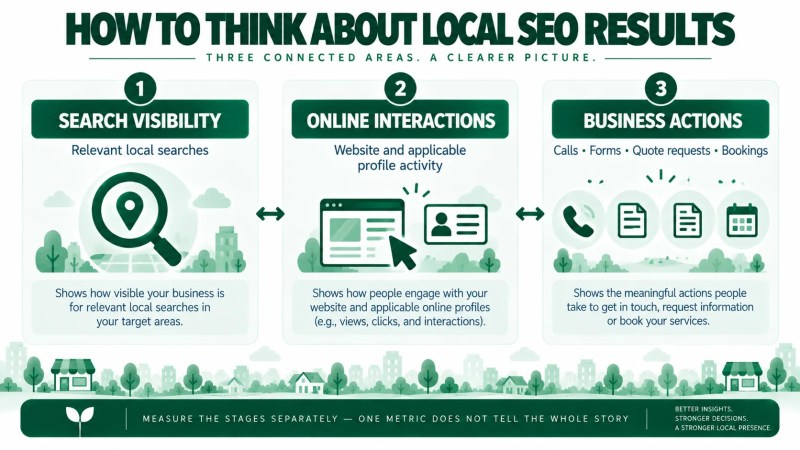
Traffisite’s guide to local SEO reporting provides a more detailed measurement framework.
Is traffic enough to judge whether local SEO is working?
No. Traffic can be useful, but more visits do not automatically mean more qualified enquiries or customers. Businesses should evaluate traffic alongside search visibility, landing-page relevance, customer interactions, and measurable conversion actions when reliable tracking is available.
For businesses focused specifically on turning local discovery into enquiries, Traffisite’s guide to local SEO lead generation explains the relationship between visibility and customer action.
Ongoing Local SEO Questions
Is local SEO a one-time project?
Some local SEO tasks can be completed as defined projects, such as correcting specific technical problems, restructuring pages, or fixing inaccurate business information. Other areas can require ongoing review as the business, website, customer feedback, competition, and search environment change.
For example, a business may need to update service information, hours, location details, website content, reviews, technical issues, or measurement as circumstances change.
How often should local SEO be reviewed?
There is no universal schedule that fits every business. Review frequency should reflect how often important information changes, how active the website and profile are, whether technical problems are appearing, and how closely the business needs to monitor performance.
Traffisite’s local SEO best practices guide provides a broader maintenance framework for businesses that already understand the fundamentals.
What should a business prioritize first?
Prioritize problems according to their potential effect on customers and the business’s search presence. An inaccessible priority page, incorrect business information, or a major profile issue may deserve attention before creating another blog post or pursuing another link.
After urgent problems are addressed, use search demand, business goals, current performance, and content gaps to determine the next improvement.
Should a business keep creating local SEO content?
Create new content when there is a real customer need or search intent that existing pages do not satisfy well. Publishing continuously without a clear purpose can create overlapping or low-value content.
Existing pages may sometimes need improvement, consolidation, stronger internal linking, or better alignment with customer needs instead of another new URL.
Questions About Professional Local SEO Help
Can a business handle local SEO internally?
Many local SEO tasks can be handled internally when the business has the necessary time, access, knowledge, and processes. Maintaining accurate business information, reviewing customer-facing pages, monitoring reviews, and tracking basic performance may be manageable for some teams.
More complex technical problems, large websites, multi-location strategies, competitive markets, or ongoing content and authority work may require additional expertise.
When might professional local SEO help make sense?
Professional help may be useful when the business lacks internal capacity, has unresolved technical or visibility problems, needs a structured strategy, operates across multiple locations, or requires ongoing execution and measurement.
The decision should be based on the actual work required rather than assuming every business needs the same level of support.
Businesses evaluating outside support can review Traffisite’s local SEO services to understand one approach to structured local SEO work.
Should a business hire a consultant, agency, or manage SEO internally?
The right model depends on the business’s resources and needs. Internal teams offer direct business knowledge and control. Consultants may provide focused strategic expertise. Agencies may provide access to a broader set of skills and execution capacity.
Before choosing, define the problems that need to be solved, the work the business can realistically handle internally, the expected responsibilities of the provider, and how progress will be evaluated.
Use Local SEO Questions to Set Better Priorities
Local SEO becomes easier to manage when businesses stop treating every tactic as equally urgent. The right question is often not whether a tactic is universally important, but whether it solves a real problem for the business, its customers, or its current search presence.
Start with accurate business information, useful customer-facing pages, an appropriate Business Profile setup when eligible, and a functional website foundation. Then use research, reviews, links, measurement, and ongoing maintenance according to the business’s actual needs.