

Backlinks can be part of a local SEO strategy, but not every link pointing to a local business is equally useful. A link can come from a website with impressive-looking metrics and still have little connection to the business, its services, its location, or the people it wants to reach.
A better way to evaluate local SEO backlinks is to look beyond a single score. Consider why the website would mention the business, whether the surrounding content is relevant, whether there is a genuine local or industry relationship, and whether the link makes sense for the people who may encounter it.
Quick Answer: A useful local SEO backlink should make sense in context. Look for links from websites, organizations, publications, businesses, or resources that have a genuine relationship to your location, industry, services, or audience. Third-party authority metrics can provide additional information, but they shouldn’t replace evaluating the actual website and the reason the link exists.
What Are Local SEO Backlinks?
A backlink is a link from another website to your website. In a local SEO context, useful opportunities can come from websites that have a meaningful connection to the business’s location, industry, services, customers, or community.
That doesn’t mean every backlink needs to come from a website physically located in the same city. An industry association, supplier, trade publication, professional organization, or useful resource may have a legitimate reason to reference the business even if its audience extends well beyond one location.
The key question is whether there is a reasonable relationship between the linking page and the business receiving the link.
Backlinks are only one part of a broader local search strategy. Traffisite’s local SEO guide covers the wider relationship between local visibility, website optimization, business information, and other supporting work.
What Makes a Backlink Relevant for Local SEO?
Instead of starting with an authority score, evaluate the reason the link would exist.
A backlink opportunity becomes easier to assess when you examine several types of relevance together.
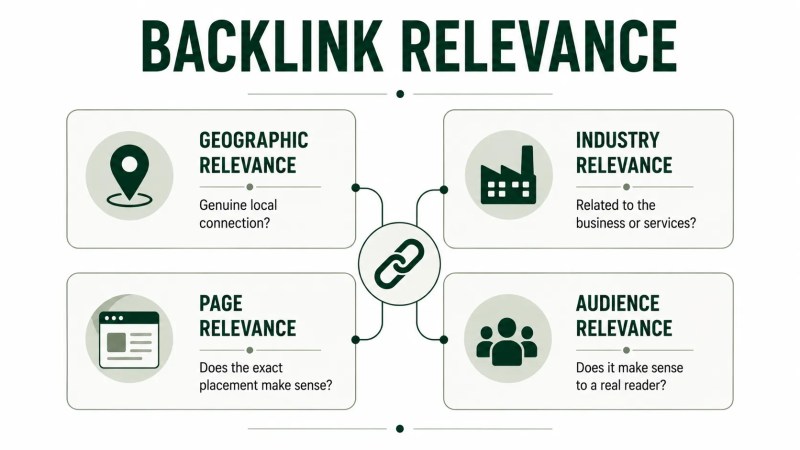
Geographic Relevance
A website can be geographically relevant when it serves, documents, represents, or provides useful information about the same community or service area as the business.
Examples might include a local organization, community resource, regional publication, chamber or business group, event website, or another legitimate local entity.
Geographic relevance shouldn’t be reduced to whether a city name appears somewhere on the domain. Review what the website actually does and whether its relationship to the location is genuine.
Industry and Service Relevance
A website may also be relevant because it is closely related to the business’s industry or services.
For example, a professional organization, trade publication, manufacturer, supplier, industry resource, or complementary business could have a legitimate reason to reference a company even when the website isn’t specifically local.
Depending on the context, an industry-related link may make more sense than a link from an unrelated website that simply happens to operate in the same city.
Page-Level Relevance
Don’t evaluate only the domain. Review the specific page where the backlink would appear.
Ask whether the surrounding content relates naturally to the business and whether a reader could understand why the business is being referenced.
A relevant website can still provide a questionable placement if the link is inserted into an unrelated page without a useful editorial reason.
Audience Relevance
Consider who might realistically encounter the link.
If the linking page serves people who could reasonably need the business, understand its services, or benefit from the referenced information, the link has a clearer purpose than a placement created only for SEO.
This doesn’t mean every backlink needs to generate referral traffic. The practical question is whether the placement makes sense for a real audience rather than existing only as a technical link.
Where Can Local Backlink Opportunities Come From?
Useful backlink opportunities can come from relationships and activities that already make sense for the business.
Potential sources to investigate include:
- Local business or professional organizations.
- Industry associations.
- Suppliers, manufacturers, or business partners.
- Local publications and community resources.
- Sponsorships or events the business genuinely participates in.
- Educational or resource pages where the business provides something relevant.
- Complementary businesses with a legitimate reason to reference one another.
- Original resources or content that other websites may find useful enough to cite.
The goal isn’t to turn every relationship into a backlink request. Start by identifying situations where referencing the business would actually help the linking website’s audience.
Start With Existing Business Relationships
Before searching broadly for websites that accept links, review the organizations and businesses the company already interacts with.
A supplier may maintain an authorized-provider directory. A professional organization may have a member profile. A community organization may list sponsors. An industry partner may maintain a resource page.
These are opportunities to investigate because the underlying relationship already exists. Whether a backlink is appropriate still depends on the specific website, page, and nature of the relationship.
Create Something Worth Referencing
Some backlink opportunities can come from having a genuinely useful resource that another website has a reason to reference.
That might be an original guide, checklist, local resource, research project, tool, or other material that solves a specific problem for the intended audience.
As a practical content strategy, the resource should have value independently of link building. That keeps usefulness at the center of the content rather than making the backlink the only reason the resource exists.
How to Evaluate a Local Backlink Opportunity
When you find a potential backlink source, evaluate the actual opportunity before deciding whether it deserves time, outreach, money, or another business commitment.
Use this practical review process:
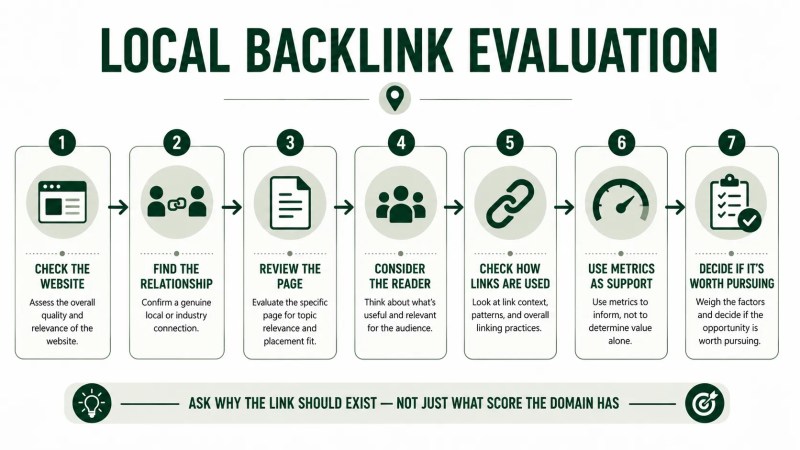
- Check the website itself. Understand who operates it, what it publishes, and who it appears to serve.
- Look for a real relationship. Determine how the website connects to your location, industry, services, business relationships, or audience.
- Review the exact page or placement. Ask whether your business would make sense in that specific context.
- Consider the reader. Determine whether the link could reasonably help someone using the page.
- Review how links are handled. Look at whether links appear to support useful content or whether the website appears primarily focused on publishing or selling links.
- Use metrics as supporting information. If you use SEO tools, consider their metrics alongside the actual website rather than allowing one score to make the decision.
- Decide whether the opportunity is worth pursuing. Consider the quality of the relationship and placement against the effort or cost required.
This approach shifts backlink evaluation from “How strong is this domain?” to “Why should this website link to this business, and does the placement make sense?”
Why Link Metrics Aren’t Enough
SEO platforms may provide proprietary metrics intended to help users evaluate websites and links. Those metrics can be useful for comparison or investigation, but they are not a substitute for reviewing the actual opportunity.
A high third-party score doesn’t automatically establish that a website is locally relevant, contextually appropriate, useful to the reader, or a good fit for the business.
Likewise, a legitimate local organization or niche industry resource may not look impressive when judged only through a third-party metric.
Use metrics as one input rather than the final verdict.
Questions to Ask Beyond the Score
- What is this website actually about?
- Who appears to use it?
- Why would it mention this business?
- Is the linking page relevant?
- Does the link fit naturally into the surrounding content?
- Does the website appear primarily focused on selling or publishing links?
- Would this opportunity still make sense if the authority score were hidden?
That final question is particularly useful as an evaluation exercise. If the opportunity becomes difficult to justify as soon as the metric disappears, review the website and placement more carefully before proceeding.
Local SEO Backlinks vs. Local Citations
Backlinks and local citations can overlap, but they aren’t the same thing.
A backlink is a clickable link from another website to your website. A local citation is a mention of a business’s identifying information on another website, commonly involving information such as its name, address, or phone number. A citation may include a website link, but the concepts shouldn’t be treated as interchangeable.
For a deeper explanation of business listings and citation management, see Traffisite’s guide to local SEO citations.
The distinction matters when evaluating an opportunity. A legitimate directory listing may serve a different purpose from an editorial backlink from a publication, partner, or resource page.
Common Local Link-Building Mistakes
Chasing Authority Scores Alone
A third-party metric can’t establish whether the website has a meaningful relationship to the business. Review relevance and placement before allowing a score to drive the decision.
Treating Every Local Website as Relevant
Sharing a city or region doesn’t automatically make two websites contextually related. The website should have a credible reason to reference the business.
Ignoring the Linking Page
A domain-level assessment can miss important context about the actual placement. Always evaluate the page and surrounding content where the link would appear.
Pursuing Links That Exist Only Because They’re Paid For
Advertising, sponsorships, and other commercial relationships can have legitimate business purposes. Google says paid links should be qualified with rel="sponsored" or rel="nofollow", and buying or selling links for the purpose of manipulating rankings can violate its spam policies.
Using Repetitive Keyword-Rich Anchor Text
Anchor text should make sense in context. Google’s spam policies specifically identify optimized anchor text in certain paid articles, guest posts, and distributed press releases as a link-spam example, so avoid treating keyword-rich anchor text as something to force into placements.
Confusing Link Quantity With Link Quality
A backlink count by itself doesn’t explain whether individual links are relevant, useful, legitimate, or appropriate. Evaluate the opportunities themselves rather than making total link volume the objective.
FAQ
What are local SEO backlinks?
Local SEO backlinks are links from other websites to a local business’s website considered within the context of its local search strategy. When evaluating opportunities, consider geographic, industry, service, audience, and business relationships rather than relying on one metric alone.
Do local backlinks need to come from websites in the same city?
No. A relevant opportunity may also come from an industry association, supplier, professional resource, trade publication, or another website with a legitimate relationship to the business, even when it isn’t based in the same city.
Are high-authority backlinks always better for local SEO?
Don’t use a single third-party authority metric as the sole basis for deciding whether a backlink opportunity is worthwhile. Evaluate the website, specific page, relevance, audience, and reason for the link, then use SEO-tool metrics as supporting information where useful.
What is the difference between a local citation and a backlink?
A backlink is a clickable link from another website to your website. A local citation is a mention of business information on another website and may or may not include a clickable website link.
Should a local business buy backlinks?
Don’t evaluate a paid opportunity solely by whether it provides a backlink. Advertising, sponsorships, memberships, and similar relationships can have legitimate business purposes, but Google says paid links should be qualified with rel="sponsored" or rel="nofollow" rather than used to pass ranking credit.
Evaluate the Reason for the Link, Not Just the Score
Local SEO backlink evaluation becomes more useful when you stop asking only how strong a website looks according to a metric and start asking why the link should exist.
Look for genuine geographic, industry, service, audience, or business relationships. Review the exact page, consider whether the placement helps a real reader, and use third-party metrics as supporting information rather than the entire decision.
Focus on backlink opportunities that have a clear reason to exist rather than pursuing link volume or attractive third-party scores as objectives on their own.