

A local SEO report should do more than list rankings, clicks, or Google Business Profile activity. Its job is to show what is changing in local search visibility, how potential customers are interacting with the business, what happens after they reach the website, and whether those activities are contributing to meaningful business outcomes.
That requires combining several sources of information rather than treating one metric as the complete picture. Search performance, Google Business Profile activity, website behavior, and conversion data each answer different questions.
Quick Answer: A useful local SEO report combines search visibility, Google Business Profile performance, website activity, and conversions. Instead of reporting isolated numbers, connect the metrics into a sequence: can people find the business, are they engaging with it, are they reaching the website or taking other actions, and are those interactions contributing to leads or other meaningful business outcomes?
What Should a Local SEO Report Show?
A local SEO report should help answer a business question, not simply prove that SEO activity took place.
For a service business, useful reporting generally needs to connect four layers:
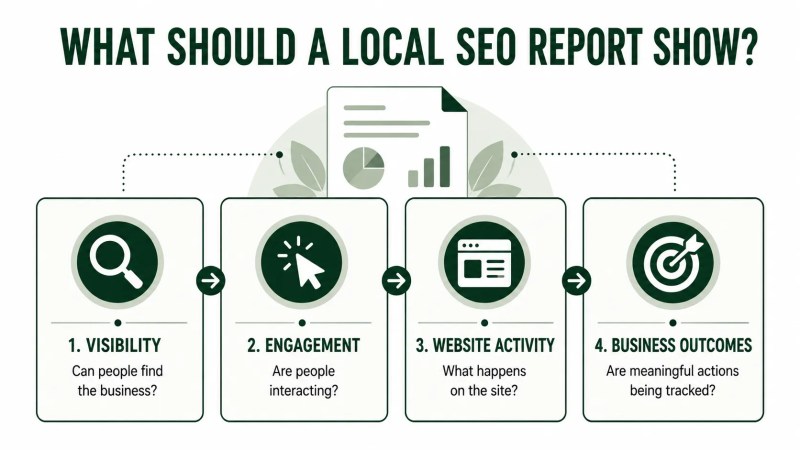
- Visibility: Is the business being found through relevant local searches?
- Engagement: What are people doing when they encounter the business in search or through its Business Profile?
- Website activity: What happens when searchers reach the website?
- Business outcomes: Are those interactions contributing to calls, forms, bookings, purchases, or other meaningful conversions the business tracks?
Looking at these layers together provides more context than reporting one metric in isolation. A change in website traffic means something different when viewed alongside search visibility and conversion activity.
This broader approach fits within SEO measurement and reporting, where metrics should be interpreted in relation to the goals they are intended to measure.
Search Visibility Metrics
The first reporting layer is whether the business is being discovered through search.
Depending on the tools and data available, useful search-performance metrics may include:
- Search impressions.
- Clicks from search results.
- Click-through rate.
- Search queries associated with relevant pages.
- Performance of important local landing pages.
- Changes in visibility for relevant local search terms.
These metrics should be interpreted together rather than as independent scorecards. For example, impressions can provide context about how often a result was shown, while clicks show how often searchers moved from the result to the website.
Don’t Reduce Local SEO to One Ranking
Rank tracking can provide useful context, but a single keyword position doesn’t represent the entire local search picture. Search performance can involve multiple queries, pages, locations, devices, and search experiences.
When reviewing keyword visibility, focus on whether the tracked terms represent searches that matter to the business rather than simply collecting a large list of keywords. Traffisite’s guide to local SEO keyword research explains how search terms can be evaluated around actual services and local intent.
Google Business Profile Metrics
For many local businesses, the Google Business Profile is another useful reporting layer because customers can interact with the business through its profile.
A Google Business Profile report can use the performance information available for the profile to help explain how people find and interact with the business. Not every performance metric is available for every business, and Google may change how some metrics are measured. Use the current data available for the profile rather than assuming every report will contain the same metrics.
Rather than copying every available number into a report, select the metrics that help answer the business’s reporting questions.
Connect Profile Activity to the Business
Profile activity becomes more meaningful when it is interpreted alongside the business’s goals.
For example, a service business may care about actions that indicate potential customer intent, while another business may prioritize a different interaction. The reporting should reflect what the business actually considers valuable rather than treating every available Business Profile metric as equally important.
Profile performance also shouldn’t be evaluated separately from profile quality. If the business is still working on categories, business information, reviews, or other foundational elements, the Google Business Profile optimization guide provides the broader context.
Website Performance Metrics
Local search visibility is only part of the journey when a potential customer continues to the website.
Website reporting can help answer questions such as:
- Which landing pages receive organic search traffic?
- Which service or location pages attract search visitors?
- What actions do visitors take after landing?
- Which pages contribute to tracked conversions?
- Are important pages gaining or losing search visibility over time?
Page-level reporting is useful because an overall traffic total can hide meaningful differences between sections of a website. A service page may be improving while another important local landing page is declining.
This is one reason a broader local SEO audit should consider the website and Business Profile together rather than treating local visibility as a profile-only issue.
Conversion and Lead Metrics
Visibility and traffic are useful signals, but reporting becomes more actionable when they can be connected to outcomes the business cares about.
Depending on the business and its tracking setup, meaningful conversions might include:
- Contact-form submissions.
- Tracked phone calls.
- Appointment or booking requests.
- Quote requests.
- Purchases or transactions.
- Other defined lead or revenue actions.
The right conversion depends on the business model. A phone call may be important for one service business, while an online booking or completed purchase may be more meaningful for another.
Separate SEO Activity From Business Outcomes
A useful report shouldn’t imply that every conversion was caused by one SEO task. Instead, reporting should show the relationships visible in the available search, website, and conversion data without claiming more attribution than the tracking supports.
This distinction matters when multiple marketing channels or customer interactions may contribute to the same outcome.
How to Combine Local SEO Data Into a Meaningful Report
The most useful reporting often comes from connecting the different layers rather than presenting separate dashboards without explanation.
A practical reporting sequence is:
- Start with visibility. Review whether relevant search exposure is changing.
- Review engagement. Look at how people interact with search results and the Business Profile.
- Follow activity to the website. Review which important pages receive organic traffic and what visitors do next.
- Connect activity to tracked outcomes. Review leads, calls, bookings, transactions, or other conversions where reliable tracking exists.
- Add context. Explain what changed, what may require investigation, and what the next reporting period should monitor.
This creates a clearer narrative:
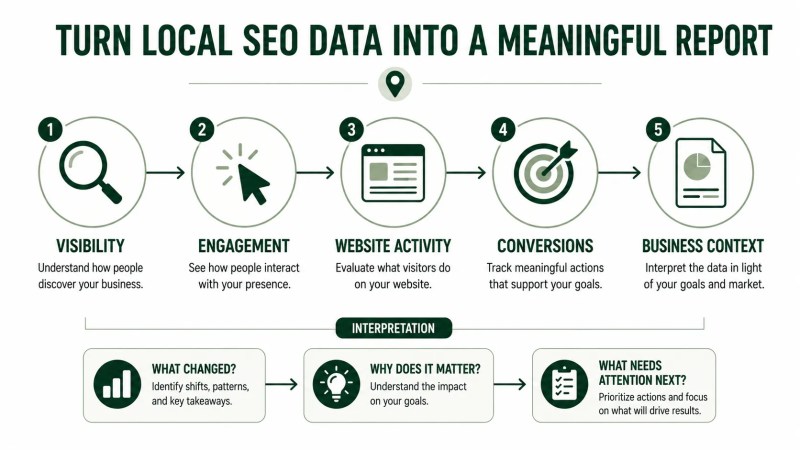
Visibility → Engagement → Website Activity → Conversions → Business Context
The purpose isn’t to prove that every metric increased. A useful report should also make declines, inconsistencies, tracking gaps, and areas requiring investigation visible.
Compare Trends, Not Just Snapshots
A number is easier to interpret when it has context. Comparing performance across appropriate reporting periods can help identify changes and patterns that may deserve further investigation.
The comparison period should make sense for the business and the question being asked. Avoid selecting a period solely because it produces the most favorable result.
Add Commentary to the Numbers
A reporting dashboard can show what changed. Commentary should help explain why the change matters and what should happen next.
Useful commentary might identify:
- A landing page that gained or lost search visibility.
- A change in Business Profile interactions.
- A conversion-tracking gap that needs correction.
- A query or service area that deserves further investigation.
- A page that may need additional optimization.
The commentary should distinguish observations supported by the data from hypotheses that still need investigation.
Local SEO Reporting Tools
There isn’t one reporting tool that every business needs. The appropriate setup depends on what the business tracks and which platforms contain the data required for the report.
Common data sources may include:
- Google Search Console for Google Search performance data.
- Google Business Profile performance data for profile visibility and interactions.
- Website analytics for landing-page activity, events, and important actions configured for measurement.
- Call-tracking or lead-management systems when those are part of the business’s measurement setup.
- SEO platforms used for rank tracking, audits, or other supporting analysis.
The reporting tool itself is less important than whether the underlying data answers a useful question. A polished dashboard with weak tracking can still produce a weak local SEO report.
Common Local SEO Reporting Mistakes
Reporting Every Available Metric
More numbers don’t automatically create more insight. Prioritize metrics that help explain visibility, engagement, website activity, and business outcomes.
Reporting Rankings Without Context
A ranking change needs context about the query, location, page, and business relevance. Avoid treating one position as a complete measure of local SEO performance.
Ignoring Conversion Tracking
If the business cares about leads or sales but the report stops at impressions and clicks, an important part of the measurement chain is missing.
Treating Correlation as Attribution
When traffic and conversions rise together, that doesn’t automatically prove one SEO change caused the business outcome. Report what the available data supports and label interpretations appropriately.
Hiding Negative Changes
Reporting should make problems easier to identify, not hide them. Declines and tracking issues can be useful when they lead to investigation and corrective action.
Using the Same Report for Every Business
The reporting framework can be consistent, but the metrics that matter should reflect the business model, goals, available data, and customer journey.
FAQ
What should be included in a local SEO report?
A useful local SEO report can combine search visibility, Google Business Profile activity, website performance, and tracked conversions. The exact metrics should reflect the business’s goals and the data that is reliably available.
What are the most important local SEO metrics?
There isn’t one metric that represents local SEO performance by itself. Useful metrics can include search impressions and clicks, relevant query or ranking visibility, Business Profile interactions, organic landing-page performance, and tracked conversions. Their importance depends on what the business is trying to achieve.
What are Google Business Profile Insights?
If you’re looking for Google Business Profile Insights, be aware that Google’s current documentation distinguishes profile Performance from an Insights feature. Performance reports show information about how people discover and interact with the profile, while Insights can provide data-driven recommendations for eligible profiles.
How often should you create a local SEO report?
The reporting schedule should match the decisions the business needs to make and the amount of meaningful data available. Choose a reporting period that provides useful comparisons without creating reports more frequently than the available data can meaningfully support.
Which local SEO reporting tools should I use?
Use the tools needed to answer the business’s reporting questions. That may involve Search Console, Business Profile performance data, website analytics, rank tracking, call tracking, or lead-management data. Avoid adding tools solely to make the reporting stack look more complex.
Make Local SEO Reporting Explain What Happens Next
A strong local SEO report isn’t just a collection of metrics. It connects search visibility to customer interaction, website activity, and the outcomes the business is trying to generate.
Start with the business question, use the data sources that can answer it, and add enough context to explain what changed and what deserves attention next. That turns reporting from a collection of disconnected metrics into a practical tool for deciding where local SEO work should focus.