

Local SEO can help businesses become easier to discover when people search for relevant products or services in a particular area. For service businesses, that means connecting what the business offers with the locations and customers it actually serves.
The basics extend beyond a single website page or business listing. Local SEO can involve the website, Google Business Profile, business information across relevant platforms, customer reviews, local and industry relationships, technical website health, and ongoing measurement.
Quick Answer: Local SEO is the process of improving a business’s presence for relevant local searches. For a service business, the basics can include maintaining an eligible Google Business Profile, creating useful service and location content, keeping important business information accurate, managing genuine customer reviews, earning relevant links and mentions, maintaining the website’s technical foundation, and measuring search visibility and customer actions over time.
How Local SEO Works
At a basic level, local SEO is about helping search engines and potential customers understand what a business offers, where it operates, and which information may be useful for a local search.
For example, someone searching for a service may need to determine:
- Whether a business provides the service they need
- Whether the business serves their location
- How to contact the business
- When the business is available
- What previous customers have said about their experiences
- Where to find more information before taking the next step
Local SEO brings several parts of that discovery process together. The website can explain services and coverage, an eligible Business Profile can provide customer-facing business information in Google Search and Maps, and other relevant sources can provide additional information about the business.
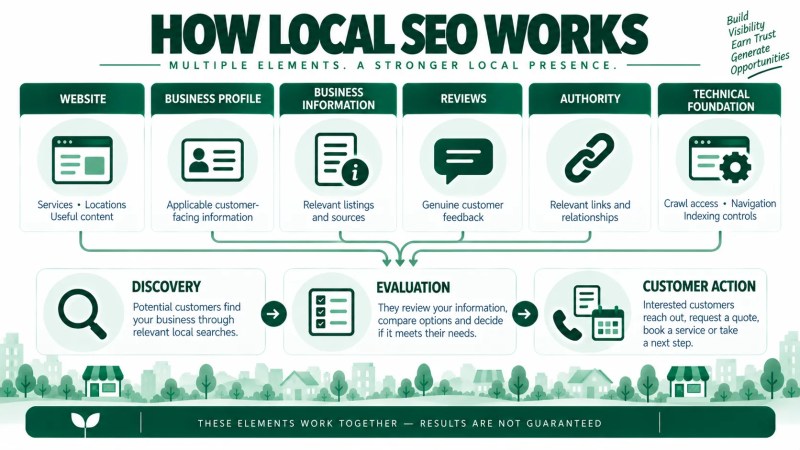
For a broader strategic explanation, Traffisite’s local SEO guide covers the topic in greater depth.
Build the Website Foundation
A business’s website is one of the main places where prospective customers can learn what the business does and determine whether it serves their needs.
For local SEO, useful website content may include:
- Clear service pages
- Relevant location or service-area information
- Useful supporting content
- Accurate contact information
- Clear paths for customers to enquire, call, request a quote, or book when applicable
Service and location content should be created for genuine user needs rather than simply producing many substantially similar pages for different keyword-and-location combinations.
Internal links can also connect related service, location, and supporting pages so visitors and search engines can navigate between useful content. Traffisite’s internal linking guide explains how those connections can be planned.
Maintain Your Google Business Profile
For eligible businesses, Google Business Profile can be an important part of local search because business information can appear in Google Search and Maps.
Depending on how the business operates and which profile features are applicable, customer-facing information may include:
- Business name
- Business category
- Address or service area
- Hours
- Phone number
- Website
- Services
- Photos
- Customer reviews
Profile information should accurately represent how the business operates. Google’s guidance distinguishes between service-area businesses that visit or deliver to customers without serving them at the business address and hybrid businesses that both serve customers at their address and travel or deliver to customers.
Traffisite’s guide to Google Business Profile optimization provides a more detailed process for reviewing and maintaining applicable profile information.
Keep Business Information Accurate
Business information can appear in multiple places beyond the company’s own website and Business Profile. Depending on the business, that can include relevant directories, industry websites, social platforms, and other third-party sources.
Important details to review may include:
- Business name
- Address or service area where applicable
- Phone number
- Website
- Hours
- Other important customer-facing information
The objective is not to appear on every directory available. Focus on relevant sources and correct important information when it becomes inaccurate or outdated.
Traffisite’s guide to local SEO citations explains this part of local SEO in more detail.
Research Relevant Local Searches
Keyword research helps connect the language potential customers use with the services, problems, and locations the business can legitimately address.
A beginner can start by examining combinations of:
- Core services
- Customer problems or needs
- Locations genuinely served
- Questions customers ask before purchasing
- Commercial searches related to the service
The next step is deciding which existing page best serves each important search need or whether a genuinely useful new page is necessary. Not every keyword requires its own URL.
A structured local SEO keyword research process can help organize this work.
Develop a Responsible Review Process
Customer reviews can provide prospective customers with information about previous customer experiences. When requesting or managing Google reviews, businesses should follow Google’s applicable policies for user-contributed content and reviews.
A practical review process may include:
- Identifying an appropriate point to request genuine feedback
- Making the review process easy to understand
- Monitoring new reviews
- Responding professionally when appropriate
- Using available reporting processes for reviews that appear to violate platform policies
For Google reviews, businesses should not solicit content that does not reflect a genuine customer experience or offer incentives in exchange for posting, changing, or removing a review.
Traffisite’s guide to Google Business Profile reviews provides more detailed guidance for Google reviews.
Build Relevant Links and Relationships
Links from other websites can be another part of a local SEO strategy, but beginners should focus on relevance and legitimate relationships rather than collecting links indiscriminately.
Depending on the business, opportunities may come from:
- Professional associations
- Industry organizations
- Suppliers and business partners
- Relevant local publications
- Community organizations
- Legitimate partnerships or sponsorships
A useful opportunity should make sense for the business even without treating the link itself as the only objective. Avoid link practices designed primarily to manipulate Google Search rankings.
Traffisite’s guide to local SEO backlinks explores this area in more detail.
Maintain the Technical Foundation
Useful content still needs a functional website foundation. For pages intended to appear in Google Search, crawl access, indexing directives, HTTP responses, and internal discovery can all matter. These checks affect different parts of how search engines discover, crawl, and process pages.
Basic technical checks can include:
- Important indexable pages returning successful HTTP responses rather than error responses
- Broken internal links
- Unintended redirects
- Crawl-access issues
- Indexing directives
- Important pages that are difficult to reach through site navigation
Beginners do not need to solve every technical SEO issue at once. Start by checking whether priority service and location pages work correctly, can be reached through the website, and are not unintentionally restricted from crawling or indexing.
Traffisite’s technical SEO guide provides broader guidance on maintaining the technical foundation of a website.
Measure Local SEO Results
Local SEO should not be measured only by whether one keyword moves up or down.
Depending on the business’s goals, tracking setup, eligibility, and available data, useful measurements may include:
- Visibility for relevant local searches
- Organic traffic to priority pages
- Search queries associated with important pages
- Available Business Profile performance information for verified profiles, where applicable
- Calls
- Form submissions
- Quote requests
- Bookings or other measurable customer actions
These measurements answer different questions. Search visibility can provide information about discovery. Website analytics and available Business Profile performance information can provide information about online interactions, while properly configured conversion tracking can help measure customer actions.
Traffisite’s guide to local SEO reporting provides a more detailed measurement framework.
How to Get Started With Local SEO
A beginner does not need to work on every component simultaneously. Start with the areas most important to customers and the business’s current search presence.
- Confirm the business basics. Review the business name, contact details, services, locations, and other important customer-facing information.
- Review the website. Make sure priority services are clearly explained and customers can understand where the business operates.
- Review the Business Profile. If the business is eligible, check that applicable information accurately represents how it operates.
- Research relevant searches. Identify how services, customer needs, and genuine service locations relate to search demand.
- Improve priority pages. Focus on useful service, location, and supporting content rather than creating pages solely to target keyword variations.
- Review customer feedback. Establish a responsible process for genuine reviews and responses.
- Check relevant listings and relationships. Correct important business information and evaluate legitimate local or industry opportunities.
- Review technical health. Check whether priority pages are accessible, linked internally, and free from obvious errors.
- Measure what matters. Track relevant visibility and meaningful customer actions where reliable data is available.
- Prioritize the next improvement. Use what you learn to decide which component deserves attention next.
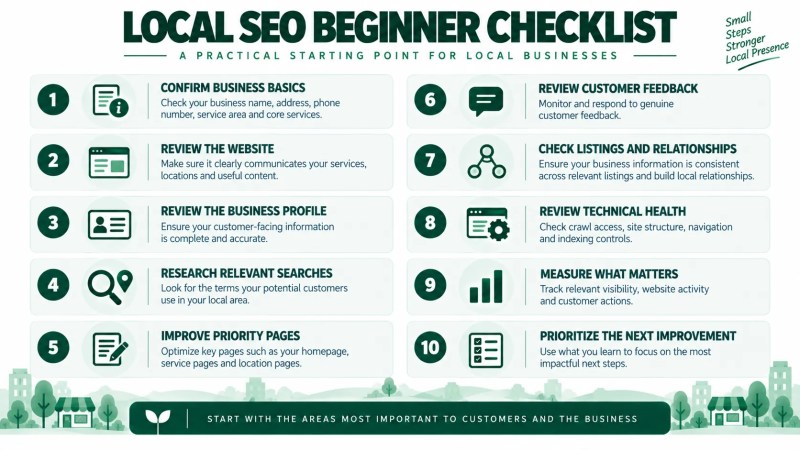
For businesses that want a more structured maintenance framework after understanding the fundamentals, Traffisite’s local SEO best practices guide provides a practical next step.
Frequently Asked Questions
What is local SEO in simple terms?
Local SEO is the process of improving a business’s presence for relevant searches connected to the products or services it offers and the locations it serves. It can involve the website, an eligible Google Business Profile, business information, reviews, links, technical website health, and ongoing measurement.
What are the main components of local SEO?
The major components can include the website, Google Business Profile for eligible businesses, relevant local business information, keyword research, useful service and location content, genuine customer reviews, relevant links and relationships, technical SEO, and performance measurement.
Does every local business need a Google Business Profile?
No. Not every local business is eligible for a Google Business Profile. Google’s eligibility requirements generally depend on whether the business has qualifying in-person contact with customers, subject to documented exceptions.
Does every city need its own location page?
No. A separate location page should have a genuine user purpose and useful information for the people it is intended to serve. Avoid creating multiple city or regional pages that are substantially similar and primarily funnel visitors toward the same destination.
How long does local SEO take?
There is no universal timeline that applies to every business. The work required and the results observed can vary according to the business’s starting position, market, website, competition, services, locations, and the improvements being made. Avoid treating a specific ranking or lead timeline as guaranteed.
Can a business do local SEO itself?
Many basic tasks can be handled internally when the business has the necessary access, time, and knowledge. More complex technical issues, larger multi-location websites, competitive research, or ongoing strategy may require additional expertise depending on the situation.
Learn the Basics, Then Build the Process
Local SEO becomes easier to manage when it is viewed as a connected system rather than a collection of unrelated tactics. The website explains services and coverage, business profiles and listings provide customer-facing information, reviews help people evaluate previous experiences, relevant relationships can support broader visibility, and measurement helps determine what deserves attention next.
Start with accurate business information and useful customer-facing pages, then improve the remaining components according to the business’s needs and available data. The goal is not to complete every possible SEO task. It is to build and maintain a local search presence that accurately represents the business and helps relevant customers find useful information.