

Most local service businesses start keyword research the same way: they open a spreadsheet and try to list every possible way someone might search for what they do. The result is usually hundreds of near-identical rows — “plumber near me,” “emergency plumber,” “24 hour plumber,” “plumber [city]” — with no clear plan for what to do with any of it.
That approach produces a long list, not a strategy. The more useful question isn’t “how many keywords can I find,” but “how do these keywords group together, and what page should each group point to.”
Quick Answer: Local SEO keyword research isn’t about collecting the longest possible list of search terms — it’s about grouping keywords by service, location, and intent, then mapping each group to one strong page instead of building a separate page for every variation.
Why Local Keyword Research Isn’t About Building a Bigger List
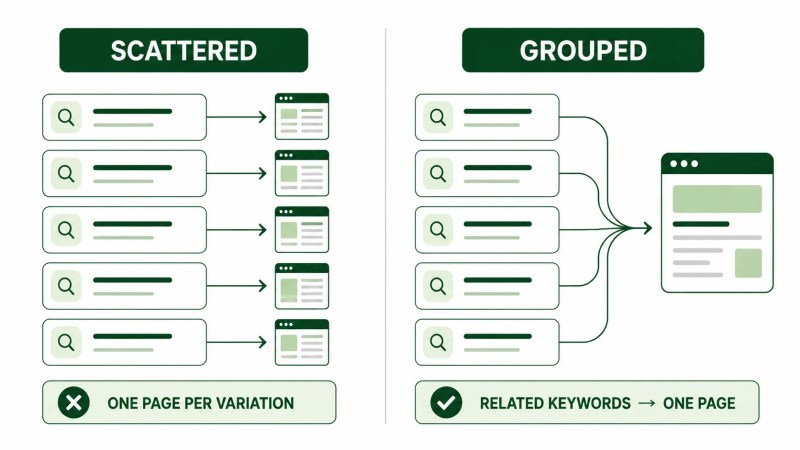
A large keyword list feels productive, but it creates a real problem once you try to act on it: the instinct to build a page for every keyword. That leads to dozens of thin pages targeting near-duplicate terms, competing with each other instead of building authority around a topic.
This is the same issue described in the comparison between topical clusters and random blogging — content built one keyword at a time, without an organizing structure, tends to dilute relevance rather than build it. Local keyword research works better when the goal from the start is a small number of strong, well-organized pages rather than a large number of narrow ones.
The Three Building Blocks: Service, Location, and Intent
Almost every local search query is a combination of three elements:
- Service — what the customer needs done (e.g., “drain cleaning,” “AC repair,” “commercial pressure washing”)
- Location — where they need it done (a city, neighborhood, or “near me”)
- Intent — what stage of the decision they’re in (researching, comparing, ready to book, looking for pricing, checking availability)
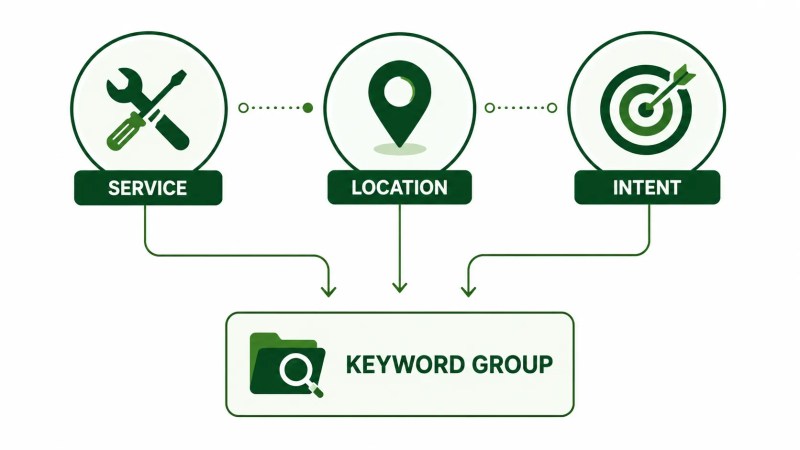
Once you separate a keyword into these three parts, patterns emerge quickly. “Emergency plumber Austin,” “24/7 plumber near me,” and “same day plumber Austin TX” aren’t three different topics — they’re the same service, the same location, and the same urgent-intent group. They belong on the same page, not three separate ones.
This is the foundation of a broader local SEO strategy: instead of chasing individual keywords, you’re mapping the actual combinations of service, location, and intent that your business can realistically serve and rank for.
How to Do Local Keyword Research, Step by Step
Step 1 — List Every Service You Actually Offer
Start with your actual service list, not a keyword tool. Be specific — “drain cleaning” and “water heater installation” are different services with different search behavior, even though both fall under “plumbing.” Vague, broad service names make it harder to group keywords accurately later.
Step 2 — Map the Locations You Actually Serve
List the cities, towns, or service areas you genuinely cover — not every location within driving distance. This step matters most for local service businesses that operate across multiple towns or a defined service radius, since it determines whether you need one location-agnostic page or several location-specific ones.
Step 3 — Layer in Search Intent
For each service and location combination, think through how someone at different stages would search: comparing options (“best plumber in [city]”), checking cost (“[service] cost [city]”), or needing something urgently (“emergency [service] [city]”). Not every combination needs its own page — this step is about understanding intent, not creating a new page for each variation.
Step 4 — Validate and Expand With Tools
Use keyword tools to confirm your assumptions and catch phrasing you wouldn’t have thought of on your own — not to generate the initial list. Tools are best used to validate and refine groupings you’ve already built from your actual services and service areas.
Free and Paid Tools for Local Keyword Research
You don’t need an expensive local SEO keyword research tool to do this well. A combination of free tools and one paid option for deeper data is usually enough for most local businesses.
| Tool | Free or Paid | Best For |
|---|---|---|
| Google Search Console | Free | Seeing the actual search terms your site already gets impressions and clicks for |
| Google Autocomplete & “People also ask” | Free | Uncovering real phrasing and related questions people use around a service |
| Google Business Profile performance (insights) | Free | Understanding how customers are finding your listing specifically |
| Google Keyword Planner | Free (requires a Google Ads account) | Rough search volume and related keyword ideas |
| Ahrefs / Semrush | Paid | Detailed local search volume, keyword difficulty, and competitor keyword gaps |
If you’re comparing paid options beyond Ahrefs and Semrush, the breakdown of Semrush versus Ubersuggest covers the tradeoffs in more depth. For a broader starting point before paying for anything, Traffisite maintains a running list of free SEO tools.
Group Keywords Into Pages, Not One Page Per Keyword
Once your keyword groups are built around service, location, and intent, the next decision is how many pages you actually need. This is where most local keyword research goes wrong — treating every keyword variation as justification for a new page.
What Belongs on the Same Page
Keywords that share the same service, the same location (or lack of one), and the same intent almost always belong together. “Water heater repair [city],” “water heater not working [city],” and “fix water heater [city]” are all urgent-intent variations of the same service and location — one well-written page can target all of them.
When a Separate Page Is Actually Justified
A new page makes sense when the service is genuinely different, the location is a distinct market you serve with different messaging or availability, or the intent requires different content entirely (a pricing page versus an emergency-service page). Outside of those cases, a new page usually just competes with an existing one instead of adding real value.
This is closely tied to overall website structure and how pages link to each other — a well-planned internal linking structure only works if the underlying pages are organized around real topics rather than individual keywords. If your current site already shows signs of keyword-per-page sprawl, that’s usually a sign it’s time to restructure the site around grouped topics rather than add more pages.
Common Local Keyword Research Mistakes
- Building a page for every keyword variation instead of grouping by service, location, and intent
- Listing service areas you don’t actually serve just because a keyword tool shows search volume there
- Ignoring Google Business Profile data, which often shows the exact terms customers already use to find you — a step worth pairing with Google Business Profile optimization
- Treating keyword volume as the only signal, without considering whether the searcher is ready to book or just browsing
- Skipping validation by relying only on assumptions about how customers search, instead of checking Search Console or a keyword tool
FAQ
What is local SEO keyword research?
Local SEO keyword research is the process of identifying the search terms potential customers use when looking for a service in a specific area, then organizing those terms by service, location, and intent so they can be mapped to the right pages on your site.
What’s a good free local SEO keyword research tool to start with?
Google Search Console is usually the best starting point since it shows search terms your site is already appearing for. Google’s autocomplete and “People also ask” results are useful free additions for finding real phrasing.
Do I need a paid local SEO keyword research tool?
Not necessarily to get started. Free tools can validate most service-and-location combinations. A paid tool becomes more useful once you need deeper competitor keyword data or more precise local search volume.
Should I create a separate page for every keyword variation I find?
No. Keywords that share the same service, location, and intent should point to the same page. A separate page is only justified when the service, location, or intent is genuinely different.
Turning Keyword Groups Into a Site Structure That Ranks
Keyword research is only useful once it turns into a page structure someone can actually build and maintain. Grouping by service, location, and intent gives you that structure before you write a single page — which is the difference between a site that builds topical authority and one that’s just accumulating pages.
If you’d rather have this mapped out for you, Traffisite’s local SEO services include this kind of keyword-to-page planning as part of a broader SEO content strategy.