

Local SEO lead generation is the process of using local search visibility to support opportunities for potential customers to discover, evaluate, and contact a business. For service businesses, that can involve improving how the business appears across relevant local search experiences while making the path from discovery to enquiry as clear as possible.
Local SEO does not guarantee leads, rankings, calls, or sales. It can support lead-generation goals by improving relevant local visibility and strengthening the pages, profiles, and conversion paths customers may use when deciding whether to contact a business.
Quick Answer: Local SEO can support lead generation by helping a service business become easier to discover for relevant local searches and by giving potential customers useful information and clear ways to take the next step. A practical strategy may consider local search visibility, Google Business Profile, service and location content, reviews, citations, website experience, and conversion paths. Results depend on the business, market, competition, website, implementation, and other factors, so specific lead or ranking outcomes should not be assumed.
What Is Local SEO Lead Generation?
Local SEO lead generation connects two related goals: improving a business’s visibility for relevant local searches and making it easier for potential customers who discover the business to take a meaningful next step.
That next step could include calling the business, submitting an enquiry form, requesting a quote, booking an appointment, or taking another action appropriate to the service.
The distinction matters because visibility and lead generation are not the same thing. A business can gain search visibility without creating a strong path to enquiry. Likewise, a well-designed website has limited opportunity to support organic lead generation if relevant customers rarely discover it through search.
A broader local SEO strategy therefore needs to consider both discoverability and what happens after a potential customer encounters the business.
How Local SEO Can Support Lead Generation
Local SEO can support lead generation at several stages of the customer’s search process. It can help create opportunities for a business to be discovered, provide information that supports evaluation, and connect potential customers with useful next steps.
Helping Relevant Local Customers Discover the Business
People may search for a local business using service or business-category terms together with local context such as a place name, “near me,” or availability-related wording. Local SEO work can help align the business’s website and local search presence with the services and areas it genuinely serves.
The objective is not simply to appear for as many searches as possible. Visibility is more useful when the search intent, service, and geographic context align with what the business actually offers.
For businesses focused specifically on geographic search visibility, Traffisite’s local SEO services page explains the broader service approach.
Giving Searchers Useful Information
Discovery is only the beginning. Potential customers may need to understand what the business does, where it operates, when it is available, how to contact it, and whether its services appear relevant to their needs.
Accurate business information, useful service content, clear location information, relevant photos, reviews, and straightforward contact options can support that evaluation process where applicable.
Creating Clear Paths to Contact
Once a potential customer reaches the website or another available conversion path, the next action should be easy to understand.
Depending on the business, that could mean a visible phone number, enquiry form, quote request, appointment option, or contact page. The appropriate conversion path depends on how the business handles enquiries and sells its services.
This is where local SEO and broader website strategy meet. Search visibility creates an opportunity; the website and enquiry process influence what a visitor can do with that opportunity.
Local SEO Components That Support Lead Generation
Local SEO is not one isolated task. Several parts of a local search strategy can contribute to the path between discovery and enquiry.
Google Business Profile
For an eligible business, Google Business Profile can display business information on Google Search and Maps and provide available ways for customers to interact with the business.
Depending on the business category and available profile features, relevant information may include categories, contact details, hours, website information, services, photos, reviews, and other applicable information. The profile should accurately represent the business.
Service Pages
Service pages help explain what the business actually provides. They can address the service itself, who it is for, important considerations, and how a potential customer can enquire.
For local lead-generation goals, a useful service page should do more than target a keyword. It should help the reader determine whether the service matches their needs and what to do next.
Location-Relevant Content
Businesses serving defined geographic markets may need content that clearly explains where services are available. Location relevance should reflect genuine operations rather than creating pages solely to repeat geographic terms.
For service businesses specifically, Traffisite’s SEO for local service businesses page provides additional context on building search visibility around services and markets.
Reviews and Reputation Signals
Reviews can give potential customers information about other customers’ experiences and can help them evaluate a business.
A review strategy should focus on genuine customer feedback and responsible review practices. Google’s policies prohibit fake engagement, incentivized reviews, selective solicitation of positive reviews, and other forms of rating manipulation.
Traffisite’s guide to Google Business Profile reviews covers this area in more detail.
Local Citations and Business Information
In local SEO, local citations generally refer to online mentions or listings containing a business’s information, commonly including its name, address, phone number, and sometimes additional details. Reviewing relevant citations can help a business identify outdated, inaccurate, or conflicting information that potential customers may encounter.
For a deeper explanation, see Traffisite’s guide to local SEO citations.
Website Experience and Technical Foundations
Technical problems, confusing navigation, poor mobile usability, broken forms, or unclear page structure can create friction after a searcher reaches the website.
Local SEO lead generation therefore should not be separated completely from website quality. A technically accessible and understandable website can provide potential customers with a clearer path from search discovery to enquiry.
Turning Local Visibility Into Enquiry Opportunities
A useful way to think about local SEO lead generation is as a sequence rather than a single ranking event.
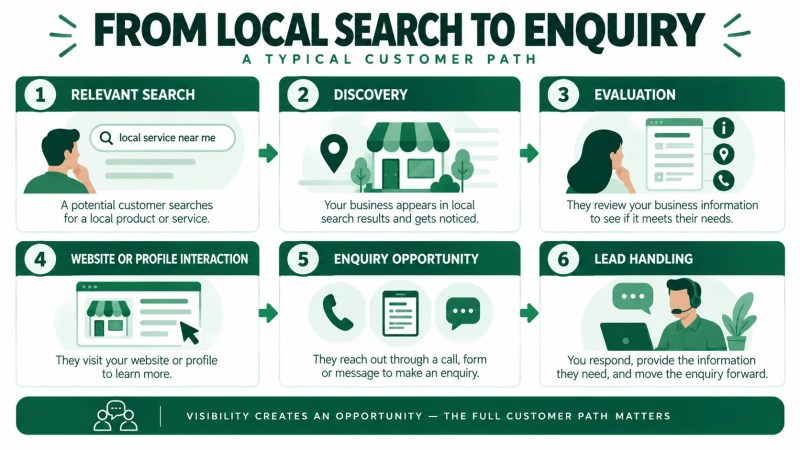
- Relevant search: A potential customer searches for a service, problem, provider, or business in a geographic context.
- Discovery: The customer encounters the business through a relevant local or organic search experience.
- Evaluation: The customer reviews available information about the business, services, location, reputation, or suitability.
- Website or profile interaction: The customer explores relevant information or an available contact path.
- Enquiry opportunity: The customer may call, submit a form, request a quote, book, or take another relevant action.
- Lead handling: The business responds to the enquiry and determines whether it meets its criteria for a qualified lead.
Each stage can create friction. A business may have limited relevant visibility, inaccurate information, insufficient service content, unclear calls to action, broken forms, or weaknesses in its enquiry follow-up process.
That is why a broader goal such as generating more local leads should be approached as a system rather than reduced to one keyword or ranking position.
How to Measure Local SEO Lead Generation
Measurement should connect SEO activity with meaningful business actions without assuming that every interaction represents a lead or qualified opportunity.
Depending on the website, analytics configuration, attribution setup, contact methods, and lead-management process, a business may choose to track measurements such as:
- Search visibility for relevant local topics and queries
- Organic visits to important service and location pages
- Calls or other contact actions where reliable tracking and attribution are available
- Completed enquiry or quote-request forms
- Appointment or booking actions where applicable and trackable
- Conversion rates for important landing pages
- Qualified enquiries recorded separately in the business’s lead-management process
These measurements answer different questions. Search visibility can help assess discoverability. Website analytics can show how visitors interact after arriving when tracking is configured appropriately. Enquiries and qualified-lead data move measurement closer to business outcomes when reliable attribution and lead tracking are available.
Traffisite’s guide to local SEO reporting explains how reporting can organize relevant local SEO metrics without reducing performance to a single number.
Do Not Treat Every Interaction as a Lead
A website visit is not automatically a lead. A profile interaction is not automatically a lead. Even a form submission or phone call may not represent a qualified opportunity.
Businesses should define what they consider a lead and, where possible, distinguish general interactions from enquiries that match the services, geography, and customer criteria they actually serve.
A Practical Local SEO Lead Generation Framework
A practical strategy can be organized around the full path from search visibility to enquiry rather than isolated SEO tasks.
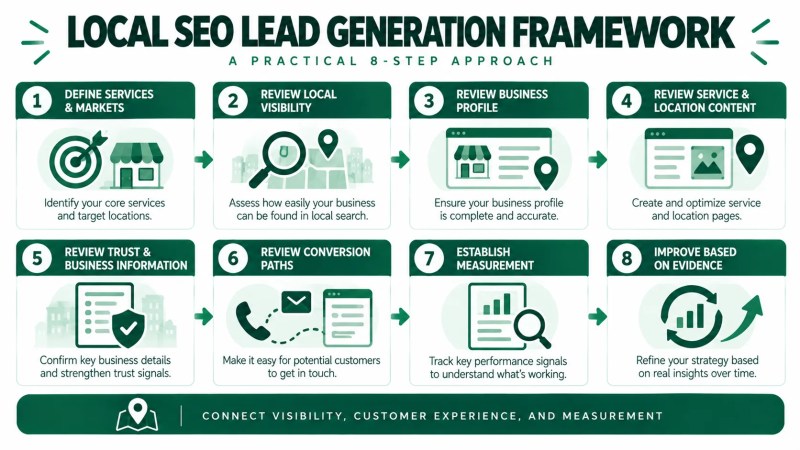
- Define the target services and markets. Identify the services the business wants to promote and the areas it genuinely serves.
- Review current local visibility. Evaluate how the website and business currently appear for relevant local searches.
- Review the Google Business Profile. Check whether important profile information accurately represents the business.
- Review service and location content. Make sure important pages clearly explain services, geographic relevance, and customer next steps.
- Review trust and business information. Check reviews, citations, contact details, and other information customers may use while evaluating the business.
- Review conversion paths. Test forms, phone links, quote requests, booking paths, and other relevant actions.
- Establish useful measurement. Decide which visibility, traffic, enquiry, and lead-quality metrics should be tracked.
- Improve based on evidence. Use search, website, and lead data to prioritize future work rather than assuming one tactic will produce a specific outcome.
Common Local SEO Lead Generation Mistakes
- Focusing only on rankings: Rankings can help describe search visibility, but they do not by themselves show whether potential customers are contacting the business.
- Targeting irrelevant searches: More visibility is not necessarily more useful when the queries do not align with the services or locations the business actually serves.
- Ignoring the website after improving local visibility: Searchers still need useful pages, clear information, and functional conversion paths.
- Using unclear calls to action: Potential customers should be able to understand how to contact the business or take the next appropriate step.
- Counting every interaction as a lead: Traffic, clicks, calls, enquiries, and qualified leads represent different stages and should not automatically be treated as equivalent.
- Ignoring lead quality: Enquiry volume alone does not show whether those enquiries match the services, geography, and customer criteria the business serves.
- Expecting guaranteed outcomes: Local SEO can support visibility and lead-generation opportunities, but specific rankings, lead volumes, and sales outcomes should not be assumed.
Frequently Asked Questions
Does local SEO generate leads?
Local SEO can support lead generation by creating opportunities for relevant local searchers to discover a business and find useful paths to contact it. It does not guarantee that a particular searcher will become a lead or that a business will receive a specific number of enquiries.
How does local SEO help service businesses get leads?
Local SEO can help a business make its website, Business Profile, service information, location information, reputation information, and contact paths more accessible to relevant local searchers. Together, these elements can create opportunities for appropriate searchers to evaluate and contact the business.
What is the difference between local SEO traffic and local SEO leads?
Traffic refers to visits to the website, while a lead depends on the criteria the business uses to define a potential sales opportunity. An enquiry may become a qualified lead after the business determines that it matches relevant service, geographic, and customer criteria. Not every website visitor or enquiry is therefore a qualified lead.
Should local SEO be measured only by rankings?
No. Rankings can provide information about search visibility, but businesses can also review relevant traffic, landing-page performance, contact actions, enquiries, and qualified leads where reliable tracking is available.
How long does local SEO take to generate leads?
There is no responsible universal timeframe for promising when local SEO will generate leads. Google notes that SEO changes themselves can take anywhere from hours to several months to be reflected in Search, while actual enquiries depend on factors beyond search visibility alone.
Do I need a Google Business Profile for local SEO lead generation?
For an eligible business, Google Business Profile can be one part of a local search strategy by providing a business presence on Google Search and Maps. Local SEO can also involve the website, service and location content, business information, reputation, technical foundations, and other elements. The appropriate strategy depends on the business and how customers search for its services.
Build the Path From Local Search to Enquiry
Local SEO lead generation works best as a connected process. Relevant visibility creates an opportunity to be discovered, useful business and service information can help potential customers evaluate the business, and clear conversion paths give them a way to take the next step.
The goal is not to chase visibility in isolation or assume that rankings automatically produce leads. Build around the services and markets the business actually serves, reduce friction between discovery and enquiry, measure meaningful actions, and use the resulting evidence to guide future improvements.