

Local SEO best practices are most useful when they work together. Optimizing a Google Business Profile while neglecting the website, publishing location pages without a clear purpose, or collecting business listings without maintaining accurate information can leave important parts of the local search presence disconnected.
For local service businesses, a practical approach is to coordinate the website, Business Profile, local business information, reviews, relevant links, and ongoing measurement around the services and locations the business actually serves.
Quick Answer: Local SEO best practices include keeping business information accurate, maintaining an eligible Google Business Profile, creating useful service and location pages, researching relevant local searches, earning and managing genuine reviews, maintaining relevant business listings, building useful local or industry relationships, monitoring technical issues, and measuring performance over time. The right priorities depend on the business, its customers, and its current local search presence.
Build an Accurate Local Search Foundation
Before adding more content or pursuing new tactics, make sure the business’s core local information reflects how it actually operates.
Review important details such as:
- Business name
- Address or service area, where applicable
- Phone number
- Website
- Business hours
- Services
- Locations or areas genuinely served
The goal is not to repeat identical information everywhere for its own sake. The goal is to prevent customers from encountering outdated or conflicting details when they move between the website, Business Profile, and other relevant sources.
A broader local SEO guide can help put these individual practices into a coordinated strategy.
Maintain Your Google Business Profile
For eligible businesses, Google Business Profile can be an important part of how business information appears in Google Search and Maps. Treat the profile as an ongoing customer-facing asset rather than a one-time setup task.
Depending on the business and the features available, areas worth reviewing may include:
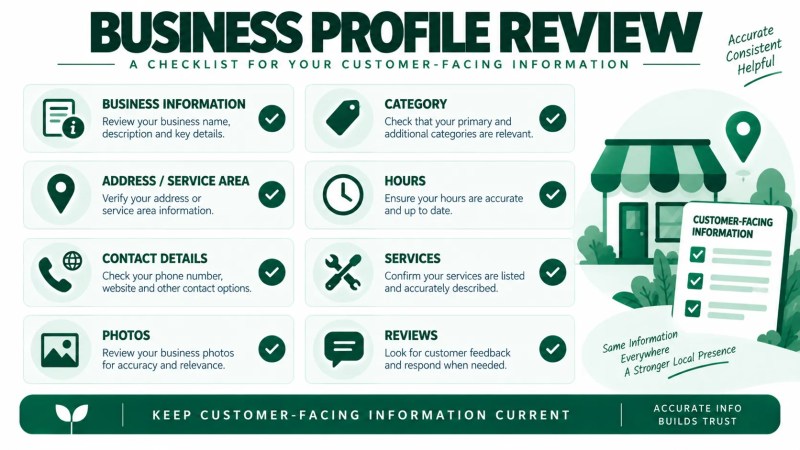
- Business name and category
- Address or service area
- Hours
- Phone number and website
- Services
- Photos
- Reviews and responses
- Other applicable profile information
Business Profile information should accurately represent how the business operates. For example, Google says business names should match real-world branding, categories should not be used solely as keywords, and service areas should be specified accurately.
Traffisite’s guide to Google Business Profile optimization covers this area in more detail.
Research Relevant Local Searches
Local SEO should be connected to the searches that matter to the business rather than built around arbitrary keyword lists.
Research can examine combinations of:
- Services
- Customer problems or needs
- Locations and service areas
- Informational questions
- Commercial or service-focused searches
The next step is deciding which existing or planned page can best satisfy each useful search need. Not every keyword requires a new page, and creating multiple overlapping pages can make the site harder to manage.
A structured local SEO keyword research process can help connect relevant searches with appropriate pages.
Create Useful Service and Location Pages
Service and location pages should help prospective customers understand what the business offers and whether that service is available where they need it.
A useful page may explain:
- The specific service
- Who may need it
- Relevant service details
- The location or service area when appropriate
- Common questions
- The next step for contacting the business
Each local page should have a genuine purpose and provide useful information for the people it is intended to serve. Avoid producing large sets of substantially similar geographic pages simply to target variations of city or regional searches. Google lists certain city- or region-targeted funnel pages and substantially similar pages among examples of doorway abuse.
Internal links should also connect related service, location, and supporting pages where those relationships help visitors navigate the site and understand related information. Traffisite’s internal linking guide explains how to approach those connections deliberately.
For businesses looking to refine page headings, useful service content, and relevant internal connections, Traffisite’s on-page SEO support addresses those page-level improvements.
Maintain Business Information Across the Web
Business details can appear on directories, platforms, industry websites, social profiles, and other third-party sources. Review the listings that matter to the business and correct important information when it becomes outdated.
Useful checks may include:
- Whether the business name is current
- Whether the address or service information is accurate
- Whether the phone number works
- Whether the website destination is correct
- Whether duplicate or outdated listings need attention
Do not treat citation building as a race to appear on as many websites as possible. Relevance, accuracy, and usefulness should guide where effort is spent.
For a more focused process, see Traffisite’s guide to local SEO citations.
Develop a Responsible Review Process
Reviews can help prospective customers learn about previous customer experiences. A sustainable process should focus on genuine customer feedback and follow the policies of the platform where reviews are requested or published.
For Google reviews, businesses should not offer incentives in exchange for reviews or encourage review content that does not reflect a genuine customer experience.
Useful operational practices can include:
- Deciding when an appropriate review request will be made
- Making the request easy for genuine customers to understand
- Monitoring new reviews
- Responding professionally when appropriate
- Reporting Google reviews that appear to violate Google’s policies through the available review-reporting process
Traffisite’s guide to Google Business Profile reviews provides more detailed Google-specific guidance.
Build Relevant Local and Industry Relationships
Link building for local SEO does not need to mean collecting links from any website willing to provide one. Focus on relationships and mentions that make sense for the business.
Depending on the business, relevant opportunities may come from:
- Industry organizations
- Professional associations
- Suppliers or business partners
- Community organizations
- Relevant local publications
- Legitimate sponsorships or partnerships
The appropriate opportunities vary by market. Avoid link practices intended to manipulate Google Search rankings. Google’s spam policies list practices such as buying or selling links for ranking purposes and excessive link exchanges as examples of link spam.
Traffisite’s guide to local SEO backlinks explores local link opportunities and evaluation in more detail.
Maintain the Technical Foundation
For pages intended to appear in Google Search, technical accessibility matters. Googlebot needs to be able to access the page, and a working indexable page generally needs to return a successful HTTP 200 response rather than an error response.
Regular reviews can look for issues such as:
- Broken internal links
- Important pages returning error responses
- Unintended redirects
- Duplicate or overlapping pages that need review
- Important pages that are difficult to reach through internal navigation
- Crawl-access or indexing issues affecting priority pages
Keep in mind that crawling and indexing are related but different. For example, blocking a page with robots.txt can prevent Googlebot from crawling its content, but the URL may still appear in Search in some circumstances. If a page should not be indexed, Google documents the use of supported indexing controls such as noindex where appropriate.
Businesses do not need to wait for a major traffic problem before reviewing these areas. A periodic local SEO audit can help organize checks across the website and broader local search presence.
Measure and Refine Local SEO
Local SEO should be reviewed over time rather than treated as a project that is permanently finished after initial optimization.
Depending on the business’s goals and available tracking, useful measurements may include:
- Visibility for relevant local searches
- Organic traffic to priority service and location pages
- Search queries leading to important pages
- Available Business Profile performance information for verified profiles
- Calls, forms, bookings, or other measurable customer actions
- Changes in the pages contributing useful organic traffic
Google’s Business Profile performance reporting can provide information about views, clicks, and other customer interactions for verified profiles. Other website and conversion measurements depend on the business’s own tracking setup.
A single metric rarely explains the whole picture. Rankings can help assess visibility, traffic can show visits, and conversion tracking can provide information about measurable customer actions. Review them together without assuming that one automatically guarantees another.
Traffisite’s guide to local SEO reporting provides a more detailed framework for evaluating performance.
Local SEO Best Practices Checklist
A practical maintenance process can be summarized as follows:
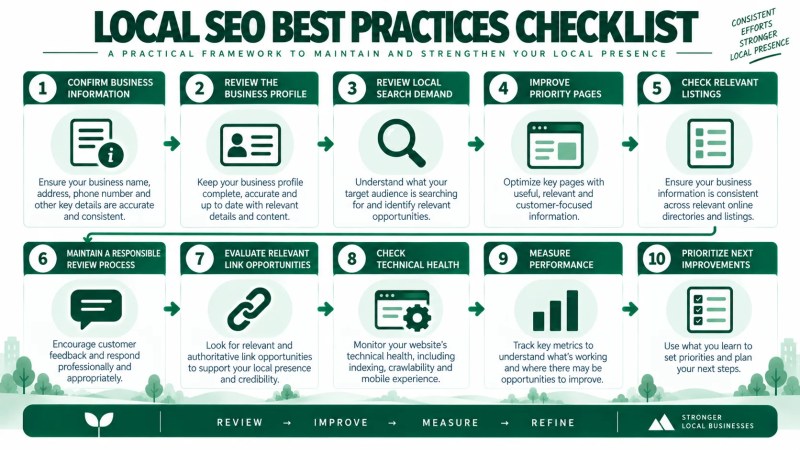
- Confirm core business information. Make sure important customer-facing details accurately reflect the business.
- Review the Business Profile. Check applicable profile information and customer-facing elements.
- Review search demand. Identify relevant services, customer needs, and local searches.
- Improve priority pages. Make important service and location pages useful, specific, and easy to navigate.
- Check relevant listings. Correct important outdated or conflicting business information.
- Maintain a responsible review process. Encourage genuine feedback without incentivizing or manipulating review content.
- Evaluate relevant link opportunities. Prioritize legitimate local and industry relationships rather than link practices intended to manipulate rankings.
- Check technical health. Review important pages for crawl access, indexing directives, internal linking, redirects, and HTTP error responses.
- Measure performance. Track useful visibility and customer-action data where reliable measurement is available.
- Prioritize the next improvements. Use business goals and observed performance to decide what deserves attention next.
Not every business needs to work through these items in the same order. An audit can help identify which weaknesses deserve attention first instead of treating every local SEO tactic as equally urgent.
Frequently Asked Questions
What are the most important local SEO best practices?
Important practices generally include maintaining accurate business information, managing an eligible Google Business Profile, researching relevant local searches, improving useful service and location pages, maintaining relevant listings, developing a responsible review process, evaluating legitimate link opportunities, checking technical issues, and measuring performance. Priorities should reflect the business’s current weaknesses and goals.
How often should local SEO be updated?
A practical maintenance schedule depends on the business, how frequently its information changes, and which local search elements need monitoring. Important business details should be reviewed when they change, while website health, reviews, listings, search visibility, and other areas can be checked at intervals appropriate to the business.
Does every location need its own SEO page?
No. A separate location page should have a genuine purpose and provide useful information for the audience it serves. Avoid creating substantially similar geographic pages simply to target many variations of city or regional searches.
Is Google Business Profile enough for local SEO?
A Business Profile can be an important part of local search visibility for eligible businesses, but local SEO may also involve the website, service and location content, reviews, business information on relevant third-party sources, links, technical health, and ongoing measurement.
Should local SEO focus on rankings?
Rankings can help evaluate search visibility, but they are only one type of measurement. Businesses can also review traffic to priority pages and measurable customer actions where reliable tracking is available.
Can a business do local SEO itself?
Many local SEO tasks can be handled internally when the business has the time, access, and knowledge required. More complex technical issues, larger multi-location websites, competitive research, or ongoing strategy may require additional expertise depending on the situation.
Make Local SEO an Ongoing Business Process
Local SEO works best as an ongoing maintenance process rather than a collection of isolated tactics. Keep business information accurate, maintain useful pages and profiles, support genuine customer feedback, build relevant relationships, protect the website’s technical foundation, and measure what changes.
Start with the issues most likely to affect customers or important search visibility, then refine the local search presence as the business, website, and market evolve.