

Local SEO marketing focuses on helping a business become easier to discover when potential customers search for relevant products or services in the areas the business serves. For service businesses, it can connect search visibility with the website, business information, customer reviews, local content, and the paths people use to enquire, call, request a quote, or book.
Local SEO is not the whole digital marketing strategy. It is one part of a broader system that may also include paid advertising, email, social media, referral marketing, content, and other channels. Understanding where local SEO fits can help businesses decide what it should accomplish and how it can support other marketing activity.
Quick Answer: Local SEO marketing is the use of local search optimization as part of a broader marketing strategy to help relevant customers discover and evaluate a business. Depending on the business, it can involve the website, an eligible Google Business Profile, service and location content, accurate business information, reviews, relevant links and mentions, technical website health, and performance measurement. These elements are most useful when they support the same services, markets, and customer journey rather than operating as disconnected tactics.
What Is Local SEO Marketing?
Local SEO marketing is the process of improving a business’s presence for relevant searches connected to the products or services it offers and the geographic areas it genuinely serves.
The work can involve several connected areas rather than one isolated tactic. Depending on the business, these may include:
- Service and location content on the website
- An eligible Google Business Profile
- Accurate customer-facing business information
- Relevant local keyword research
- Customer reviews
- Relevant links and mentions
- Technical website health
- Performance and conversion measurement
These components can support different parts of local discovery and customer evaluation. Traffisite’s local SEO basics guide explains the individual components in more detail.
How is local SEO marketing different from general SEO?
Local SEO places additional emphasis on geographic relevance and how a business serves customers in particular areas. A broader SEO strategy may target topics and audiences without the same local intent.
The distinction is not absolute. A service business can use both approaches on the same website. Some pages may target searches with clear local intent, while other resources may answer broader questions relevant to prospective customers regardless of location.
Traffisite’s comparison of local SEO vs traditional SEO provides a more focused explanation of where the approaches overlap and differ.
How Local SEO Fits Into Broader Digital Marketing
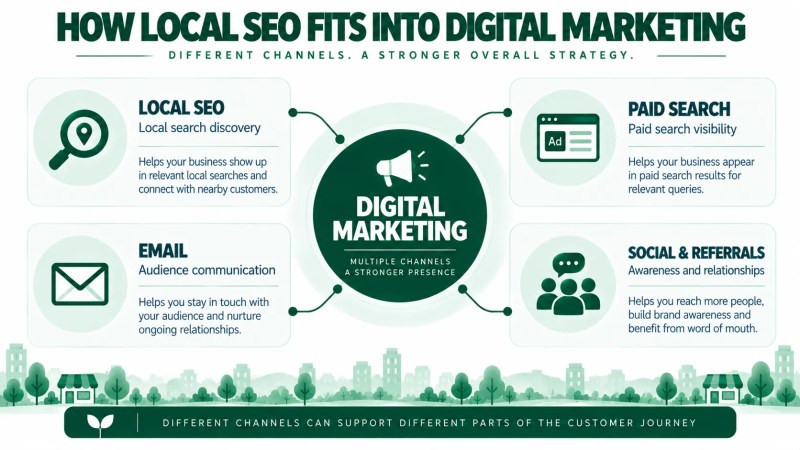
Digital marketing can use multiple channels to help a business attract, inform, and convert prospective customers. Local SEO contributes by focusing on organic discovery connected to relevant services and locations.
For example, a service business might use:
- Local SEO to improve its presence for relevant local searches
- Paid search to advertise for selected searches through paid placements
- Email marketing to communicate with an existing audience where appropriate
- Social media to distribute updates, content, or other business information
- Referral and relationship marketing to develop business through customers, partners, and professional relationships
These channels do not need to perform the same job. A business can decide which channels are appropriate according to its audience, resources, goals, and ability to measure results.
Local SEO can support other marketing activity
A useful website and accurate local presence can support customers who first encounter the business through another channel. Someone who sees an advertisement, receives a referral, notices a social post, or hears the business name elsewhere may later search for the company, its services, reviews, or contact information.
That means local SEO can support more than first-time discovery. It can also help maintain useful information that customers encounter while researching and evaluating the business.
Core Components of Local SEO Marketing
Website and service content
The website provides a controlled environment for explaining what the business offers, who it serves, where it operates, and what prospective customers should know before taking the next step.
Useful service pages should focus on genuine customer needs rather than simply targeting as many keyword variations as possible. Location pages should also have a meaningful purpose for people in the areas they represent rather than consisting of substantially similar pages created primarily to target geographic search variations.
Businesses serving local customers can review Traffisite’s framework for SEO for local service businesses for a broader view of website and search considerations.
Google Business Profile
For eligible businesses, Google Business Profile can provide customer-facing business information through Google Search and Maps. Depending on the business and applicable profile features, customer-facing information can include details such as the business name, website, phone number, hours, services, reviews, and service-area information.
Profile information should accurately represent how the business operates. Google’s guidance distinguishes service-area businesses that visit or deliver to customers without serving customers at the business address from hybrid businesses that both serve customers at their address and visit or deliver to customers.
Traffisite’s guide to Google Business Profile optimization provides a more detailed profile-review process.
Local keyword and content research
Local keyword research helps a business understand how relevant services, customer problems, and genuine service areas connect with search demand.
The goal is not to create a separate page for every phrase found in a keyword tool. Research should help determine which existing pages already satisfy important search needs, which pages need improvement, and where a genuinely useful new page may be justified.
A structured local SEO keyword research process can help organize those decisions.
Business information and citations
Customer-facing business information can appear on directories, industry websites, social platforms, and other third-party sources. Relevant listings may therefore need review when important details become inaccurate or outdated.
This does not mean a business needs to appear in every directory available. The priority should be useful and relevant sources. Traffisite’s guide to local SEO citations explains this area in more detail.
Reviews and customer feedback
Reviews can help prospective customers evaluate previous customer experiences. Businesses using Google reviews should follow Google’s applicable policies, including its rules addressing fake engagement and incentives connected with reviews.
A practical process can include requesting genuine feedback appropriately, monitoring new reviews, responding professionally where useful, and using available reporting processes when content appears to violate platform policies.
Traffisite’s guide to Google Business Profile reviews covers these considerations in greater depth.
Relevant links and relationships
Links and mentions can develop through legitimate business relationships such as professional associations, suppliers, industry organizations, local publications, partnerships, or community involvement.
The objective should not be to collect links indiscriminately. Businesses should avoid link practices intended primarily to manipulate Google Search rankings and focus on opportunities that make sense for the organization and its audience.
Traffisite’s guide to local SEO backlinks provides a more detailed framework for evaluating these opportunities.
Technical website health
Local SEO content still depends on a functional website foundation. Priority pages intended to appear in search should be reviewed for crawl access, indexing controls, internal links, redirects, and other technical issues that could prevent Google from properly crawling or indexing important URLs.
Technical SEO should support the site’s useful service and location content rather than operate as a substitute for it. Traffisite’s technical SEO guide explains the broader technical foundation.
How Local SEO Supports the Customer Journey
Local SEO marketing becomes easier to understand when viewed through the customer’s journey rather than as a list of isolated optimization tasks.
A potential customer may move through several stages:
- Need recognition. The customer identifies a service, problem, or need.
- Local discovery. The customer searches for relevant information, services, or businesses.
- Evaluation. The customer reviews websites, business information, services, reviews, and other available information.
- Action. The customer may call, submit a form, request a quote, book, visit, or take another relevant step.
Local SEO can support these stages, but it does not guarantee that every search impression or website visit becomes a customer. Service relevance, pricing, availability, reputation, website experience, competition, and other business factors can also affect what happens after discovery.
For businesses specifically focused on turning local visibility into enquiries, Traffisite’s guide to local SEO lead generation explores the connection between search discovery and customer action.
Local SEO Marketing and Paid Search
Local SEO and paid search can both help businesses appear when potential customers are searching, but they operate differently.
Local SEO focuses on improving organic search presence and relevant local business information. Paid search uses advertising campaigns to compete for paid search visibility, with factors such as targeting, budget, and bidding configured within the advertising platform.
A business does not necessarily need to choose only one. The appropriate mix depends on factors such as budget, timing, search demand, competition, existing organic visibility, and the business’s ability to manage and measure each channel.
Traffisite’s comparison of SEO vs paid search provides a broader framework for evaluating the two approaches.
How to Build a Local SEO Marketing Strategy
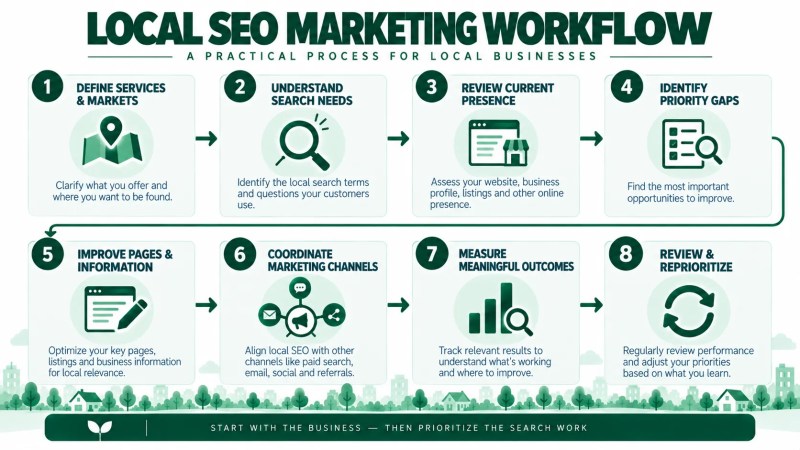
A local SEO marketing strategy should begin with the business rather than with a list of SEO tactics.
- Define the services and markets. Confirm what the business offers and where it genuinely operates.
- Understand customer search needs. Research the services, problems, questions, and locations relevant to potential customers.
- Review the current search presence. Examine the website, Business Profile where eligible, important business information, reviews, links, and technical condition.
- Identify priority gaps. Determine which issues are most important for customers and search visibility.
- Improve useful pages and information. Strengthen priority service, location, and supporting content where needed.
- Coordinate with other marketing channels. Keep important service, offer, brand, and contact information aligned where appropriate.
- Measure meaningful outcomes. Track relevant visibility, interactions, and customer actions using available reliable data.
- Review and reprioritize. Use performance, business changes, and new problems to determine the next work.
For businesses that need a broader framework for prioritizing these activities, Traffisite’s guide to local SEO strategies explains how individual tactics can be organized into a more deliberate plan.
How to Measure Local SEO Marketing
Local SEO marketing should not be evaluated from one metric alone. Different measurements answer different questions about discovery, engagement, and business outcomes.
Depending on the business’s goals, eligibility, analytics setup, and available data, useful measurements may include:
- Visibility for relevant local searches
- Organic traffic to priority service and location pages
- Search queries associated with important pages
- Available Business Profile performance information for verified profiles, where applicable
- Calls
- Form submissions
- Quote requests
- Bookings or other measurable customer actions
Search visibility can help assess discovery. Website and applicable profile data can provide information about online interactions. Where reliable conversion tracking is configured, businesses can also measure defined actions such as calls, forms, quote requests, or bookings.
Traffisite’s guide to local SEO reporting provides a more detailed framework for organizing local search performance information.
Measure channels without assuming causation
Marketing channels can interact with one another, but a customer action should not automatically be credited to local SEO simply because the customer used search at some point.
Businesses should use the best available analytics and conversion data, understand the limitations of their tracking setup, and avoid drawing conclusions that the available evidence cannot support.
Local SEO as Ongoing Marketing Work
Some local SEO improvements can be completed as individual projects. Examples may include correcting inaccurate business information, fixing technical issues, improving important pages, or restructuring parts of a website.
Other work may need periodic attention because businesses and their marketing environments change. Services, hours, locations, customer questions, reviews, competitors, website content, and performance can all change over time.
That does not mean every local SEO task needs constant activity. Review frequency and workload should reflect the business’s actual needs rather than an arbitrary publishing or optimization schedule.
Traffisite’s local SEO best practices guide provides a practical framework for maintaining important areas over time.
Frequently Asked Questions
Is local SEO a form of digital marketing?
Yes. Local SEO can be treated as one part of a broader digital marketing strategy focused on helping relevant customers discover and evaluate a business through local search.
What is the difference between local SEO and local marketing?
Local marketing is broader. It can include appropriate marketing activity aimed at customers in a geographic market, such as local SEO, paid advertising, email, social media, partnerships, referrals, sponsorships, print activity, or other channels. Local SEO focuses specifically on improving organic search presence and related local search information.
Can local SEO replace paid advertising?
Not necessarily. The channels operate differently and can serve different goals. Whether a business should use local SEO, paid advertising, or both depends on its objectives, budget, timing, market, existing visibility, and ability to manage each channel effectively.
Does local SEO marketing require a Google Business Profile?
No. Google Business Profile can be an important local search asset for eligible businesses, but local SEO can also involve the website, service and location content, technical SEO, relevant business information, reviews, links, and measurement. Google has eligibility requirements for Business Profiles, so not every business can use one.
How long does local SEO marketing take to work?
There is no universal timeline. The work required and the changes observed can vary according to the business’s starting position, website, market, competition, services, locations, technical condition, and the improvements being implemented. Specific ranking, traffic, or lead timelines should not be treated as guaranteed.
Can a service business manage local SEO internally?
Some businesses can manage basic local SEO internally when they have sufficient time, access, knowledge, and processes. More complex technical work, competitive research, multi-location strategies, content programs, authority development, or ongoing measurement may require additional expertise.
Make Local SEO Part of the Marketing System
Local SEO marketing is most useful when it supports the same business goals as the rest of the marketing strategy. The website, business information, search presence, reviews, content, and measurement should help prospective customers understand what the business offers, where it operates, and how to take the next step.
Instead of treating local SEO as a collection of isolated ranking tactics, businesses can use it as one part of a broader system for local discovery and customer evaluation. Start with the services and markets that matter, strengthen the most important search assets, measure meaningful outcomes, and coordinate the work with other marketing activity where appropriate.