

Local SEO works best when the major parts of your local search presence support each other. Improving a Google Business Profile while ignoring the website, publishing local content without a clear keyword strategy, or building citations without checking business information can leave important gaps.
A practical local SEO strategy coordinates the website, Google Business Profile, local relevance, reviews, citations, links, and measurement around the customers and locations the business actually serves. Businesses looking for help coordinating these activities can explore Traffisite’s local SEO services.
Quick Answer: A practical local SEO strategy starts with clear business and location information, a useful website structure, relevant local pages and content, an accurate Google Business Profile, consistent citations, a responsible review process, relevant links, and ongoing measurement. The goal is to coordinate these areas rather than rely on a single local SEO tactic.
Start With Local Search Goals
Before choosing local SEO tactics, define what the strategy is supposed to support. A service business may want more visibility for high-value services, stronger visibility in specific service areas, more qualified enquiries, or better discovery by people searching nearby.
The goal affects what should be prioritized. A business trying to improve visibility for an established location may need a different plan from a company expanding into additional service areas.
Start by clarifying:
- Which services matter most?
- Which locations or service areas does the business actually serve?
- Which customer searches are relevant to those services?
- Which pages should satisfy those searches?
- What actions should potential customers take after finding the business?
This gives individual local SEO tactics a common direction. For a broader foundation, Traffisite’s local SEO guide explains the major concepts involved in local search optimization.
Build the Website Foundation
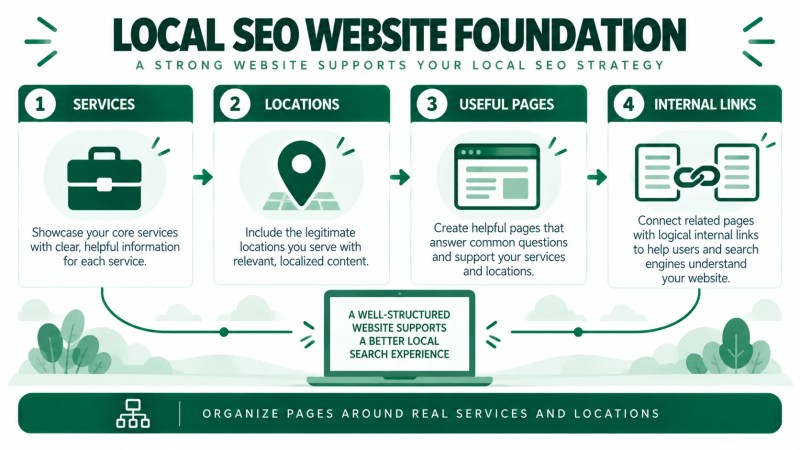
The website should clearly explain what the business does, where it operates, and how customers can take the next step. Local SEO becomes harder to coordinate when services, locations, and supporting information are scattered across unclear or overlapping pages.
Map Services and Locations to Useful Pages
Review the services the business offers and the geographic areas it legitimately serves. Then determine which searches deserve dedicated pages and which can be addressed within existing content.
Avoid creating substantially similar geographic pages primarily to capture similar city or regional searches and funnel visitors toward the same destination. Google lists certain region- or city-targeted funnel pages and substantially similar pages among examples of doorway abuse.
Each location page should have a genuine purpose for the customer and accurately represent the business’s service coverage.
Businesses can use local SEO keyword research to understand how relevant services and geographic intent appear in search demand before deciding what content to create or improve.
Keep the Site Structure Understandable
Important service and location pages should fit into a logical website hierarchy. Visitors should be able to understand how services, locations, supporting articles, and conversion pages relate to one another.
Internal links can reinforce those relationships by connecting useful supporting content with the pages that explain the business’s core services and locations. Traffisite’s internal linking guide covers how to approach those connections intentionally.
Check the Technical Foundation
For pages intended to appear in Google Search, review whether Google can crawl the relevant content and whether important URLs are indexable. Redirects and canonicalization should also be checked where relevant so they do not unintentionally point Google toward a different URL or interfere with the intended site structure.
A broader SEO audit can help identify website issues that need to be prioritized before or alongside ongoing local optimization.
Manage Your Google Business Profile
For eligible businesses, Google Business Profile can be one part of a business’s presence in Google’s local search results. Google requires Business Profile information to reflect the business accurately and to represent it consistently with how it exists in the real world.
Depending on the business and the profile features available, important information to review may include:
- Business name
- Address or service-area setup
- Business categories
- Hours
- Phone number
- Website destination
- Services and other applicable business information
- Photos and branding
Profile work should not be treated as a one-time setup task. Business information can change, and the options available on a Business Profile may also vary over time or by business. A recurring review process helps identify information that needs attention.
Traffisite’s guide to Google Business Profile optimization covers the profile-specific areas businesses can evaluate in more detail.
Strengthen Local Relevance
A business can strengthen the local context of its online presence by clearly communicating the relationship between its services and the places it actually serves. That information can appear across service pages, location content, supporting articles, Business Profile information, and other relevant sources.
Create Content Around Real Customer Needs
Local content should answer questions that matter to prospective customers rather than simply repeating a city name and service keyword.
Useful topics may include:
- Service-specific questions
- Pricing considerations
- Preparation or maintenance guidance
- Local service considerations
- Comparisons between relevant options
- Problems customers commonly need solved
Supporting content can strengthen the wider site when it connects naturally to relevant service and location pages rather than existing as an isolated collection of blog posts.
Avoid Creating Pages Without a Distinct Purpose
More pages do not automatically create a stronger local SEO strategy. Before creating a new page, determine what search need it serves, how it differs from existing pages, and where it belongs within the website.
This is especially important for service-area businesses considering large numbers of similar geographic pages.
Coordinate Citations, Reviews, and Links
The business’s online presence extends beyond its own website and Business Profile. Accurate business information on relevant third-party platforms can help customers find consistent details, reviews can help prospective customers evaluate the business, and relevant links can connect the site with other useful sources across the web.
Maintain Accurate Local Citations
When business information appears on directories and other relevant third-party platforms, review important details for accuracy rather than treating directory submissions as a volume exercise.
Compare important details with the business’s current information and correct meaningful inconsistencies where possible. Traffisite’s guide to local SEO citations explains this area in more detail.
Build a Sustainable Review Process
Google says reviews can provide potential customers with helpful information and that reviews appear alongside Business Profiles in Search and Maps. Businesses can ask customers for reviews, but review activity should follow Google’s applicable policies.
Review management should focus on genuine customer experiences. Google prohibits offering incentives in exchange for customers posting reviews, changing reviews, or removing negative reviews.
For Google-specific considerations, see Traffisite’s guide to Google Business Profile reviews.
Earn Relevant Local and Industry Links
Link building for a local business should focus on relevant opportunities rather than collecting unrelated links simply to increase a count.
Potential opportunities can come from legitimate business relationships, industry organizations, local organizations, partnerships, useful resources, sponsorships, or editorial mentions where there is a genuine connection.
A local SEO backlinks strategy can be reviewed separately when the business is ready to strengthen this part of its local search program.
Measure Local SEO Performance
A strategy needs measurement so the business can distinguish completed tasks from meaningful progress.
The exact metrics worth monitoring depend on the business and its goals, but a local SEO review may consider areas such as:
- Relevant organic search visibility
- Performance of priority service and location pages
- Search traffic to locally relevant pages
- Customer actions and enquiries from organic search
- Available Business Profile performance data for verified profiles
- Review activity and customer feedback
- Technical issues affecting important pages
Google provides Business Profile performance information for verified profiles, although the available metrics can vary depending on what applies to the business.
A report should provide enough context to support decisions rather than presenting metrics without explaining what changed or what should happen next. Traffisite’s guide to local SEO reporting covers how businesses can think about measurement more practically.
A Practical Local SEO Strategy Workflow
Instead of treating local SEO as a collection of unrelated tasks, organize the work into a repeatable sequence.
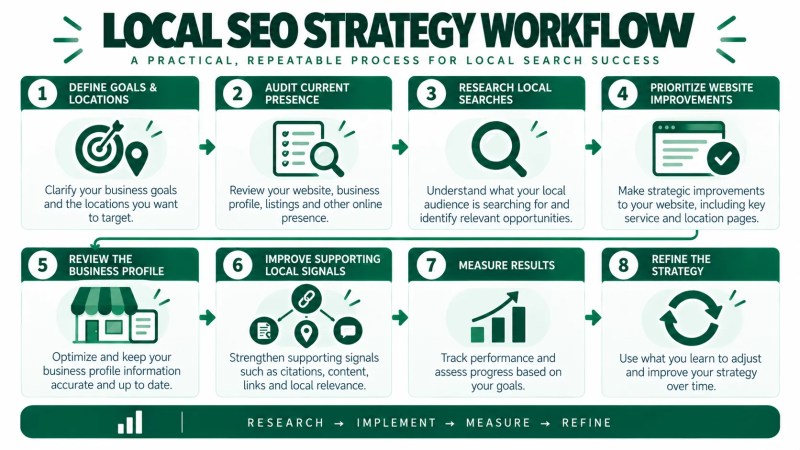
- Define the business goals and priority locations. Decide which services, customers, and geographic areas the strategy needs to support.
- Audit the current local search presence. Review the website, important pages, Business Profile, citations, reviews, links, and available performance data.
- Research relevant local searches. Identify the service and location intent that matters to the business.
- Prioritize website improvements. Improve important service, location, conversion, and supporting pages before creating unnecessary new content.
- Review the Business Profile. Check whether profile information accurately represents the business and its current operations.
- Improve supporting local signals. Address relevant citations, review processes, content opportunities, and link opportunities.
- Measure the results. Monitor the metrics that connect most closely to the business’s local search goals.
- Refine the strategy. Use performance data, business changes, and newly identified problems to determine the next priorities.
Businesses that need a more structured evaluation can also use a local SEO audit to identify gaps before prioritizing the next round of work.
Frequently Asked Questions
What are local SEO strategies?
Local SEO strategies are coordinated approaches for improving how a business is represented and discovered in relevant local searches. They can involve the website, Google Business Profile, locally relevant content, citations, reviews, links, and measurement.
What local SEO tactics should a business start with?
Start with the areas most likely to limit the current strategy. That may include inaccurate business information, weak service or location pages, an incomplete Business Profile, technical website problems, inconsistent citations, or a lack of useful local content. An audit can help determine the order rather than assuming every business needs the same first tactic.
Is Google Business Profile enough for local SEO?
No single profile or tactic represents the entire local SEO process. A broader strategy can include the website, Business Profile, reviews, citations, relevant links, content, and measurement. The appropriate mix depends on the business and its local search goals.
How many location pages should a business create?
Choose the number of location pages based on genuine customer and search needs rather than a predetermined SEO quota. Each page should have a distinct purpose and useful information for the area it represents. Avoid substantially similar city or regional pages created mainly to funnel visitors toward the same destination.
How long does a local SEO strategy take to work?
Avoid relying on a guaranteed local SEO timeframe. How quickly meaningful changes become visible can depend on the work being implemented, the site’s starting condition, the market, and how search systems recrawl and reassess relevant pages. Use ongoing measurement to evaluate progress instead of assuming a fixed timeline.
Should local SEO be a one-time project?
Some issues can be fixed once, but local SEO often benefits from continued review because business information, websites, customer needs, platform features, and search performance can change over time.
Build Local SEO as a Coordinated System
A useful local SEO strategy is not simply a checklist of disconnected tactics. Start with the services and locations that matter to the business, make sure the website and Business Profile communicate them clearly, strengthen supporting local information, and measure whether the work is moving the business toward its goals.
Priorities should change as problems are fixed and new opportunities appear. Treat local SEO as an ongoing system of research, implementation, measurement, and refinement rather than a series of isolated tasks.