

Local search optimization is the process of improving a business’s website and online presence so it can be more relevant and useful for searches connected to the products or services it offers and the geographic areas it genuinely serves.
For service businesses, that work can extend beyond adding city names to pages. It may involve understanding local search demand, improving service and location content, maintaining accurate business information, managing an eligible Google Business Profile, earning genuine reviews and relevant authority, addressing technical website issues, and measuring whether the work supports meaningful business outcomes.
Quick Answer: Local search optimization helps a business strengthen its presence for geographically relevant searches. Depending on the business, this can involve improving website content and structure, optimizing an eligible Google Business Profile, maintaining accurate business information, developing useful service and location pages, managing reviews, building relevant links and mentions, addressing technical SEO issues, and measuring local search performance.
What Is Local Search Optimization?
Local search optimization is the practical work of improving the website, business information, profiles, and other search assets that support a broader local SEO strategy. It focuses on helping those assets accurately represent the business, its services, and the geographic markets it genuinely serves.
The exact work depends on how the business operates. A company serving customers at a physical location may have different local-search needs from a service-area business that travels to customers. A business operating in one market may also require a different website structure from a company with multiple genuine locations or service areas.
Traffisite’s local SEO basics guide provides a broader introduction to the components that can support local visibility.
Local search optimization is more than adding location keywords
Geographic wording can help explain where a business operates, but inserting city names repeatedly does not create a useful local search strategy by itself.
Effective optimization starts with understanding what the business offers, where it genuinely serves customers, what people in those markets search for, and which pages or business information can best satisfy those needs.
This makes local search optimization a combination of relevance, useful content, accurate information, website organization, and ongoing review rather than a single on-page technique.
Understand Local Search Intent Before Optimizing
Before changing pages or creating new content, identify the searches that matter to the business. Some local searches state a place directly, while others may still be relevant to a local business without including a city or other geographic term.
A prospective customer might search for:
- A service combined with a city, suburb, or other geographic term
- A type of business near a particular place
- A service without explicitly naming a location when the search still has local relevance
- A question related to a service before deciding which provider to contact
- A specific business name, location, phone number, hours, or other business information
The goal is to understand these search needs before deciding what to optimize. Keyword research can help organize services, topics, and geographic demand without requiring a separate page for every keyword variation.
Traffisite’s guide to local SEO keyword research explains how businesses can approach this research more systematically.
Match search needs to the right page
After identifying relevant searches, determine which existing page should satisfy each important need.
A core service query may belong on a service page. A genuinely location-specific need may justify a useful location page. An informational question may be better answered through a guide or blog article.

This approach helps avoid creating multiple pages that attempt to satisfy essentially the same customer need.
Optimize Your Website for Local Search
The website should clearly communicate what the business does, where it operates, and how prospective customers can take the next step.
Local website optimization can include improving:
- Core service pages
- Useful location or service-area pages where justified
- Page titles and headings
- Page copy and supporting information
- Internal links
- Contact and business information
- Calls to action
- Technical accessibility for important pages
The objective is not to place the target location in every possible element. The page should first provide a clear and useful answer to the searcher’s need.
For service businesses, Traffisite’s framework for SEO for local service businesses provides additional guidance on connecting website structure with local search needs.
Create useful service pages
Each important service should have enough useful information for a prospective customer to understand what is offered and determine whether the business may be relevant to their needs.
A service page can explain the service, appropriate use cases, process, important considerations, service availability, and the next step for contacting the business. The exact information should reflect the real service rather than a fixed SEO template.
Use location pages when they have a real purpose
Location pages can be useful when a business genuinely operates in multiple markets and can provide meaningful information for customers in those areas.
A useful location page should do more than replace one city name with another. It may explain the services available in that market, relevant service-area information, location-specific considerations, or other details that genuinely help prospective customers.
Businesses should avoid creating substantially similar pages for multiple cities or regions primarily to capture similar searches or funnel visitors toward the same destination. A new location page should instead have a distinct and useful purpose for people in the market it represents.
Strengthen internal linking
Internal links help connect related service, location, and informational content. They can also give visitors clear paths to related pages and help search engines discover important URLs.
Use descriptive anchors where they naturally help the reader. Traffisite’s internal linking guide provides a broader framework for planning these connections.
Optimize an Eligible Google Business Profile
For eligible businesses, Google Business Profile can be an important part of local search optimization because it provides business information that customers may encounter through Google Search and Maps.
Businesses should accurately represent how they operate and keep applicable profile information current. Depending on the business and available profile features, useful areas to review can include core business information such as the website, phone number, hours, services, reviews, and other applicable profile details.
Traffisite’s guide to Google Business Profile optimization provides a more detailed review process.
Make the profile match the real business
The profile should accurately represent the real business customers interact with. Names, addresses, service areas, categories, and other profile information should reflect how the business actually operates.
Service-area and hybrid businesses should also configure their address and service-area information according to Google’s applicable requirements.
Keep Important Business Information Accurate
Customers may encounter business information in more places than the company’s own website. Relevant directories, industry websites, social platforms, mapping services, and other third-party sources can contain names, addresses, phone numbers, websites, hours, or other details.
When important information changes, businesses should review the sources that matter to their customers and correct inaccurate details where possible.
This does not mean submitting the business to every directory available. A focused approach prioritizes relevant, legitimate sources rather than accumulating listings without considering their usefulness.
Traffisite’s guide to local SEO citations explains how business listings fit into local SEO.
Build Reviews and Relevant Local Authority
Local search optimization also includes signals and information that exist beyond the business’s own website.
Develop a genuine review process
Customer reviews can provide useful information to people evaluating a business. A practical review process may include appropriately requesting genuine feedback, monitoring new reviews, responding professionally where useful, and addressing content that appears to violate applicable platform policies through available reporting processes.
Businesses should follow the policies of the review platform they use. For Google reviews, this includes rules addressing fake engagement and prohibited incentives.
Traffisite’s guide to Google Business Profile reviews covers review management in more detail.
Earn relevant links and mentions
Relevant links and mentions may develop through legitimate relationships with industry organizations, professional associations, suppliers, partners, local publications, community organizations, or other businesses.
The goal should not be to acquire links simply because a website can provide one. Opportunities should make sense for the business and its audience, and businesses should avoid link practices intended primarily to manipulate search rankings.
Traffisite’s guide to local SEO backlinks provides a framework for evaluating these opportunities.
Support Local Search Optimization With a Technical Foundation
Local search optimization also depends on a website foundation that allows important pages to be accessed, crawled, and considered for indexing by search engines.
Businesses should periodically review issues such as:
- Crawl access for important pages
- Indexing directives
- Internal links to priority content
- Redirects after URL changes
- Broken links and unavailable pages
- Duplicate or unnecessary URLs
- Mobile usability and general website functionality
Technical SEO does not replace useful local content, but technical problems can interfere with how important pages are discovered, crawled, or indexed.
Traffisite’s technical SEO guide explains the broader technical considerations.
Measure Local Search Performance
Local search optimization should be measured against the business’s actual goals rather than one isolated SEO metric.
Depending on the business’s analytics setup, eligibility, and available data, useful measurements may include:
- Visibility for relevant local searches
- Organic traffic to priority service and location pages
- Search queries associated with important pages
- Available Business Profile performance information for verified profiles, where applicable
- Calls
- Form submissions
- Quote requests
- Bookings or other measurable customer actions
These measurements answer different questions. Search visibility can provide information about discovery, while website and applicable profile data can help evaluate interactions. Properly configured conversion measurement can track defined customer actions.
Traffisite’s guide to local SEO reporting provides a more detailed framework for organizing this information.
Avoid judging local SEO from rankings alone
A ranking position does not explain the entire customer journey. Businesses should consider whether relevant pages are being discovered, whether prospective customers engage with useful information, and whether measurable business actions are occurring.
Performance should also be interpreted carefully because search visibility and customer actions can be influenced by factors beyond the SEO work itself.
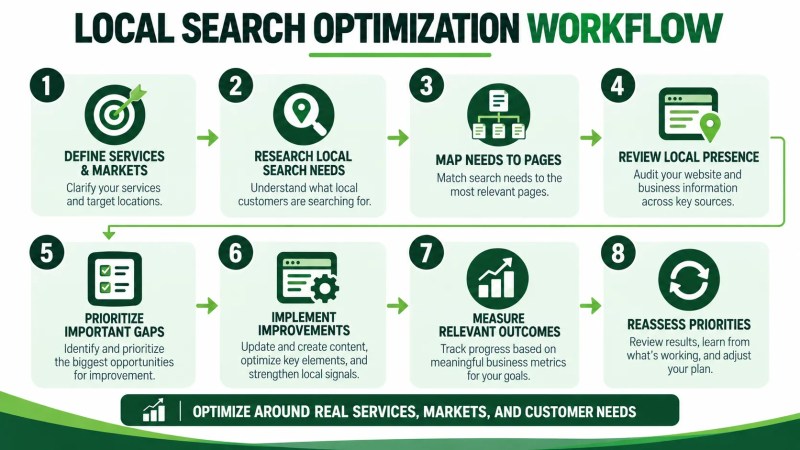
Build an Ongoing Local Search Optimization Process
Local search optimization is easier to manage when the work is organized around priorities rather than a collection of disconnected tasks.
- Define services and genuine markets. Confirm what the business offers and where it actually serves customers.
- Research local search needs. Identify relevant services, questions, topics, and geographic demand.
- Map needs to existing pages. Determine which URLs should satisfy important searches before creating new content.
- Review the local presence. Examine priority website pages, an eligible Business Profile, business information, reviews, authority, and technical condition.
- Prioritize important gaps. Focus on issues that matter most to customers and search visibility.
- Implement useful improvements. Update pages, information, internal links, profile details, or technical elements where justified.
- Measure relevant outcomes. Review available search, interaction, and conversion data.
- Reassess priorities. Use new information, business changes, and performance to decide what should be addressed next.
For a more detailed diagnostic process, Traffisite’s local SEO audit guide can help businesses review the current state of their local search presence before prioritizing improvements.
Businesses that want a broader planning framework can use Traffisite’s guide to local SEO strategies to organize individual optimization activities into a more deliberate program.
Frequently Asked Questions
What is local search optimization?
Local search optimization is the process of improving a business’s website and relevant online presence for searches connected to its services and genuine geographic markets. It can include website content, business information, an eligible Business Profile, reviews, links and mentions, technical SEO, and measurement.
Is local search optimization the same as local SEO?
The terms are closely related and may sometimes be used interchangeably. In this guide, local search optimization refers specifically to the practical work of improving the website, business information, profiles, and other search assets within a broader local SEO strategy.
Does every local business need location pages?
No. Location pages should have a genuine purpose. A business may benefit from them when it serves distinct markets and can provide useful information for customers in those areas. Businesses should avoid creating substantially similar city or regional pages primarily to target similar searches or funnel visitors toward the same destination.
Does a business need a Google Business Profile for local search optimization?
No. Google Business Profile can be valuable for eligible businesses, but local search optimization can also involve the website, local content, business information, reviews, authority, technical SEO, and measurement. Google has eligibility requirements for Business Profiles.
How often should local search optimization be reviewed?
There is no universal schedule. Review frequency should reflect how often the business, website, services, locations, customer information, reviews, search demand, and performance change. Some issues require one-time fixes, while others benefit from periodic monitoring.
How long does local search optimization take?
There is no guaranteed timeline. The work required and the changes observed depend on factors such as the business’s starting position, website condition, market, competition, services, geographic coverage, and the specific improvements being implemented.
Optimize for Real Customers in Real Markets
Local search optimization should make a business’s online presence clearer and more useful for the customers and markets it genuinely serves. Start with real services and locations, understand the searches that matter, and improve the pages and business information that can best satisfy those needs.
From there, review the Business Profile where eligible, maintain important business information, develop genuine reviews and relevant authority, address technical problems, measure meaningful outcomes, and continue prioritizing improvements based on what the business actually needs.