

Local search results can reveal which businesses appear prominently for important services and markets. However, simply listing the companies that appear above your business does not explain why they are visible or what you should improve.
A useful local SEO competitor analysis examines the complete local presence of each relevant business. That includes search visibility, service and location pages, Google Business Profiles, reviews, citations, backlinks, content, and the path customers follow from discovery to enquiry.
Quick Answer: A local SEO competitor analysis compares your business with relevant local competitors across search results, website pages, Google Business Profiles, reviews, citations, backlinks, and customer experience. Its purpose is to identify useful gaps and priorities—not to copy competitors or assume that every difference explains their visibility.
What Is Local SEO Competitor Analysis?
Local SEO competitor analysis is the process of comparing your local search presence with businesses competing for similar customers, services, and geographic markets.
The analysis should investigate several connected areas:
- which businesses appear for commercially relevant local searches
- which services and locations their websites cover
- how their important pages are structured
- how their business profiles present their offers
- what customers discuss in their reviews
- whether their business information is consistent across important platforms
- which websites mention or link to them
- how easily a potential customer can understand the business and take the next step
This is not a search for one tactic that explains every result. A competitor may have several strong elements across its local presence, while another may appear prominently for only one service or market. Each observation should be investigated before it becomes a recommendation.
A structured local SEO strategy can use these observations to prioritize improvements that match the business’s actual services, customers, and operating areas.
Define the Market You Are Analyzing
Competitor research becomes unreliable when the market is too broadly defined. A company may compete with different businesses depending on the service, location, customer type, and urgency of the search.
Before collecting competitors, document:
- the specific service being investigated
- the location or service area being evaluated
- the intended customer type
- whether the search need is commercial or informational
- the device and approximate search location used during manual checks
- the date the observation was made
For example, a roofing company may face one set of competitors for emergency roof repair and another for commercial roof replacement. A pressure-washing business may compete with different providers across neighboring service areas.
Businesses serving several markets should analyze each priority market separately. The companies visible in one city may not be the same businesses competing in another. Traffisite’s article about local SEO for multiple locations explains why market-level distinctions matter when planning local visibility.
Identify the Right Local Competitors
Your closest business competitor is not automatically your most important search competitor. A company can compete with you commercially while having little organic or map visibility. Another company may appear repeatedly in search even if you rarely encounter it offline.
Build the comparison set from several sources:
- businesses appearing for priority service-and-location searches
- businesses appearing in local map results
- companies that customers frequently compare with yours
- established providers serving the same geographic market
- websites competing for useful informational searches related to the service
Separate direct service providers from directories, lead-generation sites, informational publishers, and other types of search competitors. They may all appear within the same results, but their business models, page purposes, and potential opportunities differ.
Start with a manageable group of direct competitors that repeatedly appear across commercially important searches. Record other domains separately when they reveal a useful content, citation, or backlink opportunity.

Review Local Search Visibility
Begin by examining searches that represent real customer needs. Avoid building the analysis around only one broad keyword.
Your search set may include:
- primary service plus location
- specialist service plus location
- urgent or problem-based searches
- service availability questions
- cost and planning searches
- comparison and decision searches
Local SEO keyword research can help organize these searches according to customer intent instead of treating every wording variation as a separate opportunity.
For each meaningful search, record which businesses appear, the type of result shown, the apparent page used, and whether the business appears across several related searches or only for a narrow query.
Google explains that local results are mainly based on relevance, distance, and popularity. These considerations work together, so one visible profile element or website difference should not be treated as the complete explanation for a competitor’s position.
Manual search observations are useful, but they should be treated as dated snapshots. Google explains that search results can differ because of factors such as time, location, device type, search context, and personalization. Avoid presenting one screenshot as proof of a permanent ranking position.
The purpose is to identify patterns that deserve further investigation. A business appearing across several closely related services may have a well-developed service structure. A competitor visible only within a specific market may have a stronger presence in that area. Neither observation proves the cause of its visibility by itself.
Compare Business Profiles
Google advises businesses to maintain complete and accurate Business Profile information so customers can understand what the business does, where it operates, and when it is available. Competitor analysis should examine profile accuracy, presentation, and customer usefulness without attempting to imitate another company’s information.
Review publicly visible elements such as:
- business name and primary presentation
- business category and relevant additional categories
- address or service-area presentation
- telephone number and website destination
- opening hours
- services or products displayed
- business description
- photographs and other original media
- questions and answers where visible
- review volume, recency, themes, and responses
Compare profile information with the corresponding website. The services, operating areas, contact details, and customer promises should not contradict one another.
Traffisite’s article on Google Business Profile optimization provides a broader framework for improving a profile using accurate and useful business information.
Do not copy a competitor’s category, description, services, or location settings without confirming that they accurately represent your own business. Google’s guidelines for representing a business require a profile to reflect the real business accurately, including its identity, address or service area, categories, hours, website, and telephone information.

Evaluate Websites and Important Pages
The website review should go beyond design preferences. Focus on whether each competitor helps customers understand what it offers, where it operates, why the service may be appropriate, and what to do next.
Start with the homepage, main service pages, priority location pages, contact path, and useful supporting resources.
Service-page coverage
Record which services receive dedicated pages and whether those pages represent genuinely distinct offers. Review the clarity of the headings, service explanations, customer problems addressed, process information, evidence, FAQs, and calls to action.
A competitor having more service pages does not automatically mean its strategy is stronger. Several overlapping pages may create repetition, while one comprehensive page may serve the customer more effectively.
Location-page coverage
Check whether location pages provide meaningful market-specific information or simply repeat the same template with a different place name. Useful distinctions may include service availability, local project considerations, confirmed examples, operating details, or genuinely relevant customer questions.
Supporting content
Review whether the website answers questions customers commonly ask before making an enquiry. Useful supporting content may explain problems, preparation, costs, options, maintenance, or what to expect from a project.
A local SEO content strategy should connect these resources with the services and locations they support rather than produce unrelated articles simply because competitors have active blogs.
Structure and customer journey
Follow the path from an informational article to a relevant service page and then to an enquiry action. Check whether navigation, contextual links, headings, and calls to action help the customer continue naturally.
If valuable pages are difficult to reach or disconnected from related topics, the problem may involve site structure or internal linking rather than missing content alone.
Analyze Reviews Carefully
Competitor reviews can reveal what customers value, what concerns appear repeatedly, which services are frequently discussed, and how businesses respond to feedback.
Review patterns instead of selecting only unusually positive or negative comments. Useful questions include:
- Which services are mentioned most often?
- What qualities do customers consistently appreciate?
- Which concerns or expectations appear repeatedly?
- How recent is the visible feedback?
- Does the business respond professionally?
- Do the reviews reflect the services emphasized on the website?
Do not copy review language or turn unverified competitor comments into factual claims. Use recurring themes to improve how your own website answers legitimate customer questions.
For example, if customers repeatedly value clear scheduling communication, that may indicate an opportunity to explain your own scheduling process more clearly. The resulting content should describe your actual process rather than imitate a competitor’s promise.
Traffisite’s article about Google Business Profile reviews provides additional guidance on building a responsible review-management process.
Review Citations and Business Information
Local citations are online mentions of a business’s identifying information. During competitor research, citation discovery can surface industry platforms, local organizations, professional associations, and established directories that may be relevant within the market.
Record potentially useful sources, but evaluate each one before pursuing a listing. Consider:
- relevance to the service or industry
- relevance to the geographic market
- whether real customers use the platform
- the accuracy and quality of existing listings
- whether the source is legitimate and maintained
- whether participation requires membership, verification, or sponsorship
Do not assume that every directory containing a competitor deserves your business information. A focused set of accurate and relevant listings is more practical to maintain than a large collection of unrelated directory submissions.
A local SEO citation review can help organize existing listings and identify information that requires correction or consolidation.
Examine Local and Relevant Backlinks
Backlink analysis can surface organizations, publications, suppliers, associations, partners, events, and community resources that mention competitors.
The objective is not to reproduce a competitor’s link profile. Instead, classify relevant sources and determine why the link exists.
Common relationship types may include:
- industry associations
- local chambers or business organizations
- supplier and manufacturer directories
- community partnerships
- local news coverage
- sponsorships and events
- professional contributions
- useful resources referenced by other websites
Ask whether your business has a genuine basis for a similar relationship. A competitor may have earned a mention through membership, a partnership, an event, a unique resource, or longstanding community activity. Without that underlying relationship, the apparent opportunity may not be available or appropriate.
Do not reproduce links solely because a competitor has them. Google defines link spam as links created to or from a site primarily to manipulate search rankings and identifies practices such as paid ranking links, excessive exchanges, automated links, and low-quality directory links.
Traffisite’s article about local SEO backlinks explains how relevant local relationships can support a broader authority-building strategy.
For businesses ready to turn competitor research into outreach, Traffisite’s relevant link-building opportunities and authority-building services can help guide the next steps.
Turn Observations Into Opportunities
A competitor spreadsheet is not useful until the observations become decisions. Separate genuine opportunities from differences that do not matter to the business.
Organize findings into four groups:
Missing foundations
These are important elements the business needs regardless of competitor activity. Examples may include an unclear primary service page, inaccurate business information, weak contact paths, or missing coverage for a commercially important service.
Customer-information gaps
These are questions competitors answer more clearly or subjects customers need help understanding. The appropriate improvement may be a stronger section, FAQ, service explanation, checklist, or supporting guide.
Market opportunities
These may include legitimate service areas, partnerships, relevant directories, or local subjects that competitors have not addressed adequately. Every opportunity still needs to match the company’s real operations.
Low-priority differences
Not every difference requires action. A competitor may offer services you do not want to provide, target customers outside your priorities, or publish content unrelated to meaningful enquiries.
Rank each useful opportunity according to customer importance, commercial relevance, effort, existing resources, and confidence in the evidence. Strengthen foundational service and location information before expanding into a large content or outreach program.
When the analysis needs to cover website content, technical accessibility, local information, and authority signals systematically, an SEO audit can help turn scattered observations into a prioritized improvement plan.
Local Competitor Analysis Workflow
A practical local SEO competitive analysis can follow these steps:
- Define the service and market. Specify the service, location, intended customer, and search need being evaluated.
- Create a relevant search set. Select a manageable group of commercial, problem-based, and planning searches.
- Identify recurring competitors. Record direct businesses appearing consistently across meaningful searches.
- Capture dated observations. Save the search, approximate location, result type, date, and relevant page.
- Review business profiles. Compare publicly visible services, categories, business information, media, reviews, and customer paths.
- Evaluate important website pages. Examine service coverage, location information, supporting content, evidence, and calls to action.
- Review citations and links. Classify relevant directories, organizations, partnerships, publications, and other mentions.
- Identify patterns and gaps. Separate repeated observations from isolated differences.
- Validate each opportunity. Confirm that it matches the company’s services, markets, customers, and resources.
- Prioritize improvements. Address important foundations before lower-value expansion.
- Implement without copying. Create original pages, information, media, and relationships based on the company’s own value.
- Measure and revisit. Monitor priority markets and update the analysis when business conditions or search results change.
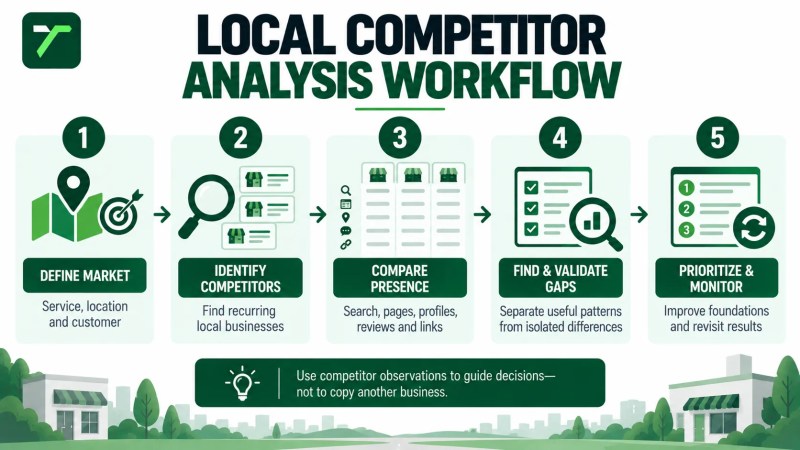
The scope should match the business. A company offering a small number of services in one market may need a focused comparison. A multi-location business may need separate reviews for its most important services and geographic markets.
Monitor the Right Competitors Over Time
Competitor analysis should be updated when it can inform a decision, not performed continuously without a purpose.
Useful reasons to revisit the analysis include:
- entering a new service or geographic market
- rebuilding important service or location pages
- investigating a sustained visibility change
- planning a content or authority-building campaign
- reviewing an underperforming local SEO strategy
- responding to meaningful changes in customer demand
Track the same priority searches and competitors where possible so comparisons remain useful. Record dates and avoid treating normal result variation as proof of a strategic change.
Measurement should remain tied to business outcomes. Visibility provides one part of the picture, while relevant visits, qualified calls, enquiry forms, booked work, and useful customer paths provide additional context for deciding whether an improvement is helping.
A broader local SEO reporting process can connect competitor observations with the website’s own visibility, engagement, enquiries, and ongoing priorities.
Frequently Asked Questions
What should a local SEO competitor analysis include?
It should evaluate relevant search visibility, Google Business Profiles, service and location pages, reviews, citations, backlinks, content, customer journeys, and the differences that matter to the business’s real services and markets.
Who are my local SEO competitors?
They are the businesses competing for visibility and customers across your important services and locations. They may not be identical to the companies you consider your closest offline competitors.
How many competitors should I analyze?
Start with a manageable group of direct businesses that repeatedly appear for commercially important searches. Add other websites only when they reveal a useful content, citation, or backlink opportunity.
Should I copy a competitor’s keywords and pages?
No. Competitor research should reveal customer needs and possible gaps, but your pages must reflect your own services, markets, processes, knowledge, and evidence. Copying a competitor can create inaccurate, repetitive, or undifferentiated content.
Can competitor reviews help with content planning?
Yes. Repeated review themes can reveal customer priorities, concerns, and terminology. Use those themes to improve how you explain your own verified services and processes rather than copying review language or competitor claims.
How often should competitor analysis be updated?
There is no universal schedule. Revisit it when entering a new market, planning major improvements, investigating sustained visibility changes, or reviewing strategy. Record dates because local search observations can change.
Use Competitor Research to Make Better Local Decisions
Local SEO competitor analysis is most useful when it explains the market without allowing competitors to define your strategy.
Examine the businesses that repeatedly appear for meaningful services and locations. Compare their profiles, pages, reviews, citations, backlinks, and customer journeys. Then validate every opportunity against what your company genuinely provides and what its customers need.
The goal is not to reproduce another company’s website or local presence. It is to make better decisions about your own services, markets, content, business information, authority, and customer experience.