

Local SEO becomes more complex when a business operates from multiple locations. Instead of maintaining one set of business information and one local presence, the company needs to keep each eligible location accurate, useful, and clearly connected to the part of the website that represents it.
The goal is not simply to duplicate the same local SEO setup across every market. Each real location should be represented accurately while the business maintains a consistent overall structure that can be managed as it grows.
Quick Answer: Local SEO for multiple locations usually involves managing each eligible location’s Google Business Profile, creating useful website pages for individual locations where appropriate, keeping important business information accurate, connecting locations through a clear website structure, and measuring performance by market. The system should be consistent enough to manage efficiently while preserving the real differences between locations.
How Does Local SEO for Multiple Locations Work?
Multi-location local SEO applies the same basic local search principles across more than one legitimate business location while keeping the information for each location distinct and accurate.
That can involve separate Business Profiles for eligible locations, dedicated website pages, locally relevant information, reviews, internal links, and measurement that allows the business to understand what is happening in each market. The broader local SEO guide explains how these elements fit into an overall local search strategy.
The challenge is balancing consistency with local accuracy. The brand, services, and overall website experience may be similar across locations, but addresses, phone numbers, hours, service availability, customer feedback, and other details can differ.
Traffisite’s local SEO services address the different elements that contribute to local search visibility, including the website and the business information associated with the markets a company serves.
Organize Google Business Profiles by Location
For businesses with multiple eligible locations, Google Business Profiles can represent individual locations in Google Search and Maps. Google’s Business Profile eligibility guidelines state that a business generally needs to make in-person contact with customers during its stated hours to qualify.
Google’s eligibility and representation requirements should determine whether a location qualifies for its own profile. Businesses should review those requirements rather than create additional profiles solely to expand their geographic coverage. Google’s guidelines for representing a business say not to create more than one profile for each business location and provide specific rules for storefront and service-area businesses. Traffisite’s Google Business Profile guidelines article provides additional context on the rules businesses need to consider.
For service-area businesses, Google says a business with different locations, separate service areas, and separate staff at each location may have one profile for each qualifying location.
Where multiple locations legitimately qualify, each profile should accurately represent the location it belongs to. Relevant details such as the business name, address or service area where applicable, phone number, hours, website destination, and other business information should reflect how that location actually operates. Category selection also needs to follow Google’s consistency requirements: all locations must share a primary category, and locations providing the same service should use consistent categories.

Businesses managing several profiles also need a repeatable process for updating them. A change to opening hours, contact information, services, or another operational detail should not leave outdated information attached to one location simply because it was missed during a broader update. Google also provides Business Profile Manager and bulk-management options for businesses managing multiple profiles.
Traffisite’s guide to Google Business Profile for multiple locations covers the profile-management side of this process in more detail.
Create Useful Pages for Individual Locations
A multi-location website often benefits from dedicated pages that help visitors understand the business’s presence in each market. These pages should represent real locations or meaningful local operations and provide information that helps visitors understand the location rather than exist primarily to target combinations of services and city names.
A useful location page can answer practical questions such as:
- Where is this location?
- Which areas does it serve?
- Which services are available there?
- How can customers contact the location?
- What hours or availability apply?
- Are there relevant details that differ from other locations?
Not every location page needs a completely different design. A consistent template can make a multi-location website easier to maintain. The important distinction is that each page should accurately represent its location and provide useful local information instead of relying on otherwise interchangeable copy with place names swapped.
This distinction matters because Google’s spam policies address doorway pages and scaled content created primarily to manipulate search rankings rather than help users. Google’s spam policies specifically include substantially similar regional or city pages that funnel visitors toward another destination as an example of doorway abuse.
If the company operates in several countries or broad markets, the same principle applies at a larger level: the website structure should help users move from broader geographic information to the specific location or service information they need.
Keep Location Information Accurate
Managing local information becomes increasingly important as the number of locations grows. A business may need to maintain addresses, phone numbers, opening hours, service areas, website destinations, and other operational information across its own website and external platforms.
The first step is to maintain a reliable internal source of truth for each location. Instead of checking individual profiles whenever someone needs an address or phone number, the business can maintain a central record of the approved information for every location.
That record can then be used when reviewing the website, Business Profiles, relevant directory listings, and other places where location information appears.
Traffisite’s guide to local SEO citations explains how business information can appear across external websites and why those references need to be managed carefully.
Make Each Location Locally Relevant
Consistency does not mean every location should have identical content.
A multi-location business should identify which differences genuinely matter to customers in each market. Depending on the business, those differences might include available services, operating hours, service areas, contact methods, local teams, facilities, processes, or questions customers commonly ask in that location.
Local relevance should come from real business differences and useful customer information rather than artificial geographic wording.
When individual locations have genuine community partners, supplier relationships, or local involvement, those connections may reveal local authority-building opportunities worth evaluating for their relevance to each market.
Keyword research can also help the business understand how people search across different markets. Search terminology and demand may vary by location, but those differences should be evaluated before creating additional pages. Traffisite’s local SEO keyword research guide explains how local search themes can be assessed more systematically.
Connect Locations Through a Clear Website Structure
As the number of locations increases, website structure becomes part of the local SEO problem.
A business with a few locations may be able to link directly to them from prominent navigation or service content. A larger organization may need a location hub that groups locations logically and helps users move from the broader business to the relevant market.
A simple structure might look like:
- Locations
- Region or country, when useful
- Individual location
- Relevant services or supporting information
The exact hierarchy depends on how the business operates. Important location pages should have useful crawlable internal links from other relevant parts of the website rather than being left isolated. Google’s link best practices recommend that every page a site owner cares about have a link from at least one other page on the site. Traffisite’s internal linking guide explains how contextual links can help connect related pages.
Traffisite’s website structure for SEO guide explains how hierarchy and page relationships can be organized across a growing website.
Manage Reviews Across Locations
Reviews can also become more complicated when a business has multiple locations because customer experiences and feedback may relate to a specific branch, office, or service area.
Businesses should make it easy for teams to understand which location a review belongs to and establish a consistent process for monitoring and responding to customer feedback.
That does not mean every location must receive the same number of reviews or follow an artificial review schedule. The aim is to manage genuine customer feedback consistently while preserving the connection between the review and the location where the experience occurred.
Businesses using Google Business Profiles should also follow Google’s policies for Maps user-contributed content. Google requires reviews to reflect genuine experiences and prohibits practices such as offering incentives in exchange for reviews. Traffisite’s guide to Google Business Profile reviews covers this topic in more detail.
Measure Performance by Location
Looking only at company-wide organic performance can hide meaningful differences between locations.
One location may attract strong search visibility but relatively few enquiries. Another may receive less traffic but generate more qualified customer actions. A newer location may still be building visibility while an established market already receives consistent search demand.
Where reliable tracking is available, businesses can review indicators such as:
- Search visibility for relevant location and service themes
- Organic traffic to individual location pages
- Calls or enquiries associated with particular locations
- Form submissions from location pages
- Appointment or consultation requests
- Other location-specific customer actions
These measures should be interpreted in context rather than used to assume that every market should produce identical results.
Traffisite’s SEO measurement and reporting guide provides a broader framework for connecting search performance with meaningful business outcomes.
Build a Process That Can Scale
The operational side of multi-location SEO becomes more important as a business grows.
With two locations, someone may be able to remember which pages and profiles need updating. With dozens of locations, relying on memory becomes much less practical.
A scalable process can include:
- A central record of approved information for every location
- A repeatable location-page template with room for genuine local differences
- Clear ownership of Business Profile updates
- A process for handling temporary and permanent hour changes
- Review-monitoring responsibilities
- Regular checks for outdated location information
- Location-level performance reporting
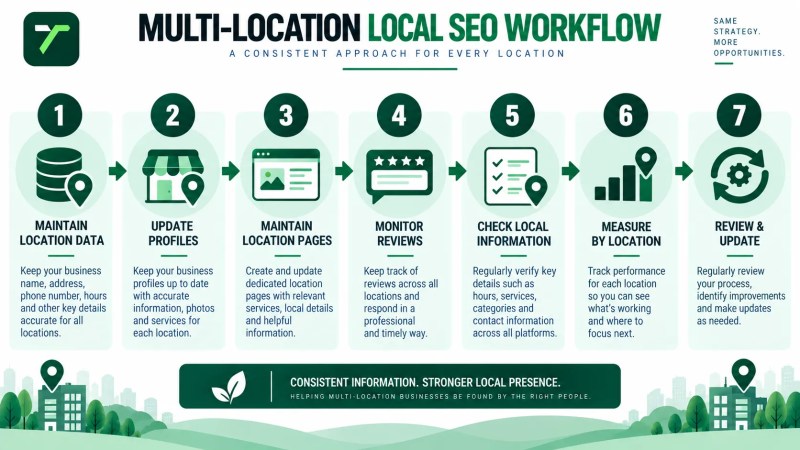
The objective is standardization without pretending every location is identical. Templates and processes should reduce avoidable administrative work while still allowing each location to be represented accurately.
Common Multi-Location Local SEO Mistakes
Many multi-location problems come from trying to scale too quickly without a clear structure.
Common issues include:
- Creating Business Profiles for locations that do not meet Google’s eligibility requirements
- Creating duplicate profiles for the same business location
- Using outdated addresses, phone numbers, or opening hours
- Using inconsistent primary categories across locations
- Creating large numbers of location pages primarily for search visibility while providing little useful location-specific information
- Leaving important location pages poorly connected to the rest of the website
- Sending users from a location-specific profile to an unrelated or overly broad website page
- Applying one market’s service information to every location without checking whether it is accurate
- Reviewing company-wide performance without examining meaningful differences between locations
A structured system makes these problems easier to identify because the business has clear expectations for how locations should be represented on the website and across relevant local platforms.
Frequently Asked Questions
Does every business location need its own Google Business Profile?
Not automatically. Whether a location is eligible for its own Business Profile depends on Google’s requirements and how the business operates there. Google generally requires businesses to make in-person contact with customers during their stated hours. Service-area businesses with different locations may have a profile for each location when those locations have separate service areas and separate staff.
Should every location have its own page?
A dedicated page is most useful when it represents a real location or meaningful local operation and provides information customers need. Creating pages primarily to target many geographic search variations without adding useful information can create low-value content and, in some cases, may conflict with Google’s spam policies.
Can multiple location pages use the same template?
Yes. A consistent template can make location pages easier to manage. The important part is ensuring that each page accurately reflects the relevant location and includes meaningful information where genuine differences exist.
Should location pages have different content?
They should contain different information where the underlying business details or customer needs differ. There is no need to manufacture uniqueness merely to make every sentence different. The more important objective is to make each page useful to people interested in that location.
How should multiple locations be organized on a website?
The appropriate structure depends on the number of locations and how the company operates. Businesses with many locations may benefit from a central location hub and additional regional organization where it genuinely helps users navigate to the correct location. Important location pages should also have crawlable internal links from relevant parts of the website.
How should a business measure multi-location local SEO?
Company-wide performance can provide an overview, but location-level measurement can reveal differences between markets. Where tracking supports it, businesses can review location-page traffic, search visibility, calls, forms, appointments, and other meaningful customer actions by location.
Build One Local SEO System Without Treating Every Location the Same
Local SEO for multiple locations works best when the business combines a consistent management system with accurate location-level information.
Business Profiles, location pages, contact details, reviews, internal links, and reporting should fit into one organized process. At the same time, each location should reflect the real services, availability, customer information, and market it represents.
That balance makes multi-location SEO easier to manage as the business grows while helping customers reach the information that is actually relevant to their location.