

A local business can publish dozens of pages and still leave potential customers without the information they need. The problem is often not a lack of content. It is a lack of coordination between the business’s services, markets, customer questions, and website pages.
A local SEO content strategy provides that coordination. It identifies which pages deserve to exist, what each page should accomplish, how location-specific information should be used, and how related pages should help customers move from research to enquiry.
Quick Answer: A local SEO content strategy organizes service pages, location pages, FAQs, guides, and supporting articles around the services a business provides, the markets it genuinely serves, and the questions local customers need answered. The goal is not to create a page for every keyword or city variation. It is to build useful, distinct content that supports discovery, customer decisions, and meaningful business outcomes.
What Is a Local SEO Content Strategy?
A local SEO content strategy is a plan for creating and maintaining website content that connects a business’s services with the locations and customers it can realistically serve.
It is broader than adding place names to headings. It determines which customer needs require dedicated service pages, when a location deserves its own page, which questions belong in FAQs or guides, and how all those resources should work together.
For a service business, the content system may include:
- core service pages
- location or service-area pages
- frequently asked questions
- problem-based articles
- planning and comparison guides
- project or service explanations
- locally relevant supporting information
Each type of content has a different role. Service pages explain what the company offers. Location pages clarify where and how those services are available. Supporting articles help customers understand problems, options, costs, preparation, and next steps.
A deliberate SEO content strategy helps coordinate those roles so that content supports the business instead of becoming a disconnected collection of pages.
Start With the Business, Not the Keyword List
Keyword research can reveal how people describe services and problems, but it should not define the business. Before deciding what to publish, establish what the company genuinely offers and where it can deliver those services.
Start by documenting:
- commercially important services
- supporting or specialist services
- the types of customers the business wants to serve
- real operating areas
- services available in each market
- common customer questions and concerns
- seasonal or regional considerations
- existing pages and content gaps
This prevents the content plan from expanding around search phrases that do not match the company’s operations. A business should not create a service page merely because a keyword has apparent demand if the service is not something the company wants, provides, or can explain usefully.
Similarly, a city should not receive a dedicated page solely because its name can be combined with a service keyword. The location should be genuinely served, and the page should have a clear purpose for customers in that market.
Businesses developing a broader local presence can use a local SEO strategy to coordinate website content with business information, local visibility, and ongoing market priorities.
Understand Local Search Needs
People searching for a local business are not always ready to contact one immediately. Their searches can reflect different problems and stages of a decision.
Common local search needs include:
- finding a provider for a specific service
- confirming whether a company serves a particular area
- understanding the cause of a problem
- comparing possible services or solutions
- learning what a project involves
- researching costs and planning factors
- checking availability, requirements, or preparation steps
- deciding whether professional assistance is appropriate
The page type should reflect the underlying need. A direct search for a service normally requires a useful commercial page. A question about symptoms or preparation may belong in a guide. A search focused on service availability within a particular market may justify location-oriented information.
Local SEO keyword research can help identify these patterns, but phrases should be grouped according to meaning rather than treated as instructions to create a separate page for every variation.
This is also why service pages and blog posts should not be interchangeable. A service page represents an offer, while an article usually helps a reader understand a related question, problem, or decision.
Build Strong Service Pages
Service pages form the commercial foundation of a local content strategy. They should help customers understand what the business does, whether the service matches their situation, and what they can do next.
A useful service page may explain:
- what the service is
- which problems or needs it addresses
- who the service is suitable for
- what the work may involve
- important options or limitations
- factors that can affect the project
- relevant service areas
- frequently asked questions
- an appropriate enquiry or booking step
The business does not necessarily need a separate page for every wording variation. If two proposed pages describe substantially the same service, satisfy the same customer need, and require nearly identical information, one stronger page may be more useful than several overlapping pages.
Where two services involve meaningfully different work, customers, considerations, or next steps, separate pages may be justified. The distinction should come from the services themselves, not from a desire to repeat keywords across more URLs.
On-page SEO can help clarify the purpose of each important service page through its headings, content, metadata, and alignment with the customer need it is intended to address.

Create Location Pages Carefully
Location pages can be useful when a business serves multiple legitimate markets and customers need market-specific information. They should provide more value than replacing one place name with another.
Before creating a location page, ask:
- Does the business genuinely serve this location?
- Which services are available there?
- Is the market commercially important?
- Do customers in this area need distinct information?
- Can the business provide real local evidence or context?
- Would the page remain useful without repeating the city name?
A location page may include the services available in the area, relevant coverage information, realistic project considerations, appropriate local examples, commonly asked questions, and a clear way to contact the business.
The exact information should reflect the company. For example, one business may offer every service throughout its operating area, while another may provide certain services only within a smaller radius. The website should communicate those differences accurately.
Google’s guidance for service-area and hybrid businesses explains that a service area shows customers where a business can provide its products and services. Google also advises businesses to make their selected service areas as specific and accurate as possible. Website content should follow the same practical principle by representing real operating coverage rather than aspirational or artificial markets.
Location pages also require maintenance. If service coverage, contact details, staffing, operating practices, or available services change, affected pages should be reviewed rather than left to present outdated information.

Use FAQ Content to Resolve Real Questions
Frequently asked questions are useful when they address genuine uncertainty. They can appear within service pages, location pages, guides, or a dedicated resource when that structure genuinely helps users.
Useful FAQ topics may include:
- service availability
- project preparation
- what is included or excluded
- timing and scheduling considerations
- factors affecting price or scope
- materials, access, or property requirements
- what customers should expect next
An FAQ should provide a direct answer rather than restating a keyword as a question. It should also appear on the page where the answer is most useful. A question specific to one service normally belongs near that service, while a broader policy or process question may be appropriate elsewhere.
Do not create repetitive FAQ blocks across every location page merely to make the pages longer. If the answer does not vary by location, it may be better maintained on the relevant service page or supporting guide.
Develop Useful Guides and Supporting Content
Supporting content can help customers before they are ready to enquire. It can explain problems, options, preparation, comparisons, maintenance, or the decisions surrounding a service.
Potential formats include:
- problem-and-symptom guides
- project preparation checklists
- service or material comparisons
- cost-factor explanations
- maintenance guidance
- seasonal considerations
- what-to-expect articles
- decision guides
Every supporting article should have a defined relationship with the business. Before approving a topic, ask which customer question it answers, which service it supports, whether an existing page already covers the need, and what useful next step should follow.
This helps prevent random publishing. Traffisite’s guide to topical authority and topic clusters explains how related service and informational pages can be developed as a connected subject area instead of a collection of isolated posts.
Google recommends creating helpful, reliable, people-first content rather than search-engine-first content created primarily to gain rankings. For a local service business, that means using genuine knowledge to help the intended customer rather than creating articles solely to attract search traffic.
Strengthen Content With Genuine Local Evidence
Local relevance is more credible when it comes from real business activity rather than repeated geographic wording.
Depending on what the business can verify and publish appropriately, useful local evidence may include:
- original photographs from completed work
- project examples with permission
- service-area details
- locally relevant property or project considerations
- accurate information about service availability
- real questions received from customers in the market
- team knowledge gained from serving the area
Evidence should not be manufactured. Do not assign a project, testimonial, review, photograph, or result to a location unless the business can confirm the relationship.
Original screenshots can also strengthen educational content when they demonstrate a real process, page, business profile, or search feature. Any private information should be removed, and the screenshot should be used to clarify the discussion rather than simply decorate the article.
This approach is particularly useful for local service businesses, where the website needs to reflect the connection between actual services, real operating markets, and customer needs.
Connect Related Local Content
A good content plan defines how pages relate to one another. Important services, markets, and supporting resources should not exist as isolated destinations.
A practical structure might connect:
- a main services section to individual service pages
- service pages to relevant service-area information
- location pages to the services available in that market
- guides to the service that addresses the problem being discussed
- service pages to useful planning or comparison resources
For example, an article explaining the causes of a common problem can link to the service that resolves it. The service page can link to a preparation guide when that information helps customers understand what happens next.
These relationships can be reinforced through navigation, contextual links, breadcrumbs where appropriate, and a logical hierarchy. Traffisite’s internal linking guide explains how links can help readers and search engines move between related pages.
Internal links should be added because the destination continues or clarifies the subject. Repeating the same collection of links on every page without considering context does not create a useful customer journey.
Avoid Repetitive and Unnecessary Pages
Local content can become difficult to manage when a business creates many pages from the same template and changes only the city or service wording.
Warning signs include:
- multiple pages satisfying the same search need
- location pages with no meaningful local distinction
- service pages that describe identical work
- FAQ sections copied across many URLs
- articles that repeat information already covered elsewhere
- pages created without a clear role in the customer journey
Google defines doorway abuse as sites or pages created to rank for specific, similar queries that lead users to less useful intermediate pages. Its examples include pages targeted at regions or cities that funnel users to one page and substantially similar pages that sit closer to search results than a clear, browsable hierarchy. Location content should therefore be planned around genuine customer usefulness, not mass-produced geographic variations.
When several existing pages overlap, the solution may involve strengthening one primary page, differentiating pages that serve truly different needs, or consolidating content where appropriate.
A content strategy should also include review and removal decisions. Creating new pages is not always the best next step. Existing pages may need improvement, consolidation, redirection, or retirement.
A Practical Local Content Workflow
A manageable local SEO content process can follow these steps:
- Document the business. List real services, priority customers, operating areas, limitations, and commercial goals.
- Inventory existing content. Record current service, location, FAQ, guide, and article pages.
- Research customer needs. Group searches and questions by their underlying intent rather than individual wording.
- Map needs to page types. Decide whether each important need belongs on a service page, location page, FAQ, guide, or existing page.
- Identify genuine gaps. Separate missing content from topics already covered adequately.
- Prioritize commercial foundations. Improve important service and market pages before expanding into a large publishing schedule.
- Create supporting resources. Develop articles and guides that answer real questions surrounding priority services.
- Add genuine local context. Use confirmed service information, original media, project knowledge, and appropriate local evidence.
- Connect related pages. Add useful navigation and contextual internal links.
- Review for overlap. Confirm that every page has a distinct purpose and does not unnecessarily compete with another page.
- Publish and verify. Check formatting, links, metadata, mobile presentation, and indexing settings.
- Measure and update. Use search and enquiry information to determine what needs improvement next.
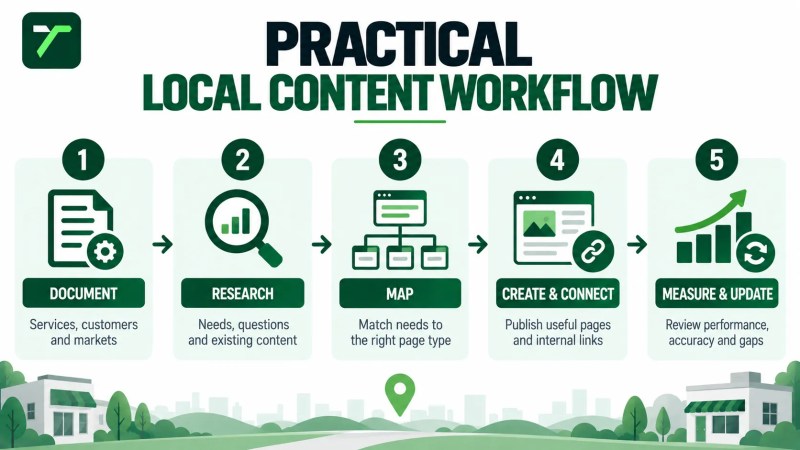
This workflow can be scaled to the size of the business. A company serving one market may need only a focused collection of pages. A multi-location business may require a larger system for maintaining accuracy and preventing duplication.
For teams maintaining content across several services or locations, monthly SEO implementation can provide a recurring structure for reviewing pages, improving internal links, and deciding what needs attention next.
Measure and Improve Local Content
Local content should be evaluated according to the role of each page. A service page and an informational guide will not necessarily produce the same user actions.
Depending on the website’s tracking setup, useful measures may include:
- visibility for priority services and markets
- organic visits to important service and location pages
- search queries bringing relevant visitors to each page
- enquiry forms, calls, or other contact actions
- internal paths between informational and commercial pages
- pages receiving little relevant visibility or engagement
- outdated, overlapping, or isolated content
- technical or indexing issues affecting important pages
The purpose of measurement is to guide decisions. A page attracting relevant visitors but producing few enquiries may require a clearer offer or next step. A useful guide may need stronger links to the service it supports. A location page with no distinct value may need improvement or reconsideration.
Performance should also be interpreted in context. Local demand can vary by service, market, season, competition, and the company’s operating priorities.
When useful pages begin to underperform or become outdated, a structured content refresh can help reassess their purpose, accuracy, coverage, internal links, and next steps.
Frequently Asked Questions
What is local SEO content?
Local SEO content is website content that helps connect a business’s genuine services and information with the customers and geographic markets it can serve. It can include service pages, location pages, FAQs, guides, and supporting articles.
Does every location need its own page?
No. A dedicated location page is most useful when the business genuinely serves the market and can provide distinct, helpful information for customers there. Creating substantially similar pages for every nearby city can produce repetitive and difficult-to-maintain content.
Should every service have a separate page?
Not automatically. A separate page is useful when the service represents a distinct customer need and can support meaningful information. Closely related variations may be better explained together when separate pages would substantially overlap.
How are service pages different from blog posts?
Service pages explain what the business offers and help customers evaluate an available service. Blog posts and guides usually answer related questions, explain problems, compare options, or help customers prepare for a decision.
Can FAQs help a local content strategy?
Yes, when they provide clear answers to real customer questions and appear in an appropriate context. Repeating the same generic FAQ section across many location pages is less useful than placing each answer where customers genuinely need it.
How often should local content be updated?
There is no universal schedule. Review content when services, operating areas, contact information, customer needs, regulations, platform requirements, or business priorities change. Performance reviews can also identify pages requiring improvement.
Build Local Content Around Real Services and Customer Needs
A useful local SEO content strategy begins with the business: what it offers, where it operates, which customers it wants to serve, and what those customers need to understand.
Service pages, location pages, FAQs, guides, original evidence, and internal links can then be developed as connected parts of one system. Each page should have a distinct purpose and a clear relationship with the services and markets it supports.
The objective is not to publish the largest number of local pages. It is to maintain an accurate, useful content system that helps potential customers find relevant information, evaluate the business, and take an appropriate next step.