

A local business does not need a traditional storefront to depend on local customers. Plumbers, electricians, cleaners, landscapers, roofers, HVAC contractors, pressure-washing companies, mobile service providers, and many other businesses travel to customers across a defined geographic area.
That operating model changes how local SEO should be planned. Instead of trying to make one physical location represent every market, a service area business needs to communicate what it does, where it genuinely provides those services, and how customers in those areas can take the next step.
Quick Answer: Local SEO for service area businesses focuses on helping a business become more visible for relevant local searches across the areas it actually serves. A practical strategy can include an accurate Google Business Profile, clear service and location information, useful service-area pages where justified, consistent business details, customer reviews, relevant local content, internal linking, and measurement of search visibility and enquiries.
What Is a Service Area Business?
A service area business serves customers at their locations rather than relying primarily on customers visiting a storefront. Depending on the business model, technicians or service teams may travel to homes, commercial properties, job sites, or other customer locations.
This distinction matters because local search information should represent how the business actually operates. A company serving customers across several towns should not need to present every service area as though it were a separate physical business location.
For SEO planning, the important questions are practical:
- Which services does the business actually provide?
- Which geographic areas does it genuinely serve?
- Which services are available in each relevant market?
- How can potential customers confirm coverage and request service?
- Does the website make those relationships easy to understand?
Traffisite’s local SEO services focus on connecting service-business websites and local search visibility with the markets those businesses actually serve.
How Local SEO Works for Service Area Businesses
Local SEO for a service area business should connect three things clearly: the services the company provides, the locations it serves, and the business information customers encounter when searching locally.
A useful strategy may involve several connected parts:
- Service relevance: making important services clear on dedicated, useful pages where appropriate.
- Geographic relevance: communicating real service coverage without presenting service areas as physical locations.
- Local business information: maintaining accurate information on Google Business Profile and other relevant business listings.
- Website relationships: connecting services, service areas, and supporting information through clear navigation and internal links.
- Reputation: developing a legitimate review profile based on actual customer experiences.
- Measurement: monitoring whether relevant local visibility contributes to enquiries and other business outcomes.
The objective is not to create a page for every possible combination of service and town. It is to build a useful local search presence that accurately represents the business and helps potential customers understand whether the company can solve their problem in their area.
Business owners who want the broader fundamentals can also use Traffisite’s local SEO guide as a foundation for the service-area-specific considerations covered here.
Set Up Google Business Profile Around the Real Business
Google distinguishes a service-area business, which visits or delivers to customers but does not serve them at its business address, from a hybrid business, which serves customers at its address and also visits or delivers to customers.
A business should represent its real operating model rather than choosing an address or service-area setup solely for perceived search visibility. Google says that if a business does not serve customers at its business address, it should remove that address from its Business Profile and use a service area instead.

Traffisite’s guide to Google Business Profile without an address covers this issue in more detail for businesses that do not serve customers at a public storefront.
Define Service Areas Accurately
Google recommends making service areas as specific and accurate as possible and removing locations the business does not serve. Its current guidance allows businesses to define service areas using cities, postal codes, or other supported areas rather than a radius around the business.
When reviewing a profile, compare its service-area information with the company’s actual operations. If coverage changes, the website and other customer-facing information may also need review so potential customers receive consistent information.
Keep the Business Model Consistent
The website, Google Business Profile, contact information, and location content should tell the same basic story about how the business operates. Google’s Business Profile guidelines tell businesses to represent themselves accurately and keep their address and/or service area accurate and precise.
For example, if the company operates without a customer-facing storefront, the website should not present each service area as though it were a separate staffed branch. Google states that a service-area business can have only one Business Profile for the whole area it serves.
Traffisite’s Google Business Profile guidelines article provides additional context for businesses reviewing how their profile represents their operations.
Build Useful Service Area Pages
A service area page can help explain where a business operates, but a city name alone does not make a page useful.
Before creating a dedicated page for a location, ask whether the page can genuinely help a customer in that market. Useful information may include:
- Which services are available in the area
- How customers there can request service
- Relevant coverage boundaries or scheduling considerations
- Property or service considerations that genuinely differ in that market
- Links to the most relevant service pages
- Clear contact or enquiry options
A location page should provide useful information beyond a changed city name. Google’s spam policies identify substantially similar pages created for specific regions or cities that funnel visitors onward as a potential form of doorway abuse. This does not mean every city or service-area page is problematic; the concern is pages created primarily to target similar searches without providing a useful destination of their own.
Do Not Confuse Service Areas With Business Locations
Serving a city does not mean the business has a physical location there. Website language should make that distinction clear.
A company may serve several nearby communities from one operational base. In that situation, location content can explain service availability without presenting every service area as a separate office.
Businesses that actually operate multiple locations face additional considerations. Traffisite’s guide to local SEO for multiple locations helps distinguish that model from ordinary service-area coverage.
Connect Services With the Locations You Serve
Service area SEO becomes easier to understand when the website separates two questions:
- What does the business do? Service pages answer this.
- Where does the business provide those services? Location or service-area content answers this.
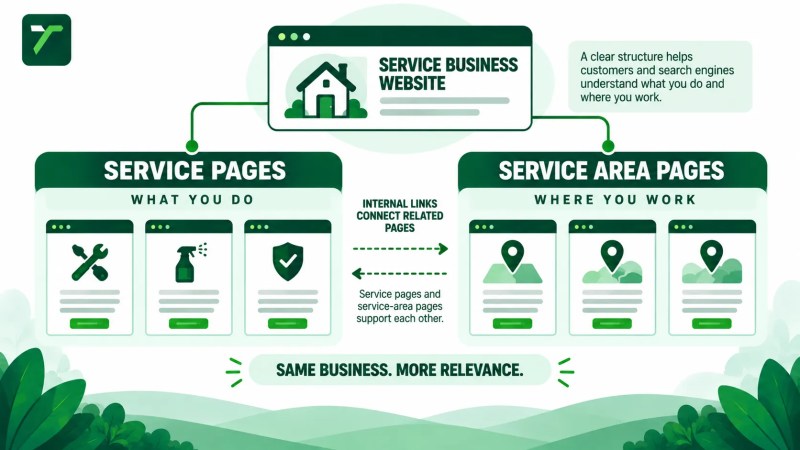
Those page types can then support each other through useful internal links.
For example, a plumbing company might maintain focused pages for drain cleaning, water-heater services, leak repair, and other meaningful offerings. A service-area page can introduce the services available in that market and direct customers to the relevant service pages for details.
The service pages can also provide appropriate coverage information without requiring a separate page for every possible service-and-location keyword combination.
Build the Structure Before Scaling Pages
As the number of services and markets grows, planning the website structure becomes more important. Without a clear hierarchy, businesses can end up with overlapping pages, isolated location pages, repetitive content, and navigation that becomes difficult for visitors to use.
Traffisite’s website structure for SEO guide explains how services, locations, and supporting content can be organized into clearer relationships.
Contextual internal links can then help users move between those related pages. The internal linking guide covers how important pages can be connected without forcing links where they do not help the reader.
Strengthen Local Trust and Business Information
A service area business often asks customers to choose a company that will travel to their home, workplace, or property. The local search experience should therefore make the business easy to identify and understand.
Keep Core Business Information Accurate
Review the business information customers encounter across the website, Google Business Profile, and other relevant listings. Names, contact information, operating details, service information, and geographic coverage should accurately represent the business.
Traffisite’s guide to local SEO citations explains how business information can appear across external directories and local listings.
Develop Reviews From Real Customers
Customer reviews can give potential customers useful information about other customers’ experiences with a business. Google’s review guidance says reviews and other Maps contributions should reflect genuine experiences and prohibits incentives offered in exchange for posting, changing, or removing reviews.
Traffisite’s Google Business Profile reviews guide provides additional guidance for businesses managing reviews on their profile.
Create Content Around Real Local Customer Needs
Local content does not need to consist entirely of city pages. A service area business can also create useful content around the questions, problems, services, and considerations that matter to customers in its markets. A service-area content strategy can prioritize those topics alongside service pages and coverage information without adding unnecessary geographic URLs.
The best opportunities depend on the business. A seasonal service company may have different customer questions from an emergency plumber, cleaning company, landscaper, or HVAC contractor.
Traffisite’s local SEO content strategy article explores how local content can support broader service and location visibility.
Measure Local SEO Across the Service Area
A service area business should avoid judging its entire local SEO program from one keyword searched from one location.
Useful areas to monitor can include:
- Search visibility for important services and markets
- Search queries associated with priority pages
- Organic visits to service and service-area pages
- Google Business Profile performance information available to the business
- Calls, forms, bookings, or other measurable enquiries
- Whether important pages are being crawled and indexed as intended
Performance can vary across services and geographic areas, so reporting should make it possible to understand which parts of the local search strategy are contributing useful visibility and enquiries.
Traffisite’s guide to local SEO KPIs provides a broader framework for choosing measurements that connect local search performance with business objectives.
Avoid Common Service Area SEO Mistakes
Many service area SEO problems begin when a website tries to manufacture geographic relevance instead of clearly representing where and how the business operates.
Common issues to review include:
- Using an address or location setup that does not accurately represent how customers interact with the business
- Creating location pages for markets the business does not genuinely serve
- Publishing large numbers of substantially similar city pages that provide little distinct value
- Implying that service areas are physical branches when they are not
- Trying to target every service-and-city combination with a separate page regardless of usefulness
- Leaving important service-area pages isolated from the rest of the website
- Allowing outdated coverage information to remain on the website or business profile
- Measuring success only through a small set of rankings instead of relevant visibility and business outcomes
A stronger approach starts with the real business model and builds the local search strategy around it. The website, business profile, service pages, location content, and measurement process should reinforce the same accurate picture of what the company does and where it works.
Service Area Business Local SEO FAQ
What is a service area business?
Google defines a service-area business as a business that visits or delivers to customers directly but does not serve customers at its business address. Cleaning services and plumbers are examples Google provides.
Can a service area business use Google Business Profile?
Yes, if it meets Google’s eligibility requirements. Google says eligible businesses generally must make in-person contact with customers during their stated hours, subject to its listed exceptions and restrictions. Businesses that travel directly to customers can qualify as service-area businesses.
Should a service area business hide its address?
If a business does not serve customers at its business address, Google instructs it to remove the address from the Business Profile and use its service area. A hybrid business that serves customers at its address and also travels or delivers to customers can show its storefront address and define a service area.
Does adding more service areas improve rankings?
Google describes service areas as a way to show customers where a business provides products or services; its service-area guidance does not state that adding more areas guarantees higher rankings in those places. Service areas should instead be specific, accurate, and limited to places the business actually serves.
Should every service area have its own page?
No. A dedicated location page is most useful when the business genuinely serves the market and the page can provide meaningful information for customers there. Google also warns against substantially similar regional or city pages created primarily to funnel visitors to another destination.
What should a service area page include?
A useful service area page can explain available services, real coverage information, relevant local considerations, how customers can request service, and where they can find more detailed service information.
How should service area businesses measure local SEO?
Measurement can combine search visibility, organic traffic, priority-page performance, available business-profile data, enquiries, and other meaningful business actions. The exact metrics should reflect the company’s goals and how customers contact or book the service.
Build Local Visibility Around Where You Actually Work
Local SEO for service area businesses should begin with the real operating model. Define the services the company provides, identify the markets it genuinely serves, represent the business accurately, and make those relationships clear across the website and local search presence.
From there, service pages, useful location content, accurate business information, reviews, internal links, and performance measurement can work together as one local strategy rather than a collection of disconnected tactics.
For service businesses that want to turn that strategy into a broader plan for attracting customers from local search, Traffisite’s local lead generation solution explains how improving local search visibility can fit into a wider organic growth program.