

Service-area pages can help a service business explain where it works, but publishing a separate page for every city on a coverage map is not automatically useful.
The important question is whether each geographic page gives customers a meaningful destination. A strong page should accurately represent an area the business serves, connect visitors with relevant services, and provide enough useful information to justify its own URL.
Service area pages SEO therefore requires more than changing a city name across a template. The website needs a deliberate geographic structure that reflects the real business while avoiding large groups of repetitive location pages.
Quick Answer: Create a separate service-area page when the business genuinely serves the location and the page can provide useful information for customers in that market. Organize those pages under a clear geographic structure, connect them with relevant service pages, and avoid creating near-identical pages where the only meaningful difference is the city name.
What Are Service-Area Pages?
A service-area page is a website page focused on a geographic market where a business provides its services. Depending on the business, that market might be a city, suburb, county, region, or another clearly defined area.
These pages are especially relevant to companies that travel to customers rather than relying entirely on visits to a storefront. Google defines a service-area business as a business that visits or delivers to customers directly but does not serve customers at its business address. Contractors, cleaners, landscapers, pest control companies, movers, plumbers, electricians, pressure washing companies, and similar businesses may operate across multiple communities.
A service-area page gives the business a place to explain its relationship with a particular market and guide customers toward the services available there.
That is different from claiming the business has a physical office in every area it serves. Traffisite’s guide to local SEO for service area businesses explains the broader relationship between real service coverage, geographic website content, and the company’s operating model.
Service-Area Pages Are Not Just City-Name Variations
The purpose of a geographic page should be to help someone interested in that particular market understand whether the business serves them and what it can provide.
If two pages contain essentially the same information and only replace one place name with another, the website may be creating separate URLs without creating meaningfully different destinations for visitors.
That is why deciding whether a location deserves a page should happen before writing the page itself.
When Does a Service Area Need Its Own Page?
Not every location within a company’s travel radius automatically needs a standalone URL.
Before creating a service-area page, consider whether the location represents a genuine and useful part of the business’s market.
Ask these questions:
- Does the business actually provide services in this area?
- Is the area commercially important enough to warrant dedicated information?
- Are customers in this market likely to benefit from a dedicated geographic destination?
- Can the page explain the services available there without simply copying another location page?
- Is there meaningful information about the company’s relationship with this area?
- Can the page fit naturally into the website’s geographic hierarchy and internal linking?
The answers do not need to produce a rigid score. They help determine whether a separate page has a clear purpose.

Create Pages Around Real Markets, Not Every Possible Place Name
A business might serve dozens of towns, neighborhoods, or surrounding communities. That does not mean each one requires a page.
Some markets may justify dedicated content because they are important service areas with enough relevant information to support a useful page. Smaller surrounding communities may be communicated more clearly through a broader service-area page or another appropriate coverage section.
The structure should follow the real business rather than expanding simply because more geographic URLs can be created.
For businesses evaluating their broader local strategy, Traffisite’s local SEO services focus on improving how services and geographic relevance are represented across organic search.
What Should a Service-Area Page Include?
A useful service-area page should answer practical questions a prospective customer in that market may have.
Alongside accurate coverage details, on-page SEO for service-area pages can help improve descriptive headings, useful copy, and connections to the services available in each market.
The exact content will depend on the industry and location, but the page may need to explain:
- which services are available in the area
- the types of customers or properties the business serves
- how the company provides service to that market
- relevant service considerations for customers in the area
- how to move from the location page to more detailed service information
- what the customer should do next to enquire about service
The goal is not to add every possible local reference. It is to provide information that helps someone understand the business’s actual relationship with the area.
Explain the Services Available in the Area
A location page should make it easy to identify what the company actually offers there.
If a company provides several distinct services across the same city, the page can introduce those offerings briefly and link visitors to the appropriate service pages for detailed information.
This prevents the location page from trying to duplicate every service page while still giving geographically focused visitors a useful starting point.
Add Geographic Context Only When It Helps
Location-specific information can make a page more useful when it genuinely affects the customer or service.
Depending on the business, relevant geographic context could involve property types, common service needs, service availability, travel coverage, or other considerations that meaningfully relate to providing the service in that market.
Do not manufacture local details simply to make two pages look different. Invented local history, fake customer examples, unsupported project claims, or generic descriptions of landmarks do not improve the page merely because they contain geographic terms.
Keep the Business Relationship Accurate
If the company travels into a market from another operating location, the page should communicate that relationship accurately.
Serving a city does not necessarily mean the business operates a customer-facing office there. Google’s Business Profile guidelines distinguish service-area businesses from storefront businesses and instruct businesses that do not serve customers at their address to remove that address from their Business Profile. Website location content should likewise describe the business’s real operating relationship with the area rather than imply a physical presence that does not exist.
This distinction is particularly important for local service businesses whose teams regularly travel to customers across multiple communities.
How to Structure Service-Area Pages
Once a business has identified which geographic markets deserve dedicated pages, those pages need a clear place within the website.
A simple structure might look like:
Locations → State or Region → City
A smaller business may need only:
Service Areas → Individual Location Pages
The appropriate depth depends on how many geographic markets the business needs to organize. A company serving a handful of nearby cities usually does not need the same hierarchy as a business operating across multiple regions.
Traffisite’s guide to website hierarchy for SEO explains how parent and child relationships can help organize larger groups of related pages.
Use a Service-Area Hub When It Improves Navigation
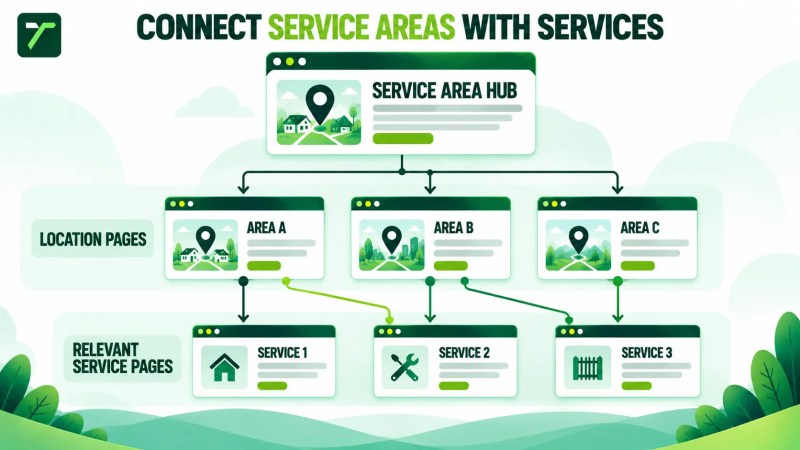
A main service-area or locations page can act as a useful geographic hub when the website contains multiple location pages.
The hub can explain the overall coverage area and provide clear paths to the individual markets that have their own pages.
This gives visitors a geographic overview rather than requiring them to discover location pages only through search engines or scattered links elsewhere on the website.
Avoid Unnecessary Geographic Depth
A hierarchy should be detailed enough to organize the content but not deeper than the business requires.
For example, creating several layers such as country, state, county, city, suburb, and neighborhood is not automatically useful if most of those levels contain little meaningful content.
Use parent pages when they have a genuine organizational purpose. Do not create intermediary geographic URLs solely to make the structure appear more elaborate.
Keep Important Location Pages Reachable
Important location pages should be reachable through crawlable internal links from other relevant pages. Google’s link best practices recommend that every page you care about have a link from at least one other page on your site.
A geographic hub, relevant service pages, contextual content, navigation, or other appropriate internal links can help visitors reach those pages.
Traffisite’s guide to orphan pages SEO covers the broader problem of pages that lack useful internal-link relationships with the rest of a website.
How to Avoid Repetitive Geographic Content
Repetition becomes a common problem when businesses create many location pages from one template.
A consistent page framework can make a website easier to maintain. The problem is when the substantive content remains nearly identical because there is little meaningful reason for each page to exist independently.
Do Not Build Pages by Swapping City Names
Consider two proposed pages where every paragraph is identical except for references to different cities.
If the business cannot identify meaningful differences in what those pages need to communicate, separate URLs may not be the clearest solution.
Google’s spam policies on doorway abuse identify region- or city-targeted pages that funnel users to one destination, as well as substantially similar pages that sit between search results and a clear browsable hierarchy, as examples of doorway abuse. That does not mean every location page is a doorway page; the concern is with pages created to capture similar searches without providing a useful distinct destination.
The goal should be to create useful geographic destinations for customers rather than expanding the site with substantially similar pages that add little new information.
Give Each Page a Distinct Purpose
Before drafting a geographic page, define what someone should learn from it that is specifically useful to that market.
The answer does not need to involve completely different services in every city. Instead, look for legitimate differences in the customer’s context and the business’s relationship with the market.
A location page may differ because of:
- which services are relevant or available there
- the customer or property types commonly served
- service considerations that genuinely vary by area
- how the location fits within a broader regional service territory
- useful connections to related services or informational resources
If none of these produce a meaningful distinction, reconsider whether a standalone page is necessary.
Do Not Add Filler for the Sake of Uniqueness
Trying to make every page technically different can lead to another problem: irrelevant filler.
A long paragraph about a city’s history, attractions, population, or landmarks does not automatically help someone choose or understand a service.
Unique content should also be useful content.
The stronger question is not, “How can we make this page different?” It is, “What does a customer in this market actually need to know?”
Connect Service-Area Pages With Service Content
Service-area pages and service pages answer different but related questions.
A service page primarily explains what the business provides. A service-area page primarily explains the business’s relationship with where that service is available.
The two page types should therefore support one another rather than repeat one another.
Traffisite’s article on service page structure SEO explains how individual services can be organized separately from the geographic layer of the website.
Link Location Pages to Relevant Services
When a location page discusses a service available in that market, a contextual internal link can take the visitor to the full service page.
For example:
Location Page → Relevant Service Page
The location page can provide the geographic context, while the service page contains the detailed explanation of the offering.
This avoids rewriting the complete service description on every geographic page.
Link Service Pages to Geographic Information When Useful
The relationship can also work in the other direction.
If customers reading a service page need to understand whether the business covers their area, the page can provide a natural route toward the appropriate service-area information.
That might be a link to the overall locations hub or, where contextually useful, a relevant geographic destination.
The objective is not to create a massive block of links between every service and every city. Internal links should help the reader move to a logical next page.
Google also recommends using descriptive, contextual internal links to help people and Google understand related pages. Traffisite’s internal linking guide provides a broader framework for building those relationships across a service-business website.
Use Supporting Content Where It Answers a Different Question
Informational content can support both service and location pages when customers have narrower questions that do not belong on the main commercial page.
For example, supporting articles might explain:
- how a particular service works
- what affects service cost
- how to prepare before an appointment
- how two service options compare
- common problems related to the service
- what customers should expect during the process
Those articles can then connect readers to the relevant service or geographic destination when the relationship is natural.
How to Audit Existing Service-Area Pages
Businesses that already have many geographic pages should review what exists before adding more.
Start with an inventory of the current service-area URLs and evaluate each page individually.
For every page, ask:
- Is this a real service area? Confirm that the business genuinely serves the market.
- Does the page have a clear purpose? Identify what useful geographic question the page answers.
- Is the content meaningfully useful? Look beyond city-name changes and boilerplate wording.
- Does it represent the business accurately? Remove language that suggests nonexistent offices, teams, projects, or locations.
- Does it connect to relevant services? Make sure customers can reach detailed service information where appropriate.
- Can visitors reach the page internally? Check whether the page has a logical place in navigation, a geographic hub, or contextual internal links.
- Does another page serve essentially the same purpose? Review overlapping geographic pages before creating or keeping multiple similar destinations.
- Does the page have a useful next step? Visitors should know how to investigate a service or contact the business.
This audit can reveal pages that need stronger content, better internal connections, clearer positioning, or reconsideration within the overall geographic structure.
Traffisite’s local SEO audit provides a broader framework for reviewing other elements of a local search strategy alongside website content.
Review the Geographic Structure as a Whole
Do not evaluate location pages only one at a time.
Step back and examine the complete structure. Look for areas where many URLs have accumulated without a clear hierarchy, important markets are buried, or location and service content have become difficult to navigate.
If the architecture itself has become difficult to manage, Traffisite’s SEO website architecture services focus on organizing site hierarchy, navigation, internal links, and related page relationships more clearly.
Service Area Pages SEO FAQ
What is a service-area page?
A service-area page is a website page focused on a geographic market where a business genuinely provides its services. It helps prospective customers understand the company’s relationship with that area and can connect them with the services available there.
Does every city I serve need its own page?
No. A separate city page is most useful when the market genuinely matters to the business and the page can provide enough relevant information to justify a distinct destination. Smaller or closely related areas may sometimes be represented more clearly through a broader geographic structure.
Can I use the same template for every service-area page?
A consistent layout can make a group of location pages easier to manage, but the substantive information should reflect the purpose of each page. Simply duplicating the same content and replacing the city name does not create a meaningfully different resource for visitors.
What should I write on a service-area page?
Focus on information that helps customers in that market understand the business’s real service coverage. This can include relevant services, customer or property types served, useful local service considerations, links to detailed service information, and a clear next step.
Should service-area pages link to service pages?
Yes, when the relationship is useful to the visitor. A location page can introduce services available in that market and link to the relevant service pages for more detailed information rather than duplicating the full service description.
Should every service have a separate page for every location?
Not automatically. Creating every possible service-and-location combination can result in a large number of repetitive URLs. Separate pages should have a clear purpose and enough useful information to justify being independent destinations.
Are service-area pages the same as physical location pages?
No. Google distinguishes service-area businesses from businesses that serve customers at their business address. A company may therefore provide service within a geographic market without operating a customer-facing location in that market. Website content should represent that relationship accurately rather than implying offices or branches that do not exist.
Build Location Pages Around Real Customer Needs
Effective service-area pages begin with the real business, not a list of place names.
Identify the markets the company genuinely serves, determine which ones need their own useful destination, organize those pages into a manageable geographic structure, and connect them with the services customers are actually looking for.
Most importantly, give each page a reason to exist beyond replacing one city name with another. A smaller set of purposeful, well-connected geographic pages can be easier for customers to understand and for the business to maintain than an uncontrolled collection of repetitive URLs.
For the broader strategy behind service pages, location content, supporting articles, and website structure, Traffisite’s SEO for service businesses guide provides the wider framework.