

An SEO budget goes wrong when it is never tied to anything specific. A number gets picked, work gets done, and nobody can say whether the spend matched the goal.
A realistic SEO budget starts from the other direction. You decide what you need SEO to achieve, look at how hard that is in your market, and then work out what it takes to get there with the resources you have. This article walks through that process step by step, whether you are planning a small business SEO budget or building SEO into a larger marketing plan.
Quick Answer: Set your SEO budget by working backward from your goals. Check how competitive your market is, decide which services matter most, list what you can handle in-house, and then fund the deliverables that close the remaining gap. Ongoing work is often more practical than a one-off spend, and you should agree on how you will measure progress before you commit.
What an SEO budget covers
An SEO budget is more than an agency fee. It is everything you spend to earn organic visibility and turn it into inquiries. That usually includes strategy and research, on-page and technical work, content creation, local profile management, link or authority building, reporting, and the internal time your team spends on approvals and subject-matter input.
If you are unsure what a provider’s fee should include, our breakdown of what SEO services include is a useful reference point before you compare quotes. For pricing context, see our article on SEO services cost.
Traffisite’s SEO services overview can also help you compare the areas of work available before deciding which deliverables fit your budget and priorities.
What shapes your SEO budget
No two service businesses need the same investment. Four factors do most of the work in deciding what is realistic.
How competitive your market is
A plumber in a small town and a law firm in a major city face very different search results. Strong, established competitors generally make it harder to stand out, so your budget may need to cover more work. Reviewing who currently ranks for your main services is the most practical way to gauge this. For more on how to do that, see our article on local SEO competitor analysis.
The current state of your website
A site with clean structure, solid service pages, and no technical problems needs less foundational work than one with crawling issues, thin pages, or a confusing layout. Starting with a diagnosis prevents you from paying for ongoing work that is really a cleanup job. A focused SEO audit is a sensible way to scope this before committing to a monthly plan.
Which services matter most to the business
Not every service deserves equal investment. Prioritize the services with the best margins, the strongest demand, or the most capacity to take on new work. Spreading a small budget evenly across every offering often produces weak results everywhere.
What you can handle in-house
If you already have someone who writes well, manages your Google Business Profile, or maintains your site, you may not need to pay for those tasks. Google’s guidance on whether you need an SEO says a small local business can probably do much of the work itself, and it points to the SEO Starter Guide as the place to begin. Be honest about time as well as skill. Tasks that are “owned” internally but never get done are effectively unfunded.
Choosing a budget approach
Once you know what shapes your needs, decide how you will buy the work. Three decisions affect how the budget is structured.
- Ongoing or one-time: Google’s SEO Starter Guide notes that some changes take effect within hours while others can take several months, so ongoing work is often the more practical plan. Our comparison of monthly SEO vs one-time SEO compares the two approaches.
- Agency or freelancer: The right choice depends on how much strategy, coordination, and breadth of skills you need. See SEO agency vs freelancer for a side-by-side comparison.
- SEO or paid search: SEO and paid search are budgeted differently, so compare them before deciding where to put marketing money. SEO vs paid search covers how they compare.
If you decide ongoing support fits, Traffisite’s monthly SEO services are organized around finished work each month rather than open-ended hours, which makes the budget easier to tie to deliverables.
Allocating your budget by priority
Rather than assigning fixed percentages, which vary widely by business, allocate in order of impact. Fund the foundation first, then the work that builds on it.
| Work area | What it covers | When to prioritize it |
|---|---|---|
| Audit and fixes | Technical issues, site structure, indexing problems | First, if the site has known problems or has never been reviewed |
| Service page optimization | Targeted pages for each priority service | Early, since these pages are often where prospects decide to get in touch |
| Local visibility | Google Business Profile, citations, reviews | Early for businesses serving a defined area |
| Content | Supporting articles and topic coverage | Once core pages are solid |
| Authority building | Earning relevant links and mentions | In competitive markets, after the basics are in place |
| Reporting | Tracking rankings, traffic, and leads | From day one |
If your service pages are weak, see our article on SEO content for service businesses. If you are mostly local, local SEO pricing gives cost context for location-based work.
If you are deciding how much to put into service pages versus blog content, service pages vs blog posts helps you weigh the two.
How to set your SEO budget step by step
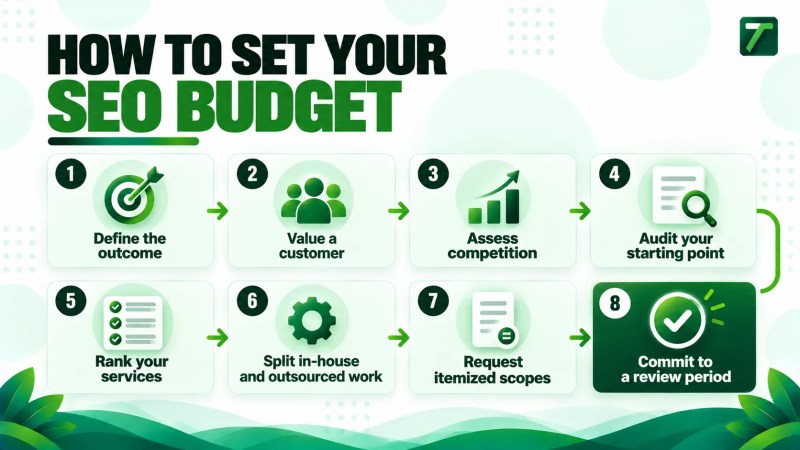
- Define the outcome. Decide what a good result looks like in business terms, such as more qualified calls or booked jobs, rather than rankings alone.
- Work out what a customer is worth. Know your average job value and close rate so you can judge what a lead is worth to you and how much you can reasonably spend to win one.
- Assess your competition. Review the businesses that appear for your key services and note how established they are.
- Audit your starting point. Identify technical, structural, and content gaps so you know the scale of the work.
- Rank your services. Choose the two or three services that deserve the most focus first.
- Split in-house and outsourced work. Assign each deliverable to a person or a provider.
- Request itemized scopes. Ask providers to list deliverables, not just a monthly fee.
- Commit to a review period. Set a fixed window, such as six months, then reassess against your goals.
For a broader look at how SEO fits into running a service business, see our guide to SEO for service businesses. If you are planning a small business SEO budget, see our article on small business SEO cost.
Measuring whether the budget is working
A budget is only realistic if you can judge its return. Agree on the metrics before work begins. Rankings and traffic show progress, but inquiries, lead quality, and revenue show value. For more on connecting spend to outcomes, see how to measure SEO ROI for service businesses, and for reporting in more depth, the SEO measurement and reporting guide.
Pay attention to lead quality too. More traffic is not a win if the inquiries do not fit the services you want to sell. See SEO lead quality for service businesses for more on this. And if you are questioning whether the investment is justified at all, read are SEO services worth it.
Common SEO budget mistakes
- Choosing the cheapest option without checking scope. A low fee can mean very little actual work.
- Expecting fast results from a short commitment. Some changes take months to show in search, so a very short engagement may not reflect what the work can do.
- Funding everything thinly. Concentrating on priority services can work better than covering every page lightly.
- Ignoring internal time. Approvals, feedback, and content input all take hours that need to be planned.
- Skipping measurement. Without agreed metrics, you cannot tell whether the spend is working.
- Treating the budget as fixed forever. Review it as results, competition, and goals change.
FAQ
How much should a service business spend on SEO?
There is no single correct figure. The right amount depends on your competition, your site’s condition, your goals, and how much you can do internally. It is more reliable to build the budget from deliverables and goals than to start from a round number. For pricing context, see what SEO services cost.
Is a small SEO budget still worth it?
It can be, if you focus it. A smaller budget works best when concentrated on one or two priority services and on foundational fixes, rather than spread across everything.
Should the budget be monthly or a one-time spend?
Ongoing monthly work is often the more practical plan, because some changes take months to show up in search and a site needs maintenance over time. A one-time project can suit a specific need, such as fixing a defined technical problem or launching a new site.
How long before I should expect results?
It varies by competition, site condition, and the work being done. Google says some changes take effect in a few hours while others can take several months, and it generally suggests waiting a few weeks before judging whether a change helped. Rather than relying on a fixed timeline, ask your provider what results and timeframe they expect, agree on early indicators, and set a review point.
Can anyone guarantee rankings for my budget?
No. Google’s guidance on hiring an SEO states that no one can guarantee a #1 ranking, and it advises caution with any SEO who claims otherwise. A reliable provider will commit to defined work and transparent reporting instead.
Putting your SEO budget into practice
A realistic SEO budget is one you can explain. You know what it is meant to achieve, why it is sized the way it is, which deliverables it pays for, and how you will judge the result. Start with your goals and your market, fund the foundation before the extras, and review on a fixed schedule.
If you would like help scoping the work, a Traffisite SEO audit of your current site ranks issues by impact and turns them into a prioritized roadmap, which gives you a clearer basis for a plan before you commit. When you are ready to compare options, you can review Traffisite pricing.