

Searching for “seo services cost” usually turns up a wall of conflicting numbers, and for good reason: two businesses in different industries, markets, and starting positions can pay very different amounts for genuinely comparable work. Before comparing quotes, it helps to understand how SEO pricing is actually structured and which variables move the price the most.
Quick Answer: SEO pricing isn’t standardized because the work itself isn’t standardized — a website with strong technical foundations and light competition needs far less investment than a newer site competing in a crowded local market. Instead of anchoring to a single number, compare providers on pricing model (retainer, project-based, or hourly), what’s included in scope, and how the price maps to your specific competitive situation.
How Much Do SEO Services Typically Cost?
There isn’t one standard price for SEO, but current industry research can provide a useful benchmark. Backlinko’s SEO pricing research reports monthly SEO costs averaging about $1,000–$2,500, hourly services averaging $50–$100 per hour, and project-based SEO commonly falling between $1,000 and $5,000.
These figures are market benchmarks rather than a recommended budget for every business. Actual pricing can vary considerably depending on the scope of the engagement, the site’s starting condition, competition, technical requirements, and the amount and type of work involved.
Why SEO Pricing Varies So Much
SEO isn’t a fixed deliverable like a logo or a single web page. It’s an ongoing set of decisions about content, site structure, technical health, and authority-building, and the amount of work required depends heavily on where a business is starting from. A site with clean technical foundations and an established content base may only need targeted improvements. A newer site, or one competing in a saturated local market, often needs more foundational work before rankings move at all.
Because scope depends on the specific site and market rather than a standard package, providers price SEO according to the work involved rather than a flat, industry-wide rate.
Common SEO Pricing Models
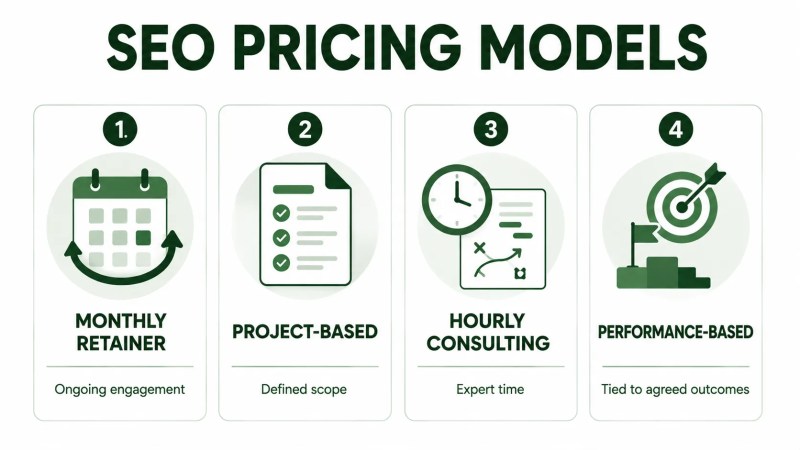
Most SEO services fall into one of a few pricing structures. Understanding which model a provider uses makes it easier to compare quotes fairly.
- Monthly retainer: An ongoing engagement covering strategy, execution, and monitoring over time. Monthly retainers are a common model for ongoing SEO work and are designed for businesses that need continued optimization rather than a single, defined project.
- Project-based / one-time: A defined scope of work, such as a technical audit, a site migration, or a content overhaul, priced as a fixed project rather than an ongoing relationship.
- Hourly consulting: Paying for expert time on specific questions or reviews, often used by businesses that have in-house resources but want outside guidance on strategy or troubleshooting.
- Performance-based pricing: Pricing that ties some or all of the fee to agreed outcomes or milestones. Businesses considering this model should look carefully at how success is defined, what tactics are included, and which outcomes are actually within the provider’s control.
A monthly retainer and a one-time project solve different problems, and the right choice depends on whether the underlying need is ongoing optimization or a defined, contained fix. Monthly SEO vs. one-time SEO breaks down that decision in more detail.
What Actually Drives the Cost of SEO Services
Within any pricing model, the scope and circumstances of the engagement can affect the price. Factors worth considering include:
- Competitive landscape: Ranking for terms with many established, well-optimized competitors generally requires more sustained work than ranking in a less contested space.
- Current site condition: A site with unresolved technical issues, thin content, or a confusing structure often needs foundational work before growth-focused work can be effective.
- Geographic scope: Optimizing for a single service area is typically a narrower scope than optimizing for multiple markets or a national footprint.
- Content requirements: Building out topical coverage from scratch takes more time than refining and expanding an existing content base.
- Technical complexity: Larger sites, custom-built platforms, or sites with a history of technical issues can require more specialized diagnostic and implementation work.
These factors are also why a price that sounds reasonable for one business can be poorly matched to another. For example, an established single-location service business with a technically healthy website and useful existing content may need a narrower scope than a multi-location business starting with technical problems, content gaps, and stronger competition across several markets. The second situation involves more areas to address, so comparing the two businesses on price alone would miss the difference in scope.
A quote should reflect the actual condition and goals of the specific website, not a generic package.

What to Evaluate Beyond the Price Itself
Comparing SEO quotes purely on the monthly or project number tends to obscure the more useful comparison: what’s actually included, and whether it matches what the business needs.
- What’s included in the scope — technical work, content, link building, reporting — and what’s billed separately?
- Is the engagement structured around the business’s actual priorities, or a standard package applied regardless of site condition?
- How is progress measured and reported, and does that reporting connect to business outcomes rather than vanity metrics alone?
- Is there a clear starting point, such as an audit, that establishes what needs to happen before ongoing work begins? An SEO audit is often the most useful way to see what a given price would actually be addressing.
It’s also worth weighing whether the work is better suited to an agency, a freelancer, or an in-house hire, since each option carries different cost structures and tradeoffs beyond price alone — covered in more detail in SEO agency vs. freelancer.
Signs a Price Doesn’t Match the Work Being Promised
Because SEO work isn’t always immediately visible to a business owner, it’s easy for pricing to become disconnected from what’s actually being delivered. A few patterns are worth questioning regardless of the price point:
- A guaranteed #1 ranking — Google’s guidance on hiring an SEO explicitly warns that no one can guarantee a #1 ranking on Google.
- A price that’s unusually low relative to the stated scope, which often means either the scope is thinner than described or lower-quality tactics are being used to cut costs.
- No clear explanation of what’s included, with vague language standing in for a defined scope of work.
- Reporting focused entirely on activity (posts published, links built) rather than any connection to search visibility or business outcomes.
A fair price, on the other hand, is one where the scope, the reasoning behind it, and the reporting all make sense together.
Frequently Asked Questions
Does a higher SEO price always mean better results?
Not necessarily. Price should track scope and complexity, not simply provider reputation. The more useful question is whether the scope and approach match what the specific site actually needs.
Should SEO pricing include content creation?
It depends on the engagement. Some providers include content within the retainer, while others treat it as a separate line item. Either approach can work, but it should be clear upfront which one applies.
Is it normal for SEO costs to change over time?
Scope often shifts as a site matures — early work may focus on foundational fixes, while later work shifts toward content expansion or authority building, which can change the investment required at each stage.
If you’re trying to figure out what a realistic SEO investment looks like for your specific site and market, a good starting point is understanding where the site currently stands. Get a growth plan to see what a scoped approach would actually involve before comparing it against a price.