

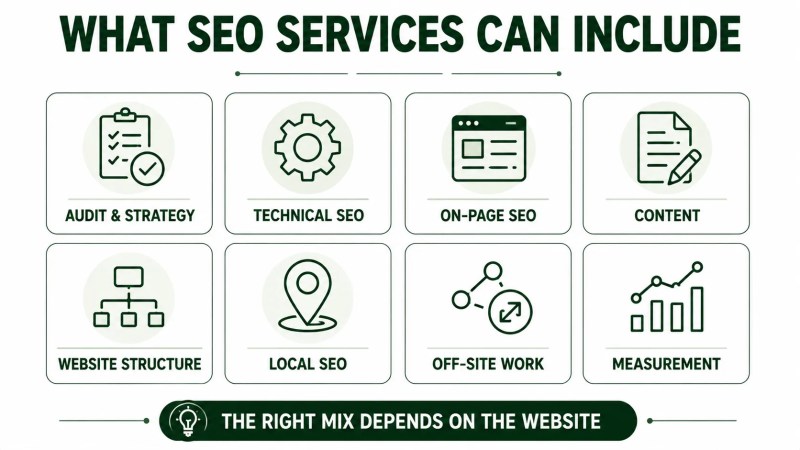
SEO services can include several different activities, from improving website structure and page content to resolving technical issues, creating useful content, handling backlink and off-site work, and measuring performance. The exact work depends on the website, its market, its current problems, and its goals.
For service businesses, the important question is not simply which SEO tasks are included. It is how those activities work together. Technical improvements have limited value if important pages lack useful content, while strong content can be harder to discover if the website has structural or crawling problems.
Quick Answer: SEO services can include audits and strategy, technical SEO, on-page optimization, content strategy and creation, website structure and internal linking, local SEO when relevant, link building or other off-site work, and ongoing measurement and reporting. The appropriate mix depends on the business, website, goals, competition, and current SEO priorities rather than every engagement following the same checklist.
What Do SEO Services Include?
SEO is not one isolated task. An engagement may involve improving the technical condition of a website, optimizing existing pages, planning new content, strengthening connections between related pages, improving local visibility, carrying out backlink-related work, and tracking how the site performs over time.
The specific combination should reflect what the website actually needs. A new service-business website may need stronger site structure and core service pages before publishing a large volume of supporting content. An established website may already have substantial content but need technical fixes, better internal linking, content refreshes, or a clearer strategy.
This is why businesses comparing SEO providers should look beyond a list of deliverables. Understanding what SEO services are and how they work makes it easier to evaluate whether individual activities contribute to a coherent strategy.
SEO Audits and Prioritization
Before deciding what to improve, an SEO provider needs to understand the current condition of the website. An audit can identify technical problems, content gaps, structural weaknesses, on-page issues, and other areas that may deserve attention.
The useful part of an audit is not simply producing a long list of findings. Those findings need to be prioritized according to the website’s goals, current condition, and the potential impact of addressing them.
A focused SEO audit can provide the starting point for deciding what should be addressed first instead of treating every possible optimization as equally urgent.
Technical SEO
Technical SEO generally focuses on aspects of a website that affect how search engines access, crawl, and index its pages. The exact work varies by site and by the problems identified during review.
Depending on the website, technical SEO work may involve reviewing crawlability and indexing, redirects, canonicalization, XML sitemaps, and other technical implementation issues.
Technical work should support the pages and content the business actually wants people to find. Fixing technical problems without considering the site’s broader content and business priorities can turn SEO into a disconnected maintenance exercise.
Businesses dealing with these issues can review what a broader technical SEO service may involve and how technical improvements fit into the rest of an SEO strategy.
On-Page SEO
In practice, on-page SEO generally refers to work performed on individual webpages. Depending on the page and its needs, this can involve elements such as titles, headings, copy, internal links, images, and other page-level content.
For a service business, this often means making sure important pages clearly explain what the business offers, answer relevant customer questions, and provide a logical path toward related information or the next step.
Effective on-page SEO should improve the page as a whole rather than treating individual keywords, headings, or metadata fields as separate boxes to check.
SEO Content Strategy and Content Creation
SEO content is broader than publishing blog posts. A content strategy determines which topics deserve pages, what type of page best satisfies the need, how topics relate to existing content, and where new content fits within the website.
Depending on the business, that can involve service pages, supporting articles, guides, location content, comparisons, resources, or updates to pages that already exist.
A useful SEO content strategy should therefore consider both creation and organization. Publishing more pages is not automatically useful if those pages duplicate existing topics, target the wrong intent, or remain disconnected from the rest of the website.
Website Structure and Internal Linking
As content grows, the relationships between pages become increasingly important. Website structure determines how major sections are organized, while internal links create additional pathways between relevant pages.
For example, a main service page may connect to detailed supporting articles, while those articles can point readers back to the broader service or toward another useful resource. These connections help prevent important content from existing as isolated pages.
A structured approach to SEO website architecture can help organize those relationships, while contextual internal linking connects pages where the relationship genuinely helps the reader.
Businesses with existing content but weak connections between pages may need to improve internal linking as part of the broader engagement rather than simply continuing to publish new pages.
Local SEO
For businesses that serve specific geographic markets, SEO services may also include local search work. The appropriate activities depend on how the business operates, where customers are located, and how people search for those services.
Depending on the business, local SEO work may involve location-relevant website content, maintaining accurate business information, managing an eligible Business Profile, and other work related to the business’s presence in local search.
Because local optimization is not equally relevant to every business model, it should be included when it supports the company’s actual market rather than added automatically to every SEO package. Traffisite’s local SEO service focuses specifically on businesses where geographic search visibility matters.
Link Building and Off-Site Work
Depending on the provider and agreed scope, an SEO engagement may also include backlink-related work and other off-site activities. When backlink-related work is included, the specific activities depend on the provider and scope and may include reviewing existing backlinks, developing useful assets, or outreach.
Whatever approach is used, it should avoid link practices designed primarily to manipulate search rankings, such as paid ranking links, excessive link exchanges, or automated link creation.
A link building and authority strategy should therefore complement the site’s content and broader SEO work rather than operate as an unrelated campaign.
SEO Measurement and Reporting
SEO work needs a way to determine what has been completed, what is changing, and where further attention may be needed. Measurement and reporting provide that feedback loop.
The metrics worth reviewing depend on the goals of the engagement, the tools being used, and the tracking available. Depending on the tools and goals involved, reporting may include Search Console data such as clicks, impressions, CTR, average position, queries, and page performance, alongside website traffic, conversions or leads when appropriate tracking is available, indexing information, and completed work.
Reporting should also provide context. A dashboard full of numbers is less useful when the business cannot tell what changed, what work may have contributed to those changes, or what should happen next.
The broader SEO measurement and reporting process can help businesses understand how performance review fits into ongoing optimization.
How Individual SEO Services Work Together
The individual components of SEO become more useful when they support one another.
An audit might reveal that an important service area lacks sufficient coverage. Content research can determine what page or information is needed. Website architecture determines where that page belongs. On-page optimization improves the page itself. Internal links connect it to related content. Technical SEO can address issues affecting how search engines access or index the page. Measurement then provides information that can guide future work.
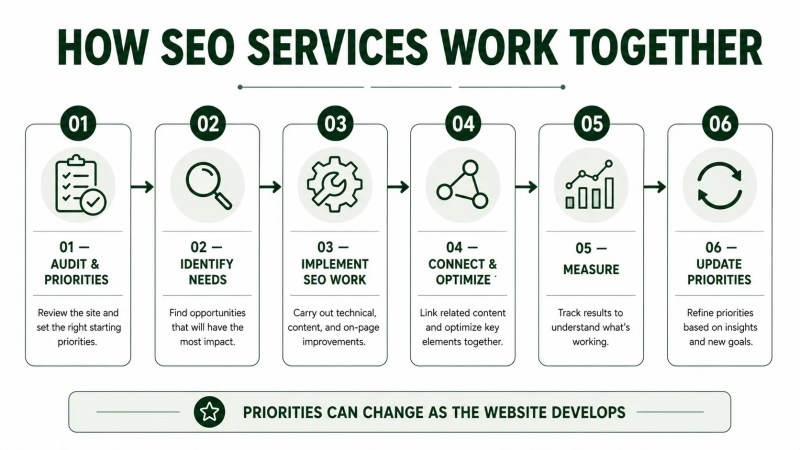
This is why an ongoing engagement should not be viewed simply as a collection of independent monthly tasks. Priorities can change as issues are resolved, new pages are published, performance is reviewed, and new opportunities become apparent.
Businesses that need several of these activities coordinated over time may find that monthly SEO services provide a more suitable framework than treating each optimization as an unrelated one-time project.
What to Look for When Evaluating SEO Services
A long list of deliverables does not necessarily tell you whether an SEO engagement is well planned. When comparing providers or packages, look at how the proposed work relates to your website and business priorities.
Useful questions to consider include:
- Has the provider explained why each major activity is needed?
- Are priorities based on the current condition of the website?
- Does the strategy connect technical work, content, structure, and other relevant SEO activities?
- Is there a process for reviewing performance and adjusting priorities?
- Are deliverables tied to specific website needs rather than a generic checklist?
- Is it clear what work is included, what is not included, and what the business should expect over time?
The right scope will differ between businesses. A local service company with several locations may need a different mix of work from a B2B service provider with a national audience or a new website that is still building its core content.
When deciding between ongoing and project-based support, the comparison between monthly SEO and one-time SEO can also help clarify which approach better matches the work required.
FAQ
What do SEO services typically include?
SEO services can include auditing, technical SEO, on-page optimization, content strategy and creation, website architecture, internal linking, local SEO when relevant, link building or off-site work, and measurement and reporting. The exact combination depends on the provider, website, goals, and agreed scope.
What do monthly SEO services include?
Monthly SEO services can combine several ongoing activities based on current priorities. Work may include technical improvements, existing-page optimization, new content, internal linking, off-site work, local SEO where relevant, and performance review. The scope can change as the website develops and earlier priorities are addressed.
Do SEO services include content writing?
They can. Content may be part of an SEO engagement when new pages are needed or existing pages require substantial improvement. Whether writing is included depends on the provider and agreed scope, so businesses should confirm this rather than assume every SEO package includes content creation.
Do SEO services include technical website fixes?
Technical SEO may be included, but the extent of implementation varies by provider and agreement. Some providers may identify technical issues and provide recommendations, while others may implement certain fixes directly. The scope should make that responsibility clear.
Does every business need every SEO service?
No. The appropriate work depends on the website’s current condition, business model, search market, existing content, technical setup, and priorities. SEO services are more useful when they address actual needs rather than applying the same checklist to every website.
How do I know which SEO services my business needs?
Start by identifying the website’s current problems and business objectives. An audit and strategic review can help determine whether the immediate priorities involve technical issues, content, on-page optimization, website structure, local visibility, off-site work, or a combination of these areas.
SEO Services Should Work as a Connected Strategy
So, what do SEO services include? The answer is usually a combination of technical, content, structural, on-page, off-site, local, and measurement work selected according to what the website actually needs.
The individual activities matter, but the connections between them matter too. Strong SEO work coordinates those activities so technical improvements support useful pages, content fits into a clear website structure, relevant pages connect naturally, and performance data informs what happens next.
If your website needs ongoing work across several of these areas, start by understanding the current priorities rather than choosing services based only on the longest deliverables list. Traffisite’s SEO process explains how an organized engagement can move from identifying priorities to implementing and reviewing the work over time.