

More website traffic is encouraging, but it does not tell a plumbing company, cleaning contractor, or professional services firm whether SEO is making money. A business can receive hundreds of organic visits and still struggle to turn those visits into paying customers.
Measuring SEO ROI for service businesses means following the results beyond rankings and traffic. You need to understand how many qualified enquiries came from organic search, how many became customers, how much revenue those customers generated, and what it cost to earn that business.
This guide explains the calculation, shows a worked example, and outlines a practical tracking process. It also covers the limitations of SEO attribution, so you can distinguish a useful estimate from a return that has been independently proven.
Quick Answer: To measure SEO ROI for a service business, calculate the contribution generated by SEO-attributed customers, subtract the cost of SEO, divide by the SEO cost, and multiply by 100. Estimate customer revenue using qualified leads, close rate, and average revenue per customer. Deduct service-delivery costs before calculating the return, and use your CRM, booking records, and analytics to check the results. Treat the figure as estimated attributed ROI unless you can establish how much business SEO actually added.
What SEO ROI Means for a Service Business
Return on investment (ROI) compares a financial return with the amount invested to produce it. For SEO, that means evaluating the financial contribution associated with organic search against the cost of the SEO work.
The important distinction is that website traffic, search impressions, enquiries, and completed sales represent different stages of the customer journey.
- Search visibility: Potential customers see the website in search results.
- Organic traffic: People visit the website through unpaid search results.
- Enquiries: Visitors call, submit a form, request an estimate, or book a consultation.
- Qualified leads: Enquiries match the services, locations, and customer types the business can serve.
- Customers won: Qualified prospects become paying customers; quotes and uncompleted bookings should be tracked separately until the sale is confirmed.
- Financial contribution: The revenue from those customers after the associated service-delivery costs.
A service company might experience a rise in organic traffic without a corresponding increase in qualified leads. Another company may receive fewer visits but win several valuable commercial contracts.
That is why financial performance should be evaluated alongside the marketing metrics. Traffisite’s SEO measurement and reporting guide covers the broader approach to evaluating search performance.
The SEO ROI Formula
A practical way to estimate SEO ROI is to compare the contribution from SEO-attributed customers with the cost of the SEO investment.
SEO ROI (%) = [(SEO-attributed contribution − SEO investment) ÷ SEO investment] × 100
For this calculation, contribution means revenue remaining after the variable costs of delivering the services. It is not necessarily the business’s final accounting profit, because other overheads may still need to be considered.
Calculate the Revenue Associated With SEO
Start with the qualified leads attributed to organic search, then calculate how many became customers.
Customers won = Qualified leads × Close rate
Attributed revenue = Customers won × Average realised revenue per customer
Use actual completed sales and realised revenue whenever that information is available. The lead and close-rate formula is most helpful when forecasting or estimating results from incomplete records; use a consistent definition of a closed customer.
Convert Revenue Into Contribution
Revenue is not the same as profit. A service business may incur labour, materials, subcontractor fees, travel, and other costs to complete the work.
Attributed contribution = Attributed revenue × Contribution margin
Use a contribution margin that reflects the actual costs included in your calculation. If service-delivery costs have already been deducted to establish the contribution, do not deduct those same costs again as part of the SEO investment.
Important: This method produces an estimated return on attributed business. It does not independently prove that every attributed customer would have been lost without SEO.
The Data You Need to Calculate SEO ROI
Before using the formula, collect information for a clearly defined reporting period. Ideally, your marketing, sales, and financial records should use compatible date ranges and customer definitions.
- Qualified organic leads: Enquiries that meet the company’s service and location requirements.
- Close rate: The percentage of qualified leads that become paying customers.
- Average realised revenue: Revenue actually earned per acquired customer or completed job, not just an initial quotation.
- Contribution margin: The percentage of revenue remaining after relevant service-delivery costs.
- SEO investment: Agency fees, internal SEO labour, content, technical improvements, and relevant tools or other agreed campaign expenses.
- Attribution information: The available evidence connecting organic search activity with the enquiries and sales included in the calculation.
For a home-service company, a qualified lead might be a homeowner within the service area asking for a service the company actually provides. A call from an unsupported location would not normally be counted as a qualified opportunity.
For a professional services firm, qualification may depend on contract size, business type, budget, or the service requested. The criteria should be defined before reporting results.
For more on moving from organic visibility to meaningful customer enquiries, see Traffisite’s SEO lead generation guide for service businesses.
Worked Example: Calculating SEO ROI
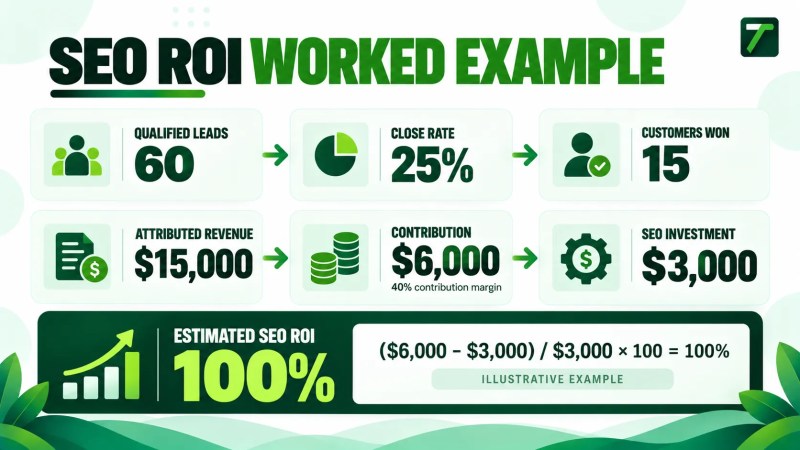
Consider a fictional home-service company reviewing the financial contribution of SEO-attributed leads during a reporting period.
The following figures are illustrative only. They do not represent actual Traffisite clients or measured campaign outcomes.
Step 1: Establish the Inputs
- Qualified leads attributed to SEO: 60
- Close rate: 25%
- Average realised revenue per customer: $1,000
- Contribution margin: 40%
- Total SEO investment: $3,000
Step 2: Calculate Customers and Revenue
First, calculate the customers won:
60 qualified leads × 25% = 15 customers
Then calculate the revenue:
15 customers × $1,000 = $15,000 attributed revenue
Step 3: Calculate Contribution
Apply the contribution margin:
$15,000 × 40% = $6,000 contribution
In this example, $6,000 remains after the assumed variable costs of performing the work, but before subtracting the SEO investment and any overhead costs not captured in the margin.
Step 4: Calculate SEO ROI
[($6,000 − $3,000) ÷ $3,000] × 100 = 100% estimated SEO ROI
The company generated $2 of attributed contribution for each $1 invested in SEO, leaving $1 above that SEO cost for every $1 spent, before any other unallocated overhead.
You can also calculate two useful acquisition metrics:
- Cost per qualified lead: $3,000 ÷ 60 = $50.
- Cost per customer acquired: $3,000 ÷ 15 = $200.
These figures help describe how efficiently the assumed investment produced the recorded opportunities and customers. They do not establish that SEO caused every sale.
Why a Revenue-Only Calculation Can Mislead
If the business compares $15,000 of revenue directly with $3,000 of SEO costs, it overlooks the costs of providing the service.
The resulting percentage would be much higher than the contribution-based ROI, but it would not accurately reflect the money remaining from the work. When comparing reports, check whether the return is based on revenue, gross profit, contribution, or another financial measure.
How to Track SEO Leads Through to Revenue
Calculating SEO ROI requires more than a traffic report. The most useful setup combines search visibility, website interactions, lead records, and actual sales outcomes.
1. Use Search Console to Understand Search Visibility
Google’s Search Console performance reports provide information such as search impressions, clicks, and click-through rate for Google Search.
These measurements help explain how visitors discover the website. They do not directly establish how many people contacted the business, signed contracts, or paid invoices.
Review important service pages and related search queries to identify changes in demand and search visibility.
2. Use Google Analytics to Measure Website Activity
In Google Analytics 4 (GA4), the Traffic acquisition report can help businesses examine website sessions by channel, including Organic Search.
Be careful when comparing platforms. Search Console reports interactions with Google Search, while GA4’s Organic Search channel can include unpaid search traffic from multiple search engines. Google’s guidance on using Search Console and Google Analytics together explains that Search Console clicks and GA4 sessions are calculated differently, so their numbers will not necessarily match.
Google Analytics allows a business to identify important website actions as key events. Depending on the implementation, relevant actions may include a successful enquiry form submission or another measurable step toward contacting the business.
A click on a telephone link is useful engagement information, but it should not automatically be counted as a connected call or qualified lead.
3. Match Website Enquiries With Customer Records
The CRM, call records, and booking system provide the information needed to connect marketing activity with business outcomes.
For each enquiry, consider recording:
- The enquiry date and available marketing source.
- The service requested and relevant location.
- Whether the lead was qualified.
- Whether an estimate, appointment, or consultation was booked.
- Whether the customer purchased.
- The completed job or contract revenue.
- Relevant delivery costs or an agreed contribution margin.
Use a consistent lead identifier where appropriate, while respecting customer privacy and applicable consent requirements. Reconcile duplicate forms, repeat callers, and multiple contacts from the same prospective customer.
Google also documents lead acquisition measurement in GA4, including lead-related events that must be implemented for the corresponding metrics to populate. Business-specific qualification and revenue records still need to be collected and maintained correctly.
Traffisite’s local SEO conversion tracking guide provides more context on separating online interactions from genuine business enquiries.

Which SEO Costs Should You Include?
An ROI calculation can become misleading when some campaign costs are included and others are ignored. Define the SEO investment consistently before comparing reporting periods.
Depending on the business, relevant costs may include:
- Monthly SEO agency or consultancy fees.
- Internal staff time spent on SEO planning, implementation, and reporting.
- SEO-specific content writing, editing, and production.
- Technical SEO work and applicable development expenses.
- SEO research, crawling, rank-tracking, and reporting tools.
- Relevant one-time setup or implementation costs, allocated to the appropriate reporting periods.
If a development project also supports other business operations, agree on a reasonable allocation rather than treating every website expense as SEO.
Similarly, do not include the same cost twice. For example, if an agency fee already includes content writing and reporting, those activities should not be added again as separate expenses unless separately billed.
For cost-planning context, Traffisite’s SEO services cost guide explains common considerations when evaluating SEO investment.
Businesses comparing recurring SEO work with measured results may also find Traffisite’s monthly SEO services relevant when reviewing the scope, ongoing activities, and investment required for a sustained programme.
Profit Margins, Repeat Customers, and Sales Cycles
Service-business economics vary. A one-off residential repair, a recurring cleaning contract, and a commercial consulting engagement can produce very different returns even when their lead counts are similar.
Use the Right Profit Measure
Some businesses work with gross profit, while others use contribution after variable service-delivery expenses. Either approach may be useful if clearly defined, consistently calculated, and labelled.
For financial comparisons, make sure the margin captures the relevant cost of fulfilling the service and that any additional overhead is treated consistently. A contribution-based campaign ROI is not necessarily the same as company-wide net profit.
Separate First Jobs From Repeat Revenue
A customer acquired through an organic search may book an initial service and later return for maintenance or a different job.
Repeat revenue can matter, but it should not automatically be counted as additional SEO-generated revenue without defining the measurement period and attribution approach.
For a conservative calculation, start with realised initial-customer revenue. If retention information is reliable, you can report a separate customer-lifetime-value scenario with clearly stated assumptions.
Allow for Longer Sales Cycles
A commercial service company may receive an enquiry this month but close the contract several weeks later. Reporting only the leads and sales recorded during the same calendar month can create a misleading picture.
Where possible, group leads by acquisition period and track their eventual outcomes. Distinguish estimated pipeline value, signed contracts, invoiced revenue, and payments received rather than treating these figures as interchangeable.
SEO Attribution and Measurement Limitations
Even with strong tracking, it is difficult to determine exactly how much business SEO caused. A customer may discover a service company through search, return by typing the website address, speak with a representative, and purchase later.
Different Touchpoints May Contribute to a Sale
Attribution assigns credit to interactions along a customer’s journey. Google’s attribution model documentation explains how different models can assign different credit to marketing touchpoints.
An SEO-attributed sale therefore depends partly on the attribution method, not just the final invoice. Use the same approach when comparing periods and explain any changes to the model.
Some Customer Activity May Be Missing
Common measurement gaps include:
- Untracked telephone conversations and offline enquiries.
- Missing or incorrectly configured analytics events.
- Customers switching between devices or channels.
- Incomplete CRM source information.
- Duplicate leads or customers appearing in multiple reports.
- Privacy choices and technical restrictions affecting measurement.
- Revenue booked after the marketing reporting period.
Some analytics reporting may also include modeled activity rather than directly observed events. Google’s documentation on modeled key events explains why estimated event data may be used when certain activity cannot be observed directly.
Attribution Is Not the Same as Incremental Impact
A customer credited to organic search may already have known the company, used another marketing channel, or intended to purchase regardless of an SEO campaign.
That is why an attributed ROI figure should not be presented as proof that SEO independently created all the associated revenue.
For more rigorous evaluation, consider comparing suitable periods, customer cohorts, or geographic segments while accounting for seasonality, brand demand, other marketing activity, and operational changes. Strong causal conclusions require an appropriate evaluation design, not just a before-and-after dashboard.
How to Report SEO ROI
A useful SEO ROI report should make it easy for a service-business owner to see what was measured, how the return was calculated, and what remains uncertain.
Use a consistent reporting format that includes:
- Reporting period: The acquisition and revenue windows being evaluated.
- Search performance: Relevant organic clicks, impressions, and important landing-page changes.
- Lead outcomes: Recorded enquiries, qualified leads, and customers won.
- Revenue: Realised revenue attributed to the defined customer group.
- Financial contribution: Revenue less the applicable service-delivery costs.
- SEO expenses: Total investment using the agreed cost definition.
- Estimated ROI: The calculation and any important assumptions.
- Data limitations: Tracking gaps, attribution uncertainty, and sales still in progress.
- Next actions: Specific improvements based on the findings.
A small number of useful measures is better than a report filled with disconnected traffic and ranking figures. The purpose is to help the owner understand the relationship between search activity, real business opportunities, and financial outcomes.
For supporting measurement indicators, see Traffisite’s local SEO KPI guide.
What to Do When SEO ROI Is Low
A low or negative calculated return does not automatically mean every SEO activity has failed. First, identify whether the problem is visibility, lead quality, sales conversion, delivery margins, campaign costs, or incomplete measurement.
If the diagnosis points to multiple SEO issues, reviewing Traffisite’s coordinated SEO services can help you compare the available areas of work before deciding what to improve first.
If Organic Traffic Is Low
Review whether the website has clear service pages, useful supporting content, accessible navigation, and appropriate coverage of the services customers actually search for.
If Traffic Is Growing but Leads Are Not
Examine whether visitors reach relevant commercial pages and can easily find contact options, service details, coverage information, and the next step.
Traffisite’s service page conversion guide explores improvements to pages that receive visitors but do not generate enough enquiries.
If Leads Are Not Becoming Customers
Check response time, service eligibility, quotation processes, scheduling, pricing, and whether the enquiries match the company’s intended customers.
More traffic may not solve an operational bottleneck in call handling or sales follow-up.
If Revenue Is Growing but Financial Return Is Weak
Review contribution margins, service-delivery costs, and the total marketing investment. Consider whether the business is attracting the right mix of services and whether the comparison period includes enough completed customer outcomes.
Make changes based on the specific weakness rather than assuming that more content, links, or keywords will automatically produce a higher return.
Frequently Asked Questions
How do you calculate SEO ROI for a service business?
Estimate the contribution from customers attributed to SEO, subtract the SEO investment, divide by that investment, and multiply by 100. Use actual financial records where possible and disclose the attribution assumptions.
Should SEO ROI be calculated using revenue or profit?
A contribution- or profit-based calculation better reflects financial return because service delivery has costs. Revenue-based comparisons can be useful, but they should be labelled separately rather than presented as profit-based ROI.
How do I calculate SEO revenue from leads?
Multiply qualified SEO-attributed leads by the close rate, then multiply customers won by average realised revenue per customer. This provides an estimate when actual customer-level revenue is unavailable.
Can Google Search Console calculate SEO ROI?
No. Search Console provides search performance information such as clicks and impressions, but it does not calculate company revenue, delivery costs, or investment return. Other business records are required.
Can Google Analytics tell me how many customers SEO generated?
Google Analytics can help track acquisition channels and configured lead-related events. Determining qualified leads, completed sales, and realised revenue usually requires reliable CRM, booking, or sales records as well.
What is a good SEO ROI percentage?
There is no universal target that suits every service business. Acceptable returns depend on margins, customer value, sales cycles, cash flow, alternative investments, and measurement quality. Compare results against the company’s own financial goals.
Can SEO have negative ROI in the short term?
Yes. SEO costs may be incurred before leads convert into completed sales, and early campaign work may not produce an immediate financial return. Use an appropriate measurement period and do not assume that a temporary loss guarantees future improvement.
Should repeat customers count toward SEO ROI?
Repeat revenue can be reported when the business has a consistent customer-cohort and attribution method. Keep realised first-job returns separate from estimated future customer value to avoid overstating the result.
Does an SEO-attributed customer prove SEO caused the sale?
No. Attribution assigns credit according to available tracking information and a selected model. Proving incremental impact requires stronger evidence that separates the effect of SEO from other influences.
Measure the Business Return, Not Just the Rankings
SEO ROI for service businesses becomes more useful when measurement follows the complete customer journey: from organic search to qualified enquiry, completed sale, realised revenue, and financial contribution.
Start with dependable lead records, an agreed cost definition, and a consistent calculation. Report the estimated return alongside the limitations of the available data so business decisions are based on a clearer picture of what SEO is contributing.
Once those foundations are in place, focus improvements on the stages that matter most, whether that means attracting better enquiries, increasing service-page conversions, improving sales follow-up, or protecting margins.