

Location pages can help service businesses explain where they operate, connect customers with relevant services, and build a clearer geographic structure across their websites. But creating a separate page for every city name is not automatically a useful SEO strategy.
A strong location page should have a real purpose. It should help visitors understand the business’s relationship with a location, provide useful information about services available there, and connect naturally with the rest of the website.
The architecture matters just as much as the individual page. When location pages are isolated, repetitive, or disconnected from service pages, they can make a website harder to navigate and maintain. A better approach is to treat locations as part of the site’s overall service and geographic structure.
Quick Answer: Location pages for SEO should represent genuine locations or meaningful service markets and provide information that is useful to people in those areas. Each page should have a clear purpose, connect with relevant service pages, fit into the website’s navigation and internal-link structure, and contain enough location-specific value to justify a separate URL. Avoid creating large numbers of near-identical pages that differ mainly by city name.
What Location Pages Are
A location page is a website page created to explain a business’s presence, services, or relationship with a particular geographic area.
For a business with multiple physical locations, a location page may represent an individual office, store, clinic, branch, or facility. For a service-area business, a geographic page may instead explain how the company serves a particular market without implying that it has a physical office there.
Those are different situations, and the page should communicate that distinction accurately.
Location pages are most useful when they help visitors answer practical questions such as:
- Does this business serve my area?
- Is there a physical location near me?
- Which services are available in this location?
- How do I contact the appropriate office or team?
- Where can I find more detailed information about the service I need?
The objective is not simply to associate a website with more place names. It is to create useful geographic destinations that support both users and the broader website structure.
For service businesses building a broader geographic search strategy, Traffisite’s local SEO services focus on connecting websites, business information, locations, and relevant local-search opportunities into a more coherent system.
When Location Pages Make Sense
A separate location page should have a reason to exist beyond targeting another geographic keyword.
For businesses with several physical offices, individual location pages can be particularly useful because each location may have its own address, contact information, opening hours, staff, services, directions, and other practical details.
Service-area businesses need a different test. They may legitimately serve many cities without maintaining an office in each one. In that situation, a dedicated page can make sense when the market is genuinely served and there is enough useful information to create a meaningful page.
Ask Whether the Page Helps Someone in That Location
Before creating a new location page, consider questions such as:
- Does the business genuinely operate in or serve this market?
- Does the location have distinct information that visitors need?
- Are particular services available there?
- Is there a physical office, branch, or facility to describe?
- Are there meaningful differences in how the business serves this area?
- Can the page provide useful information beyond changing the place name?
- Does the page fit naturally into the existing website structure?
The answers do not need to produce a rigid score. They help determine whether a separate URL has a useful role within the site.
For service-area businesses specifically, Traffisite’s guide to service area pages SEO goes deeper into deciding when geographic service-area pages deserve their own URLs.
What a Useful Location Page Should Include
The contents of a location page should reflect the type of business and what is actually true about that location.
A physical branch page, for example, may require different information from a page describing a city that a mobile service business covers.
Useful elements may include:
- the location or service area’s relationship with the business
- services genuinely available in that market
- accurate contact details where applicable
- address and opening hours for a real physical location
- practical access, directions, or service-area information
- relevant staff or team information where appropriate
- helpful answers to location-specific customer questions
- links to detailed service pages
- a clear next step for contacting the business
Not every location page needs every element. A page should contain information that genuinely helps someone understand the business’s presence or service availability in that area.
Keep Detailed Service Information on Service Pages
A location page does not need to reproduce every detail from the business’s main service pages.
If the company has a detailed page explaining a particular service, the location page can summarize its availability in that market and direct visitors to the full service page.
This helps preserve clearer roles across the website:
Service Page → Explains the Service
Location Page → Explains the Geographic Context
Traffisite’s comparison of service pages vs blog posts provides additional context on giving important page types distinct jobs instead of asking every page to cover every stage of the customer journey.
Build Location Pages Into Website Architecture
Location pages should not be treated as a separate collection of landing pages disconnected from the rest of the website.
They need a logical place within the site’s hierarchy.
A service business with several meaningful geographic pages might use a structure such as:
Home → Locations → Individual Location
A multi-location business might similarly use a central locations page that helps visitors discover individual branches or offices.
The appropriate structure depends on the size and complexity of the business. The important principle is that users should have a logical way to discover important location pages rather than relying only on search engines to find them.
Traffisite’s SEO website architecture service addresses this broader relationship among page hierarchy, navigation, internal linking, and the way important pages fit together across a site.
Use a Location Hub When It Improves Navigation
When a business has several important locations or service markets, a central location hub can provide a useful entry point.
The hub can help visitors identify relevant areas and move to the appropriate individual pages. It can also give the geographic section of the website a clear structural parent.
That does not mean every business needs a large locations directory. A company with only one physical office and a limited geographic footprint may require a much simpler structure.
The broader principles in Traffisite’s website structure for SEO guide can help businesses evaluate how location content should fit alongside services, resources, and other important site sections.
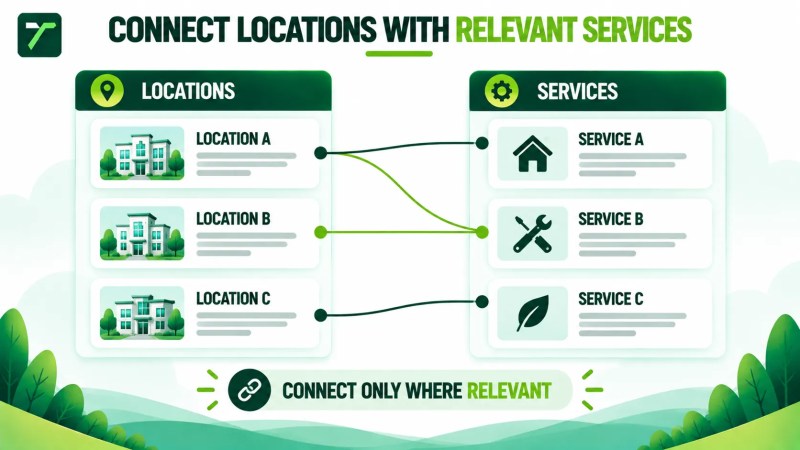
Connect Locations With Relevant Services
One of the most important architectural relationships on a service-business website is the connection between what the business does and where it does it.
Location pages and service pages should support one another without becoming duplicates.
A location page can explain which services are available in a market and link visitors to detailed service pages. Relevant service pages can also point toward locations or service areas when geographic information helps users take the next step.
A simple structure might look like:
Location Hub → Location Page → Relevant Service Pages
and, where useful:
Service Page → Relevant Locations
The connections should reflect the real business. If a service is not offered in a particular location, the site should not imply otherwise merely to create another internal link or geographic keyword combination.
Avoid Building Every Service × Location Combination
Suppose a business offers eight services across ten markets. That does not automatically mean it needs eighty separate service-and-location pages.
Creating every mathematical combination can quickly produce pages with very similar purposes and content.
Instead, determine whether users genuinely need a dedicated page for a particular service in a particular market. In many cases, a strong service page connected to useful location pages can communicate the relationship without another URL.
Traffisite’s guide to service page structure SEO explains how service pages can be organized as their own layer while still connecting naturally with geographic content.
Avoid Repetitive Location Pages
A common location-page problem is creating a template and replacing little more than the city name.
For example, if several pages contain essentially the same introduction, service descriptions, benefits, FAQs, and calls to action, changing a handful of geographic references may not give each page a meaningful individual purpose.
Google’s spam policies for Google Search specifically identify doorway abuse involving pages targeted at different regions or cities that funnel users toward the same destination, as well as substantially similar pages created closer to search results than a clear, browsable hierarchy.
This does not mean location pages must avoid shared layouts or that every sentence must be different. The more useful question is whether each page has a genuine role and provides information that makes sense specifically for the location it represents.
Start With Real Differences
Instead of rewriting generic paragraphs repeatedly, build location pages around information that actually differs.
Depending on the business, those differences could include:
- services available at the location
- physical address and contact information
- office or service hours
- staff or teams associated with the location
- service boundaries or coverage information
- access or arrival information
- location-specific customer questions
- other practical details unique to that market
If there is almost nothing meaningful to say about one market that is not already communicated elsewhere, that can be a sign that a dedicated page may not be necessary. Thoughtful SEO content planning for location pages can help distinguish markets that warrant standalone pages from those better covered by broader content.
A broader local SEO content strategy can help determine which geographic topics deserve core pages and which are better handled through existing services, locations, or supporting content.
Physical Locations vs Service Areas
A physical location and a service area are not the same thing.
For Google Business Profile purposes, Google distinguishes a service-area business that visits or delivers to customers but does not serve them at its business address from a hybrid business that both serves customers at its address and visits or delivers to customers. Website location pages should likewise avoid implying that a service market is a physical office when it is not.
A multi-location company may need dedicated website pages for its genuine branches while also explaining broader areas those branches serve. A mobile or home-service company may operate from one base while serving customers across many surrounding communities.
Traffisite’s article on service area business SEO explores the broader website and local-search considerations for businesses that travel to customers rather than relying primarily on customer visits to multiple storefronts.
Keep Google Business Profile and Website Information Accurate
Website location architecture and Google Business Profile structure are related, but they should not be treated as interchangeable.
A business can describe genuine service markets on its website without creating a separate Google Business Profile for every area it serves. Under Google’s Business Profile guidelines, a service-area business generally uses one profile for the location from which it operates, while businesses with separate eligible locations, service areas, and staff may qualify for a profile for each location.
Google’s guidelines also distinguish among storefront, service-area, and hybrid businesses and require businesses to represent their real-world locations and service areas accurately. Those platform requirements should be evaluated separately from decisions about how geographic content is organized on the website.
Traffisite’s guide to Google Business Profile for multiple locations provides additional context for businesses managing more than one eligible location.
Internal Linking for Location Pages
Creating a location page is only part of the job. Important pages also need useful paths into and out of them.
Internal links help users move between related parts of the website. For location content, that commonly means connecting location hubs, individual geographic pages, relevant service pages, and other useful supporting content.
Link From Logical Parent and Related Pages
Potential internal-link relationships can include:
- the main navigation or location hub linking to important location pages
- location pages linking to services genuinely available there
- service pages linking to relevant locations where useful
- supporting articles linking to an appropriate service or location page
- related location pages connecting when the relationship genuinely helps navigation
Avoid adding links solely because two pages share a city or service keyword. The link should help someone continue to a useful next destination.
Traffisite’s internal linking guide covers the broader principles behind connecting related pages and maintaining useful pathways through a website.
Watch for Orphaned Location Pages
If a location page is published but has no meaningful internal links pointing to it, users may have difficulty discovering it through normal site navigation.
Location pages should be incorporated deliberately into the website rather than created and left as isolated URLs.
Traffisite’s article on orphan pages SEO explains the structural problem created when pages lack internal links from the rest of the website.
Measure Location Page Performance
Once location pages are published, evaluate them as part of the broader website rather than judging them solely by whether one location keyword changes position.
Depending on the business and its tracking setup, useful areas to review may include:
- organic visibility for relevant geographic searches
- organic traffic to important location pages
- engagement with relevant service links
- enquiries or other qualified conversions associated with location pages
- whether important location pages are indexed and accessible
- whether visitors can move effectively between locations and services
The purpose of measurement is not simply to collect more location-level numbers. It is to understand whether the geographic section of the site is helping the right visitors find relevant services and take useful next steps.
Traffisite’s guide to local SEO reporting covers the broader process of organizing local-search performance information into a useful reporting system.
Location Page SEO Checklist
Use this checklist when planning or reviewing location pages for a service-business website:

- Confirm the geographic relationship. Determine whether the page represents a real physical location or a market the business genuinely serves.
- Define the page’s purpose. Identify what useful information someone in that location should find there.
- Confirm service availability. Make sure the page only associates the location with services genuinely offered there.
- Add accurate location information. Include appropriate address, contact, hours, access, or service-area details where relevant.
- Avoid template-only differentiation. Do not rely primarily on replacing city names across otherwise identical pages.
- Connect relevant service pages. Let detailed service pages explain the services instead of duplicating them unnecessarily.
- Place the page in the site hierarchy. Make important location pages discoverable through a logical location hub, navigation path, or other relevant page.
- Build useful internal links. Connect locations, services, and supporting content where those relationships help users.
- Check for overlapping pages. Review whether another page already serves substantially the same purpose.
- Measure useful outcomes. Evaluate visibility and traffic alongside enquiries, navigation behavior, and other meaningful business outcomes.
Location Pages SEO FAQ
What is a location page for SEO?
A location page is a website page that explains a business’s presence or service relationship with a specific geographic area. Depending on the business, it may represent a real physical branch or a genuine service market.
Do location pages help SEO?
Location pages can support a local-search strategy when they represent genuine locations or markets, provide useful information, and fit logically into the website. Creating large numbers of repetitive geographic pages does not by itself make the pages more useful or guarantee stronger search performance.
How many location pages should a business have?
There is no universal number. The appropriate number depends on the business’s real locations, service markets, available information, website structure, and whether each page has a meaningful purpose. The goal should not be to reach a particular page count.
Should every city a business serves have a separate page?
No. A separate city page should be created when it has a useful role and accurately represents the business’s relationship with that market. Some areas can be communicated effectively through broader location or service-area structures without receiving their own URLs.
What should a location page include?
A location page can include accurate geographic information, services available in the area, contact information, real address and hours where applicable, useful access or service-area details, relevant staff information, links to service pages, and a clear next step. The exact content should reflect what is genuinely useful for that location.
Should location pages and service pages contain the same content?
No. Service pages should primarily explain what the business provides, while location pages should provide geographic context. The pages can link to one another so visitors can understand both the service and where it is available without unnecessarily duplicating the same information.
Should location pages be linked from the website?
Important location pages should have logical internal paths from relevant areas of the website. Depending on the site’s structure, that may include a locations hub, navigation, service pages, or contextual internal links.
What is the difference between a location page and a service-area page?
A physical location page typically represents a genuine office, branch, store, or facility. A service-area page describes a geographic market the business serves and should accurately distinguish that market from a physical business location.
Build Location Pages Around Real Business Structure
Effective location pages start with the business itself: where it actually operates, which markets it genuinely serves, what services are available in those areas, and what information customers need before taking the next step.
From there, the website can connect location pages with service pages, navigation, internal links, and supporting content in a structure that is understandable and maintainable.
The objective is not to publish the largest possible collection of city pages. It is to create useful geographic pages that have clear purposes and fit naturally into the wider website.
For the broader framework behind geographic visibility, business information, local content, and measurement, Traffisite’s local SEO guide provides additional strategic context.