

Local SEO can help a business become easier to discover when potential customers search for relevant services in the areas it serves. But the value of local SEO is broader than simply improving a ranking position.
For service businesses, the potential benefits can extend across the customer journey: improving relevant search visibility, connecting customers with useful service and location information, strengthening important business information, supporting customer evaluation, and creating clearer paths toward enquiries or other meaningful actions.
Quick Answer: Local SEO can support greater visibility for relevant local searches, help prospective customers find useful business information, strengthen the connection between services and locations, support customer evaluation, and contribute to measurable actions such as calls, enquiries, bookings, or website visits. These benefits are not guaranteed, and businesses should evaluate local SEO using both search-performance indicators and meaningful customer actions.
Improve Relevant Local Search Visibility
One of the clearest potential benefits of local SEO is improving a business’s ability to appear when people search for relevant services, businesses, or needs connected to a particular area.
The goal should not simply be to appear for as many searches as possible. Useful visibility comes from reaching searches that align with what the business actually offers and where it legitimately operates.
That can involve improving several parts of the local search presence, including:
- Relevant service pages
- Useful location or service-area content
- An eligible Google Business Profile
- Accurate business information
- Supporting informational content
- Internal links between related pages
A broader local SEO strategy can help coordinate these elements instead of treating visibility as the result of one isolated tactic.
Connect Services With the Locations You Serve
Local search often combines two important questions: what does the customer need, and where do they need it?
A useful local SEO strategy helps make that relationship clear. Service pages can explain what the business offers, while appropriate location or service-area content can help customers understand where those services are available.
This is particularly relevant for local service businesses whose customers need to determine whether a provider offers the required service in their area.
The objective is not to create a page for every possible keyword-and-location combination. Pages should have a distinct user purpose, accurately represent the business’s service coverage, and provide useful information rather than functioning as substantially similar geographic funnel pages.
Help Customers Find Useful Business Information
Local SEO can also help prospective customers find and confirm important information about a business.
Depending on the business, platform, and available features, useful customer-facing information may include:
- Business name
- Services
- Address or service area
- Hours
- Phone number
- Website
- Photos
- Customer reviews
For eligible businesses, Google Business Profile can be one customer-facing source for business information in Google Search and Maps. The website and other relevant listings may provide additional context.
Maintaining accurate information does not guarantee that a customer will choose the business, but it can help reduce unnecessary confusion during discovery and evaluation.
Traffisite’s guide to Google Business Profile optimization explains how businesses can review and maintain applicable profile information.
Support Customer Evaluation
Being discovered is only one part of the customer journey. After finding a business, a prospective customer may compare services, locations, reviews, website information, and other available details before deciding what to do next.
Local SEO can support this evaluation process by making useful information easier to find and understand.
For example, a well-developed service page can explain what the service involves, while relevant location information can clarify coverage. Genuine customer reviews may provide additional information about previous customer experiences.
The benefit here is not simply a higher search position. It is creating a more useful path from discovery to an informed next step.
Support Local Lead Generation
For many service businesses, the commercial objective behind local SEO is not traffic alone. The business ultimately wants relevant prospective customers to take meaningful actions.
Depending on the business, those actions might include:
- Calling
- Submitting an enquiry
- Requesting a quote
- Booking an appointment
- Visiting a physical location
Local SEO can support this process by connecting relevant searches with useful customer-facing information and clear conversion paths. It cannot guarantee that every search impression, profile interaction, or website visit will become a lead.

Traffisite’s guide to local SEO lead generation explains this relationship from discovery through customer action in more detail.
Businesses focused specifically on increasing relevant enquiries can also review Traffisite’s approach to generating more local leads.
Build a More Durable Search Presence
Another potential benefit of local SEO is that many improvements involve assets the business can continue maintaining and refining over time rather than relying only on temporary campaign activity.
Examples can include:
- Improved service pages
- Useful location content
- Better internal linking
- Accurate customer-facing business information
- Relevant supporting content
- Legitimate local or industry relationships
That does not mean SEO produces permanent rankings or that completed work never needs attention again. Websites change, competitors change, business information changes, search demand evolves, and technical issues can appear.
Local SEO is therefore better treated as an ongoing business process than a one-time attempt to secure a fixed search position.
For businesses comparing different acquisition approaches, Traffisite’s SEO vs paid search comparison provides additional context around how organic search and paid search differ.
Measure Local SEO Results
Understanding local SEO benefits requires measuring more than rankings.
Rankings can provide information about search visibility, but they do not show the entire customer journey. Traffic can show that people reached the website, but traffic alone does not reveal whether those visitors became useful enquiries.
Depending on the business’s tracking setup, eligibility, platform features, and available data, local SEO results may be evaluated using:
- Visibility for relevant local searches
- Organic traffic to priority service and location pages
- Search queries associated with important pages
- Available Google Business Profile performance information for verified profiles
- Calls
- Form submissions
- Quote requests
- Bookings or other measurable customer actions
These measurements answer different questions. Search visibility can help show whether the business is being discovered. Website data and available Business Profile interaction metrics can provide information about how people interact with the business online. Conversion tracking can help connect search activity with measurable business actions when reliable tracking is available.
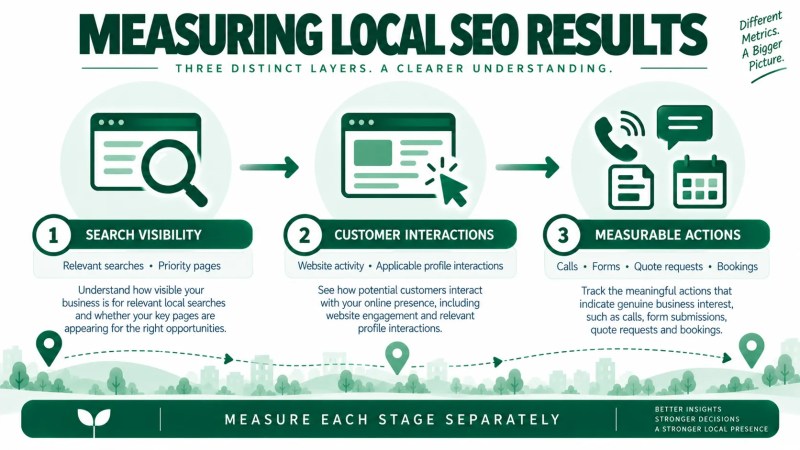
Traffisite’s guide to local SEO reporting provides a more detailed framework for evaluating these measurements together.
Set Realistic Expectations for Local SEO Benefits
Local SEO can create valuable opportunities, but it should not be evaluated as a guaranteed formula for rankings, traffic, or leads.
Results can vary according to factors such as:
- The business’s starting search presence
- The relevance and usefulness of its website
- The services and locations involved
- The competitive environment
- Technical website health
- The accuracy and quality of customer-facing business information
- How well interested visitors can take the next step
This is why meaningful evaluation should begin with the business objective. A company trying to increase enquiries for a priority service may need to examine different measurements from a company focused on improving visibility in a new service area.
A structured local SEO audit can help establish the current position before deciding which improvements deserve priority.
Frequently Asked Questions
What are the main benefits of local SEO?
Potential benefits include improving relevant local search visibility, helping customers find useful business and service information, connecting services with legitimate service areas, supporting customer evaluation, and creating clearer paths toward enquiries or other meaningful actions.
Does local SEO guarantee more customers?
No. Local SEO can improve opportunities for relevant customers to discover and evaluate a business, but visibility does not guarantee that a person will contact or choose the business. Service fit, competition, reputation, pricing, customer experience, and other factors can influence the final decision.
How do you measure local SEO results?
Local SEO results can be evaluated using a combination of relevant search visibility, organic traffic to priority pages, available Business Profile performance information for verified profiles, and measurable customer actions such as calls, forms, quote requests, or bookings when reliable tracking is available.
Is local SEO only useful for businesses with physical locations?
No. Eligible service-area businesses that travel to customers rather than serving them at a customer-facing storefront can also use a Google Business Profile, and local search strategies may be relevant to those businesses. The appropriate website and Business Profile setup depends on how the business operates.
How long do local SEO benefits last?
There is no fixed duration that applies to every improvement. Useful website content and accurate business information can remain valuable assets, but businesses should not assume that a particular search position will remain fixed over time. Important pages, profiles, technical health, and customer-facing information should be reviewed as the business and search environment change.
Is local SEO worth measuring if rankings improve?
Yes. Ranking improvements provide information about visibility, but businesses should also evaluate whether relevant pages receive useful traffic and whether measurable customer actions are occurring. Rankings and business outcomes should not be treated as the same measurement.
Evaluate Local SEO by the Business Value It Supports
The strongest local SEO benefits are not limited to ranking positions. A coordinated strategy can help relevant customers discover the business, understand its services and coverage, evaluate useful information, and reach an appropriate next step.
Measure those stages separately and compare them over time. That provides a more useful picture of local SEO results than relying on a single ranking, traffic number, or profile metric.