

SEO keyword research for a service business starts with understanding what potential customers actually need, not with collecting the largest possible list of search terms.
A customer might search for the name of a service, describe the problem they need solved, add a city or service area, compare options, ask a question, or look for a provider ready to hire. Those searches represent different needs and often belong on different pages of a website.
The goal is to identify useful search themes, understand the intent behind them, and connect each important topic with the page best suited to answer it.
Quick Answer: To find SEO keywords for a service business, start with your core services and expand into customer problems, service variations, locations, questions, and related search intent. Group closely related terms into topics instead of creating a separate page for every keyword variation. Then map each topic to the most appropriate service page, location page, blog post, guide, or other useful page based on what the searcher is trying to accomplish.
What Are SEO Keywords for Service Businesses?
SEO keywords for service businesses are the words and phrases people use when searching for services, providers, solutions to problems, local options, pricing information, comparisons, or answers related to a service.
For a plumbing company, that might include searches around drain cleaning, leaking pipes, water heaters, emergency plumbing, plumbing costs, or finding a plumber in a particular area. A professional-services company may have a very different vocabulary, but the research principle is the same: understand how potential customers describe what they need.
Keyword research helps turn those searches into a practical content and website plan. It can help determine which services deserve dedicated pages, which questions belong in supporting content, which local topics need coverage, and how related pages should connect.
This is one part of a broader SEO content strategy. The objective is not simply to place keywords into copy. It is to understand demand and organize useful content around the topics that matter to potential customers.
Think in Topics, Not Isolated Keywords
One service can be described in several closely related ways.
For example, a customer looking for help with a blocked drain may use different wording from another customer with the same underlying need. Those variations do not automatically require separate pages.
Instead, identify the main topic and the related language around it. A strong service page can often address a primary service, relevant variations, common problems, and supporting questions together when they share the same underlying intent.
This approach also helps avoid building a website full of thin pages created only to target slight wording differences. Google’s spam policies specifically warn about doorway abuse involving pages created to rank for similar queries, including substantially similar pages and pages targeted at regions or cities that funnel users toward the same destination.
Start With Your Core Services
Your service list is usually the most practical starting point for keyword research.
Write down every meaningful service the business actually offers. Avoid beginning with keyword tools. Start with the business itself.
For each service, consider:
- the standard name of the service
- alternative terms customers may use
- specific versions of the service
- the type of customer who needs it
- the problems that lead someone to need it
- related services customers commonly consider
For example, a cleaning company should not stop at a broad term such as “cleaning services.” Residential cleaning, commercial cleaning, deep cleaning, move-out cleaning, and other genuinely distinct offerings may represent different customer needs.
The important distinction is whether the business actually provides the service and whether the search represents a meaningfully different need.
Separate Broad Services From Specific Services
Broad keywords can help you understand a market, but specific service searches often reveal more about what the customer wants.
Consider a contractor that offers several types of work. A broad search for a contractor says relatively little about the exact job. A search for a specific service provides more context about what the customer is trying to accomplish.
Use your service hierarchy to organize these relationships:
- business category
- core service
- service subtype
- customer problem
- supporting questions
This research can later inform service page structure and help determine which topics deserve dedicated pages versus supporting sections within a broader service page.
Research the Problems Customers Are Trying to Solve
Customers do not always know the professional name of the service they need.
They may search for the symptom or problem instead.
A homeowner might describe water where it should not be, an electrical issue, stains on an exterior surface, unusual HVAC behavior, pests in a particular part of the property, or another observable problem before knowing which service solves it.
Problem-based keyword research helps you identify those earlier-stage searches.
For each core service, ask:
- What usually causes someone to need this service?
- What symptoms might they notice?
- How would a non-expert describe the problem?
- What might they search before knowing the service name?
- What concerns could delay them from contacting a provider?
These searches can reveal useful topics for service-page sections, FAQs, troubleshooting articles, educational content, and other supporting pages.
Connect Problems Back to Services
Problem-based content should not become disconnected from the commercial parts of the website.
If an article explains a problem that a particular service solves, a contextual internal link can help the reader move from understanding the issue to exploring the relevant service.
This is one reason internal linking matters in a service-business content strategy. Informational and commercial pages can support different stages of the same customer journey.
Add Relevant Location Keywords
Location can become an important part of keyword research when the business serves customers in defined geographic markets.
Start with the locations the business genuinely serves rather than generating every possible city-and-service combination.
Useful location research may include:
- primary city or market
- important surrounding service areas
- service plus city combinations
- service plus neighborhood or regional terminology where genuinely relevant
- location-specific customer needs
The research should help answer a practical question: where does the business need useful local content because it actually serves customers there?
For service-area businesses, the relationship between services and geographic coverage requires particular care. Traffisite’s guide to service area pages explains how those pages can fit into a local website without relying on near-duplicate city pages.
Do Not Turn Every Location Keyword Into a Page
Finding a location-modified keyword does not automatically justify creating a location page.
A dedicated page should have a meaningful purpose for users. The business should genuinely serve the area, and the page should be able to provide useful information rather than simply replacing one city name with another.
Businesses operating from physical locations can also evaluate their geographic page strategy through a broader location page SEO framework.
The keyword list should inform the architecture. It should not dictate hundreds of pages without considering whether those pages are useful or distinct.
Find the Questions Customers Ask
Questions can reveal what customers need to know before, during, and after deciding to hire a service provider.
Common themes include:
- cost and pricing
- how a service works
- how long a process takes
- when a service is necessary
- differences between service options
- preparation requirements
- maintenance and aftercare
- safety or suitability concerns
- what causes a particular problem
Some questions belong directly on service pages because they help someone make a hiring decision. Others deserve dedicated articles because the answer requires more depth.
Use Real Customer Language
Keyword tools are useful, but they are not the only source of keyword ideas.
Service businesses can also collect language from:
- sales enquiries
- customer emails
- phone-call notes
- quote requests
- support questions
- reviews
- frequently asked questions from staff
These sources can reveal terminology that internal teams take for granted but customers describe differently.
Do not publish private customer information or copy individual customer messages into content without appropriate permission. The objective is to identify recurring language and questions.
Understand the Search Intent Behind the Keyword
A keyword becomes more useful when you understand what the searcher appears to want.
Two keywords can discuss the same service while requiring very different pages.
For practical service-business research, you can think about intent in terms such as:
- Service intent: the searcher appears to be looking for a provider or specific service.
- Local intent: the searcher is looking for a service or provider relevant to a particular area.
- Informational intent: the searcher wants to understand a problem, process, cost, requirement, or concept.
- Comparison intent: the searcher is evaluating different services, methods, providers, or approaches.
- Brand or navigational intent: the searcher is looking for a specific company, website, product, or resource.
These labels are useful planning tools, but the important question is simpler: what would satisfy the person making this search?
Use the Search Results as Research Evidence
Google’s Search Essentials recommends creating helpful, reliable, people-first content, and Google’s people-first content guidance explains that SEO can be useful when it is applied to people-first rather than search-engine-first content.
As a practical research step, inspect the search results for a keyword to see what kinds of pages currently appear. Look at whether the results are mainly service pages, local results, articles, category pages, comparison content, videos, or a mixture.
The current search results are not a permanent template, and they should not be copied. They can, however, provide useful context when interpreting what people searching that query may need.
This step is particularly useful when a keyword could reasonably belong to either a commercial service page or an informational article.
Build a Repeatable Keyword Research Process
Once you understand the main keyword sources, combine them into a repeatable workflow.
- List the services. Start with the services the business actually provides.
- Expand each service. Add service variations, customer terminology, and closely related needs.
- List customer problems. Identify symptoms, pain points, and situations that lead someone to need each service.
- Add geographic context. Research relevant cities, service areas, and other genuine geographic modifiers.
- Collect customer questions. Include cost, process, timing, comparisons, preparation, and other recurring concerns.
- Use keyword research tools. Expand and validate ideas with available keyword data rather than relying on brainstorming alone.
- Inspect search results. Review the apparent intent and the types of pages currently surfaced.
- Group related terms. Combine keywords that represent substantially the same topic and intent.
- Map each group to a page. Decide whether the topic belongs on an existing page, needs a new page, or does not justify content.
- Prioritize. Focus on topics that combine business relevance, useful search demand, appropriate intent, and realistic content opportunities.
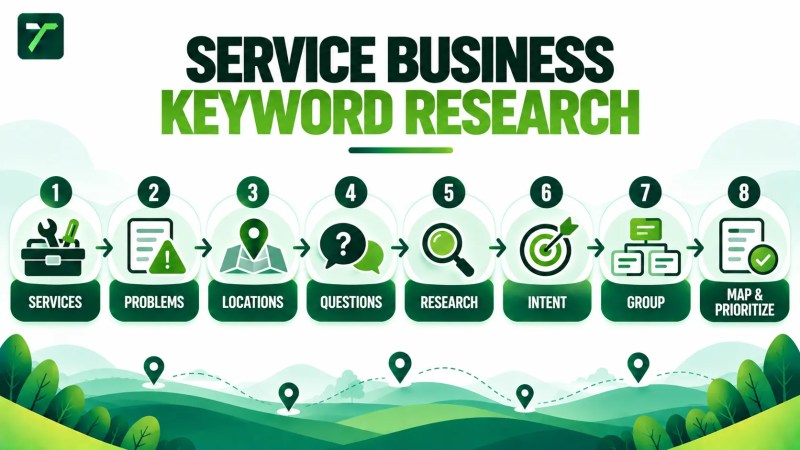
Keyword tools can support several stages of this process. Traffisite’s SEO tools resource provides a broader starting point for the types of tools used in SEO research and measurement. Google’s documentation also describes using Google Trends for keyword research, including identifying terms and topics connected to a website and reviewing related topics and queries.
Do Not Treat Search Volume as the Only Decision
Keyword tools can provide useful search-demand data, but that data should be treated as one input rather than the entire prioritization decision. For example, Google describes Keyword Planner’s monthly-search figures as estimates.
For a service-business content plan, it can therefore make sense to prioritize a highly relevant service term over a broader topic simply because the broader topic reports more searches.
Consider several factors together:
- relevance to a real service
- search intent
- geographic relevance
- business value
- existing website coverage
- ability to create genuinely useful content
- available keyword data
- competition and the current search landscape
The goal is not to find the keyword with the largest number beside it. It is to identify search opportunities that make sense for the business and its customers.
Map Keywords to the Right Pages
After collecting and grouping keywords, decide where each topic belongs.
A practical keyword map might connect:
- core service terms to service pages
- distinct service variations to specific service pages where justified
- location-focused service needs to useful location or service-area pages
- customer questions to FAQs or blog articles
- broad educational topics to guides
- comparison searches to comparison content

This prevents keyword research from becoming a disconnected spreadsheet with no effect on the website.
Service Page or Blog Post?
One of the most common mapping decisions is whether a keyword belongs on a service page or a blog post.
If the searcher appears ready to understand or hire a particular service, a service page may be the better destination. If the searcher primarily needs an explanation, troubleshooting help, research, or education, an article may be more appropriate.
Traffisite’s comparison of service pages vs. blog posts explores this distinction in more detail.
Avoid Creating Multiple Pages for the Same Intent
Keyword lists often contain many similar phrases. If every variation becomes a separate page, several pages may end up trying to satisfy essentially the same search need.
Before creating a new URL, ask:
- Does this keyword represent a genuinely different service or question?
- Is the search intent meaningfully different?
- Can an existing page satisfy this topic well?
- Would a new page provide distinct value?
- How would the new page fit into the website structure?
This is where keyword research and SEO website architecture intersect. Keywords help identify topics, while architecture determines how those topics should be organized into a coherent website.
Prioritize the Right Keywords for the Business
A service business usually cannot create or improve every possible page at once. Keyword research therefore needs a prioritization step.
Start with topics that are closely connected to the services the business most needs customers to find.
A simple prioritization review can consider:
- Service relevance: Does the business actually provide what the searcher wants?
- Intent fit: Can the planned page satisfy the apparent search need?
- Business importance: Is the service or topic meaningful to the company’s goals?
- Current coverage: Does the website already have a useful page for it?
- Search opportunity: Does the available research indicate relevant search demand?
- Content gap: Can the business add genuinely useful information that is currently missing from its site?
These factors help turn a large keyword export into a manageable content plan.
Before expanding the content plan, a prioritized SEO audit can help identify existing page and technical issues that may need attention first.
For service businesses building a broader SEO program, the SEO for service businesses guide provides additional context for connecting keyword research with website structure, content, local visibility, authority, and measurement.
Common Service Business Keyword Research Mistakes
Keyword research becomes less useful when the spreadsheet takes priority over the customer and the website.
Watch for these mistakes:
- targeting services the business does not actually provide
- choosing keywords only because they have high reported search volume
- ignoring customer problems and questions
- creating separate pages for minor wording variations
- generating large numbers of weak location pages
- assuming every keyword needs a new URL
- ignoring the intent behind the search
- mapping several existing pages to essentially the same topic without a clear reason
- collecting keywords without turning them into a content or page plan
A useful keyword strategy should make the website clearer, not more complicated.
SEO Keywords for Service Businesses FAQ
How do I find keywords for my service business?
Start by listing your actual services, service variations, customer problems, relevant locations, and common customer questions. Expand those ideas with keyword research tools and real customer language, review the apparent search intent, group related terms, and map each useful topic to the appropriate page.
Should every service have its own SEO keyword?
Every meaningful service should be researched, but it does not need to target only one keyword. A useful service page can address a main service topic alongside closely related variations, terminology, questions, and supporting concepts when they share the same intent.
Should every keyword have its own page?
No. Closely related keywords often represent the same underlying topic and can be covered by one useful page. Create a separate page when the keyword represents a meaningfully different service, location need, question, or search intent that deserves distinct content.
Are local keywords important for service businesses?
They can be important when location affects how customers search for the service. Research should reflect the areas the business genuinely serves and should not automatically lead to a separate page for every city-and-service combination.
What is a good keyword for a service business?
A useful keyword is relevant to something the business actually offers or can meaningfully explain, reflects a real customer need, has an appropriate search intent, and can be supported by a page that genuinely helps the searcher. Search-demand data can inform the decision, but it should not be the only criterion.
How many keywords should a service page target?
Rather than following a fixed keyword count, focus the page on one coherent service topic and the closely related terms, questions, and concepts needed to explain that topic naturally.
Where can service businesses get keyword ideas besides SEO tools?
Useful ideas can come from sales conversations, enquiries, quote requests, support questions, reviews, staff experience, service documentation, and recurring customer concerns. These sources can help reveal how customers describe their needs in their own language.
Turn Keyword Research Into a Useful Website Plan
The most valuable output of keyword research is not a spreadsheet containing thousands of terms. It is a clearer understanding of what potential customers need and how the website should respond.
Start with real services. Expand into customer problems, locations, questions, and search intent. Group related terms into meaningful topics, map those topics to the right pages, and prioritize the opportunities that matter most to the business.
When keyword research informs both content and website structure, it becomes a practical foundation for helping the right pages address the right searches.