

People searching for a cleaning company often have a specific service and location in mind. They may need recurring house cleaning, office cleaning, move-out cleaning, carpet cleaning, or another specialized service in an area the company serves.
SEO for cleaning companies helps a website represent those services and markets clearly. The objective is not simply to attract more website visits. It is to help relevant prospective customers find the appropriate page, understand the offer, and take a useful next step.
Quick Answer: Cleaning company SEO improves how a residential or commercial cleaning business appears in relevant searches. A practical strategy usually combines focused service pages, accurate location information, Google Business Profile optimization, useful supporting content, trustworthy business information, sound website structure, and ongoing measurement.
What Cleaning Company SEO Means
Cleaning company SEO is the process of improving a cleaning business’s website and wider search presence so relevant customers can discover its services.
For a local operator, that may include searches related to house cleaning in a particular city. A commercial provider may need visibility for office cleaning, janitorial services, medical-office cleaning, retail cleaning, or other specialized work across a defined service area.
The strategy therefore needs to reflect three basic facts:
- Which cleaning services the company actually provides
- Which customers or property types it serves
- Where the company can realistically complete the work
This is why an effective strategy begins with the business itself. Keyword research can reveal how people search, but it should not persuade a company to promote services or locations it cannot support.
Cleaning businesses that depend on a defined geographic market can use local SEO services to coordinate their website, local search presence, and ongoing improvements around the areas they genuinely serve.
Start With Services and Markets
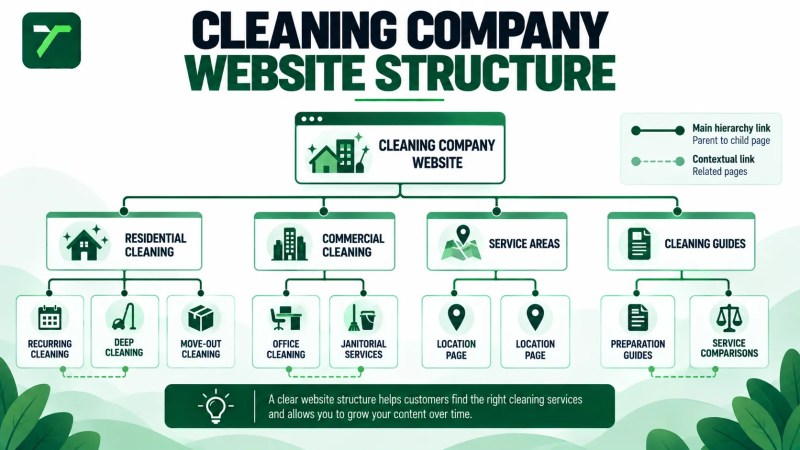
Before creating pages, list the company’s active services and divide them into meaningful groups. A residential cleaner and a commercial janitorial provider may both operate in the cleaning industry, but their customers, sales cycles, terminology, and proof requirements can differ substantially.
Residential cleaning examples
- Recurring house cleaning
- Deep cleaning
- Move-in and move-out cleaning
- Apartment cleaning
- Post-construction cleaning
- Carpet or upholstery cleaning
Commercial cleaning examples
- Office cleaning
- Janitorial services
- Retail cleaning
- Medical-office cleaning
- School or daycare cleaning
- Industrial or warehouse cleaning
These lists should be treated as examples rather than a required page inventory. A company should create pages only for services it genuinely offers and can explain with enough detail to help a prospective customer.
The same principle applies to geography. Define the primary market, nearby service areas, travel limitations, and any differences in service availability. A clear operating model provides a stronger foundation than a collection of pages targeting every nearby town.
The broader guide to SEO for service businesses explains how services, customer needs, and market coverage should shape the website rather than being added after the site is already built.
Build Useful Service Pages
A cleaning company’s most important commercial pages should explain its actual services. When every service is compressed into a few lines on the homepage, visitors may struggle to determine whether the company handles their particular cleaning need.
A focused service page can address:
- What the service includes
- Which properties or customers it suits
- What may affect the scope of work
- How the company approaches scheduling or preparation
- What the customer should expect next
- How to request an estimate or consultation
The page should contain enough original information to stand on its own. Replacing only the service name in an otherwise duplicated template produces a group of pages that are difficult for customers to distinguish.
Service pages and educational articles also have different roles. A service page helps someone evaluate an offer, while a blog post answers a focused question or supports research. The distinction is explored further in the comparison of service pages versus blog posts.
Match each page to a clear search need
A page about recurring house cleaning should not try to address every residential and commercial cleaning need at once. Its headings, examples, proof, and call to action should remain centered on the customer who needs that particular service.
This does not mean repeating one keyword throughout the page. It means answering the questions someone would reasonably have before contacting the business.
Create Location Pages Carefully
Location pages can help a cleaning company explain where it operates, but only when each page serves a real business and customer purpose.
Avoid producing substantially similar location pages created mainly to capture geographic search variations and direct visitors to the same destination. Google identifies this kind of pattern as doorway abuse. A legitimate location page should instead provide useful information about the services and operations available in that market.
A useful location page may include:
- The services available in that market
- Relevant scheduling or coverage information
- Local proof that can be supported accurately
- Property types commonly served in the area
- A clear path to the appropriate service pages
- An inquiry method for customers in that location
Do not claim to have an office, team, customer, or completed project in a place unless that statement can be verified. Location relevance should come from accurate operational information rather than decorative references to landmarks.
Companies serving several legitimate markets should establish a controlled structure before expanding. The guide to local SEO for multiple locations covers how to organize markets without producing an unmanageable collection of repetitive pages.
Improve Local Search Presence
A cleaning company’s website is one part of its wider local search presence. Google’s Business Profile guidelines require businesses to represent themselves accurately and use precise information for their real-world name, address or service area, categories, phone number, website, and customer-facing hours.
Maintain an accurate Google Business Profile
Review the profile whenever important business information changes. Google recommends keeping Business Profile information complete and accurate so customers can understand what the business does, where it operates, and when it is available.
Photos can also help customers understand the business. Use authentic images of the team, vehicles, equipment, completed work, and operating environment when appropriate and permitted. Avoid presenting stock photography as evidence of the company’s own work.
A complete approach to Google Business Profile optimization should keep the profile aligned with the website and the company’s real-world operations.

Use location-focused keyword research responsibly
Customers may use different language when searching for cleaning services. One person may search for a house cleaner, another for a maid service, and a facilities manager may look for commercial janitorial services.
Research should identify these differences without producing one thin page for every wording variation. Closely related phrases can often be addressed naturally on one strong page when they represent the same underlying service and intent.
A structured process for local SEO keyword research can help connect real search language with the company’s actual services and locations.
Publish Supporting Content
Blog content can support a cleaning company’s commercial pages by answering questions that arise before, during, or after a service. It should not be treated as a stream of unrelated posts published only to keep the website active.
Useful topics may include:
- How to prepare a home or office for a cleaning appointment
- What affects the scope of a move-out cleaning
- How recurring cleaning differs from deep cleaning
- Questions to ask when comparing commercial cleaning providers
- How cleaning plans may differ by property type
- What customers should clarify before requesting an estimate
Each article should have a defined reader, purpose, and relationship to the company’s services. When the connection is helpful, link from the article to a relevant service page. The service page may also link to supporting guidance where that information helps a prospective customer make a decision.
Build connected subject areas
A residential cleaning company might organize content around recurring cleaning, deep cleaning, moving, and property preparation. A commercial provider might develop focused resources for facility types, scheduling, procurement questions, and ongoing cleaning programs.
This creates a connected body of information instead of random blogging. The company can expand subjects gradually as customer questions, service priorities, and available expertise justify additional content.
Strengthen Trust and Conversion
Visibility has limited value if visitors cannot determine whether a cleaning company is suitable for their needs. Important pages should reduce uncertainty and make the next step clear.
Relevant trust information may include:
- Clearly stated residential or commercial specialization
- Accurate service coverage
- Authentic customer feedback
- Original project or team photography
- Relevant insurance, training, or screening information when verifiable
- A straightforward explanation of the estimate process
- Clear phone, form, or booking options
Reviews are most useful when they are authentic and connected to the company’s real service experience. Avoid rewriting feedback in a way that changes its meaning or attaching a location to a reviewer when that location has not been confirmed.
Calls to action should also fit the page. Someone reading about office cleaning may need to request a site assessment, while a homeowner may want to ask about availability or receive an estimate. The next step should match the service rather than relying on the same generic button everywhere.
Maintain Technical Foundations
A cleaning website still needs a dependable technical foundation. Important pages should be connected through crawlable links so visitors and search engines can reach them. Pages intended for search should also be indexable, while their primary content should remain available and usable on mobile devices.
Google primarily uses the mobile version of a website’s content for indexing and recommends maintaining equivalent primary content across mobile and desktop versions. Its mobile-first indexing guidance provides the technical details.
Review areas such as:
- Mobile usability
- Page loading performance
- HTTPS and basic website security
- Indexing status for important pages
- Broken internal links
- Duplicate or outdated pages
- Logical navigation and page hierarchy
- Descriptive page titles and headings
Technical work should be prioritized according to its effect on important pages and users. A long audit export is not a strategy by itself. Each issue needs to be assessed, assigned an appropriate priority, and connected to a practical improvement.
Measure Meaningful Results
Rankings can provide diagnostic information, but a cleaning company should also measure whether organic visibility contributes to useful business activity.
Depending on the website and available tracking, meaningful indicators may include:
- Qualified phone calls
- Estimate or consultation requests
- Booking actions
- Visits to priority service pages
- Visibility in important service areas
- Conversion performance by landing page
- Changes in organic inquiries over time

Separate branded activity from non-branded discovery where possible. A person searching for the company by name represents a different type of search activity from someone discovering it while researching a cleaning service.
Reporting should lead to decisions. If an important service page receives visibility but few inquiries, review its offer, clarity, proof, and next step. If a strong page receives little qualified traffic, investigate targeting, internal linking, competition, and technical accessibility.
Cleaning Company SEO Checklist
- Document the cleaning services the company currently offers.
- Confirm the geographic markets the company can reliably serve.
- Create focused pages for important services with distinct customer needs.
- Develop location pages only for legitimate and supportable markets.
- Keep Google Business Profile information accurate and current.
- Use original business and project photography where appropriate.
- Publish content that answers real customer questions.
- Connect related services, locations, and articles with useful internal links.
- Review mobile usability, indexing, duplication, and broken links.
- Track inquiries and commercial outcomes, not rankings alone.
- Update pages when services, markets, or customer needs change.
Frequently Asked Questions
What is SEO for cleaning companies?
SEO for cleaning companies is the ongoing process of improving a cleaning business’s website and local search presence so relevant customers can find its services. It can include service pages, location targeting, Google Business Profile work, supporting content, website structure, technical improvements, and performance measurement.
Does a cleaning company need a page for every service?
Not necessarily. A separate page is useful when a service has a distinct customer need, scope, search intent, or sales process. Closely related offerings may be explained together when separating them would create thin or repetitive pages.
Should every city have its own cleaning-service page?
No. Create location pages only for areas the company genuinely serves and where the page can provide useful, accurate information. Avoid publishing substantially similar city pages created mainly to capture geographic search variations and funnel visitors to the same destination.
Is Google Business Profile enough for a cleaning company?
A Google Business Profile can provide a useful way for local customers to discover and evaluate a cleaning company, but the website serves a different role. It gives the company more room to explain services, coverage, qualifications, processes, and next steps.
What should a cleaning company publish on its blog?
Publish content that answers real questions related to the company’s services. Examples include preparation guidance, service comparisons, scheduling considerations, property-specific cleaning information, and questions customers should ask before hiring a provider.
How long does cleaning company SEO take?
There is no universal timeline. Progress depends on the website’s current condition, market competition, service coverage, available proof, implementation pace, and the type of improvement being measured. SEO should be managed as an ongoing business process rather than treated as a guaranteed short-term result.
Build a Practical Cleaning Company SEO Strategy
A cleaning company does not need hundreds of pages or a constant stream of generic articles. It needs a clear representation of its services, markets, customers, expertise, and next steps.
Start with the pages closest to revenue: the main services and legitimate service areas. Support those pages with accurate local information, useful content, authentic proof, sound internal linking, and a website that works properly on the devices customers use.
From there, review performance and improve the parts of the system that limit discovery or conversion. A focused strategy built around the real business is more sustainable than publishing pages simply because a keyword exists.