

SEO can feel complicated when a small business tries to improve everything at once. A more practical approach is to work through the website in a logical order: understand what the business needs to rank for, make sure the right pages exist, improve local visibility where relevant, strengthen content and internal links, check the technical foundations, build legitimate authority, and measure what happens next.
This small business SEO checklist organizes those areas into a process you can use to review an existing website or plan improvements to a newer one. Not every business will need the same amount of work in every section, so use the checklist to identify priorities rather than treating every item as an equal requirement.
Quick Answer: A practical small business SEO strategy starts with clear goals and a well-organized website, then reviews service pages, local visibility, useful content, internal linking, technical SEO, authority, and measurement. Work through each area, identify the biggest gaps, and prioritize improvements that support the services and markets that matter to the business.
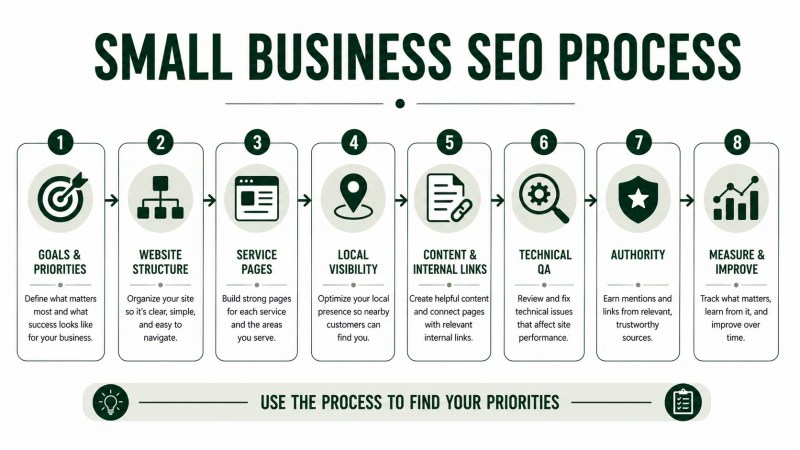
1. Define the SEO Foundation
Before changing pages or publishing content, define what the business is actually trying to accomplish through search.
Start with a few practical questions:
- Which services are most important to the business?
- Which locations or markets does the business actually serve?
- What types of searches are relevant to those services?
- Which pages already exist for those needs?
- Which parts of the website are currently weak, missing, or unclear?
- What business actions should SEO ultimately support?
The goal is not to build an enormous keyword list before doing anything else. It is to establish enough direction to make better decisions about pages, content, local SEO, and measurement.
For service companies, Traffisite’s SEO for service businesses guide provides a broader framework for connecting search strategy to services, website structure, and business goals.
2. Review the Website Structure
Next, look at how the website is organized.
A visitor should be able to understand what the business offers and move logically between important sections. Search engines can also use crawlable links between pages to discover other content on a website.
Review whether the website has a clear hierarchy connecting major areas such as:
- Homepage
- Core services
- Individual service pages
- Locations or service areas when appropriate
- Supporting guides or blog content
- About and contact information
Also look for pages that are difficult to reach, unnecessary layers of navigation, overlapping pages, or important content that has few useful internal connections.
Traffisite’s guide to website structure for SEO explains how page hierarchy and relationships can be planned more deliberately.
Website Structure Checklist
- Can visitors quickly understand the main services?
- Are important pages accessible through normal navigation or contextual links?
- Do parent and supporting pages have a logical relationship?
- Are there pages covering substantially overlapping purposes that should be reviewed?
- Can important content be reached without relying on an internal search box?
3. Strengthen the Pages That Explain Your Services
For a service business, important services should be explained clearly on pages that help potential customers understand what the business offers.
Review each important service page and ask whether it:
- Clearly identifies the service.
- Explains what the service involves.
- Addresses useful questions a potential customer may have.
- Reflects the actual service being offered.
- Provides a logical next step for the visitor.
- Connects to related pages when those links help the reader.
Avoid creating multiple pages simply because slightly different keywords exist. Each page should have a distinct purpose and enough useful information to justify its place on the website.
If you are deciding whether a topic belongs on a commercial page or in supporting informational content, Traffisite’s service pages vs. blog posts comparison explains how their roles differ.
4. Review Local Visibility
Businesses that serve customers in specific geographic areas may need to include local visibility in their SEO review.
The exact work depends on how the business operates. For businesses using Google Business Profile, review whether profile details such as location or service area, hours, categories, and other important business information are accurate and current. You may also review relevant listings, customer reviews, and location-focused website content as part of the broader local SEO process.
Local SEO Checklist
- Is the business information presented accurately?
- Does the Google Business Profile reflect the real business?
- Are the most appropriate business categories being used?
- Are hours and contact details current?
- Are relevant business listings accurate?
- Does the website clearly explain where the business operates?
- Do location-focused pages have a real purpose rather than merely swapping city names?
- Is there a process for earning and responding to legitimate customer reviews?
For a deeper review of this area, use Traffisite’s local SEO audit alongside this broader checklist.
5. Build Useful Supporting Content
Once the core website and service pages are clear, review what information potential customers may need before, during, or after evaluating a service.
Useful supporting content might explain processes, costs, comparisons, common problems, preparation, maintenance, terminology, or other questions closely connected to the services the business provides.
Content should not be created simply to increase the number of indexed pages. Each piece should have a useful purpose and a clear relationship to the rest of the website.
Content Checklist
- Does the topic address a real question or information need?
- Is there already a page serving substantially the same purpose?
- Does the content support a relevant service, topic, or customer decision?
- Is the information accurate and useful?
- Does the page have a clear place within the site’s broader structure?
- Can it naturally connect readers to other relevant pages?
A structured SEO content strategy can help turn individual content ideas into a more coherent plan.
6. Improve Internal Linking
Internal links connect pages on the same website. They can give visitors useful paths to additional information and provide crawlable links that search engines can use to discover other pages.
Review important pages individually rather than adding links everywhere simply to reach a target number.
Internal Linking Checklist
- Do important pages receive relevant internal links?
- Do service pages connect to useful supporting content?
- Can supporting articles lead readers toward relevant service or guide pages?
- Are anchor texts descriptive enough to indicate what the linked page is about?
- Are links placed where they genuinely help the reader?
- Are there important pages with very few useful internal connections?
- Are broken internal links being identified and corrected?
For a more detailed process, Traffisite’s internal linking guide explains how to evaluate page relationships and link placement across a site.
7. Check the Technical SEO Foundations
Important pages need to be accessible to users and available to search engines as intended. A technical SEO review can help identify issues that affect crawling, indexing, page delivery, or important website paths.
A technical review does not mean every small-business owner needs to become a developer. It means checking for problems that could interfere with important pages or create unnecessary confusion.
Technical SEO Checklist
- Can important pages be crawled?
- Are pages intended for search eligible to be indexed?
- Are redirects working as intended?
- Are canonical signals being reviewed where duplicate or similar URLs exist?
- Are broken links or error pages affecting important paths?
- Does the website work appropriately on mobile devices?
- Are important pages served securely?
- Are XML sitemap and crawling directives being reviewed where relevant?
- Are significant page-performance problems being investigated?
Traffisite’s technical SEO guide provides more context for these checks and how they fit into a broader SEO process.
8. Review Relevant Authority Opportunities
SEO work can also include reviewing how other websites reference or link to the business and its website.
For a local or service business, potential opportunities may come from genuine relationships with industry organizations, local organizations, business partners, community resources, publications, or other relevant websites.
When evaluating an opportunity, do not rely solely on a third-party metric. Consider why the reference or link would exist, where it would appear, and whether it makes sense for the business and the reader.
Authority Checklist
- Does the source have a genuine relationship to the business, industry, location, or audience?
- Would a mention or link make sense to a real reader?
- Is the specific page relevant to the business?
- Does the opportunity exist for a legitimate reason?
- If a link comes from a paid or sponsored relationship, is it being handled in line with applicable search-engine guidance?
- Are third-party metrics being used as supporting information rather than the entire decision?
For local businesses evaluating these opportunities, Traffisite’s guide to local SEO backlinks provides a practical relevance-first framework.
Measure What Happens and Improve the Strategy
SEO should not end when a page is published or an optimization task is completed. Search Console can provide Google Search performance data, while website analytics can report website activity and important actions configured for measurement.
Useful measurement can include:
- Google Search performance for relevant queries and pages.
- Organic landing-page activity.
- Important website actions configured for measurement.
- Google Business Profile performance where relevant.
- Crawling or indexing issues that require attention.
- Performance of priority services, pages, and content over time.
Do not evaluate SEO from a single metric in isolation. Connect visibility and website activity to the pages, services, markets, and business actions that matter.
Traffisite’s guide to SEO measurement and reporting explains how to organize this information into a more useful reporting process.
How to Prioritize This Small Business SEO Checklist
You do not need to complete every item at the same time.
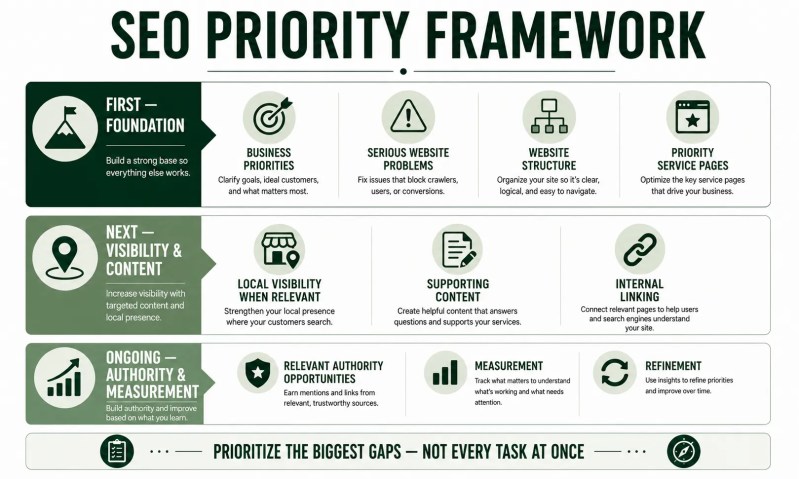
Start with issues that prevent important pages from functioning as intended or being accessible. Then make sure the website has a sensible structure and useful pages for priority services. From there, review local visibility where relevant, improve supporting content and internal links, evaluate authority opportunities, and continue measuring results.
A practical order is:
- Clarify the business priorities.
- Fix serious accessibility, crawling, indexing, or website problems.
- Organize the website and priority service pages.
- Review local visibility when the business depends on geographic searches.
- Build or improve useful supporting content.
- Strengthen relevant internal connections.
- Evaluate legitimate authority opportunities.
- Measure performance and refine priorities.
The exact order can change when a business has a specific problem that deserves immediate attention. The checklist is a practical framework for making decisions, not an official search-engine-prescribed sequence or a requirement to complete every SEO activity in a fixed order.
FAQ
What should be included in a small business SEO checklist?
A practical checklist should review business goals, website structure, important service pages, local visibility when relevant, supporting content, internal linking, technical SEO, authority opportunities, and measurement. The depth required in each area depends on the website and business.
Where should a small business start with SEO?
Start by identifying the services and markets that matter, then review whether the website has a clear structure and useful pages supporting those priorities. Serious technical problems that interfere with important pages should also be addressed early.
Does every small business need local SEO?
No. Local SEO is particularly relevant when a business wants search visibility for customers in specific geographic areas. A business without a meaningful local search component may require a different emphasis.
How often should a small business review its SEO?
There is no single review schedule that fits every business. Review frequency should reflect how often the website changes, how actively SEO work is being performed, and whether search, website, or business performance indicates that something needs attention.
Does a small business need to do every SEO task on this checklist?
No. The checklist is designed to help identify priorities. Some websites may need substantial technical work, while others may need stronger service pages, better internal linking, improved local visibility, or more useful supporting content.
Use the Checklist to Find the Next SEO Priority
A small business SEO strategy becomes more manageable when it is broken into connected areas instead of treated as one large task.
Start with the business goals and website foundation. Make sure important services are represented clearly, strengthen local visibility where it matters, create useful supporting content, connect related pages, review technical issues, evaluate legitimate authority opportunities, and measure what happens afterward.
The purpose of this small business SEO checklist is not to make every business follow an identical process. It is to give you a structured way to find the next useful improvement and understand how that work fits into the larger SEO strategy.