

A local SEO case study can make a strategy look convincing, but the headline result rarely tells the whole story.
A business may report more organic traffic, stronger local visibility, additional leads, or improved search performance after SEO work. Those outcomes can be useful evidence, but they become much more meaningful when you understand where the business started, what changed, how the results were measured, how long the work ran, and what limitations affect the comparison.
For service-business owners evaluating an SEO provider, the goal is not to find a case study that looks exactly like your business. It is to determine whether the case study clearly connects a real starting situation, specific actions, appropriate measurements, and a reasonable interpretation of the results.
Quick Answer: A useful local SEO case study should explain the business’s starting conditions, the problem being addressed, the work completed, the measurement period, the metrics used, the results observed, and important limitations. Do not evaluate a case study from percentage growth or ranking screenshots alone. Look for enough context to understand what changed, how the comparison was made, and whether the evidence supports the conclusions being presented.
What a Local SEO Case Study Should Show
A local SEO case study should tell a sequence, not just display an outcome.
At minimum, you should be able to understand:
- what type of business was involved
- what market or local-search challenge existed
- what the starting conditions were
- what SEO work was completed
- what period the case study covers
- which metrics were measured
- what changed during the measurement period
- what limitations affect the interpretation
Without those elements, it becomes difficult to determine whether a result is connected with the work described or whether important context is missing.
This matters because local SEO services can involve multiple activities, including business-profile work, website optimization, local content, technical improvements, authority building, measurement, and ongoing refinement. A case study should make it reasonably clear which activities were actually part of the project rather than attributing every change to “SEO” as one undefined action.
Think of a Case Study as Evidence, Not a Promise
A case study documents what happened in a particular situation. It does not establish that another business will receive the same result.
Markets differ. Websites begin with different levels of authority, content, technical health, competition, brand recognition, location coverage, and existing search visibility. Businesses also differ in their services, budgets, operating capacity, and ability to convert search demand into customers.
The most useful question is therefore not, “Can I get this exact result?”
Instead ask, “Does this case study show a clear process, appropriate evidence, and a reasonable connection between the work completed and the outcomes being discussed?”
Start With the Starting Conditions
A result has little meaning without a baseline.
Imagine two businesses that each gain 1,000 additional organic visits during a reporting period. If one previously received 100 visits and the other already received 50,000, the same numerical increase represents very different changes in performance.
That is why a useful local SEO case study should provide enough starting context to understand the scale and condition of the project.
Depending on the campaign, useful baseline information might include:
- existing organic search traffic
- search impressions and clicks
- important keyword or local-search visibility
- number and quality of existing service or location pages
- Google Business Profile condition
- technical or indexing problems
- existing local citations or links
- lead or conversion tracking already available
- number of business locations or service areas
Not every case study needs every measurement. The baseline should reflect the actual problem the campaign was designed to address.
For example, if the project focused primarily on generating more local enquiries, starting information about relevant search visibility, landing-page performance, and tracked conversions may be more useful than a large collection of unrelated SEO metrics.
Check Whether the Business and Market Are Explained
Context about the business can also affect how you interpret results.
A single-location contractor serving one city faces a different search environment from a multi-location company operating across several markets. A new website also starts from a different position than an established domain with years of existing content and backlinks.
You do not need every confidential business detail. You do need enough information to understand what kind of SEO situation produced the reported outcome.
Traffisite’s SEO results and case studies provide examples of how individual projects can be presented within their own business and campaign context rather than treated as universal performance benchmarks.
Identify the SEO Actions
Once the starting point is clear, look at what actually changed.
Statements such as “we improved local SEO” or “we optimized the website” are too broad to explain the work behind a result.
A stronger case study identifies the major actions completed during the campaign. Depending on the project’s scope, those actions might include:
- improving Google Business Profile information
- researching local search demand
- creating or improving service pages
- building useful location or service-area pages
- improving internal linking and website structure
- resolving crawling, indexing, or technical issues
- improving on-page content and metadata
- building or cleaning up local citations
- earning relevant backlinks
- developing supporting local content
- improving measurement and reporting
The actions should relate logically to the starting problem.
When evaluating authority-building activities in a case study, check whether the actual link outreach, relevant mentions, and resulting work are described rather than relying on a backlink count alone.
For example, if a business had weak pages for its core services, improvements to service-page structure and content have a clear relationship to that issue. If a multi-location business had poorly differentiated location pages, location architecture and page improvements would be more directly relevant.
This is where understanding the wider local SEO process can help. Knowing the major components of local SEO makes it easier to evaluate whether the actions described in a case study actually address the stated problem.
Look for a Strategy, Not Just a Task List
A long list of completed tasks does not automatically demonstrate a coherent strategy.
Look for the relationship between the problem and the work:
Starting condition → identified problem → action → measurement → observed result
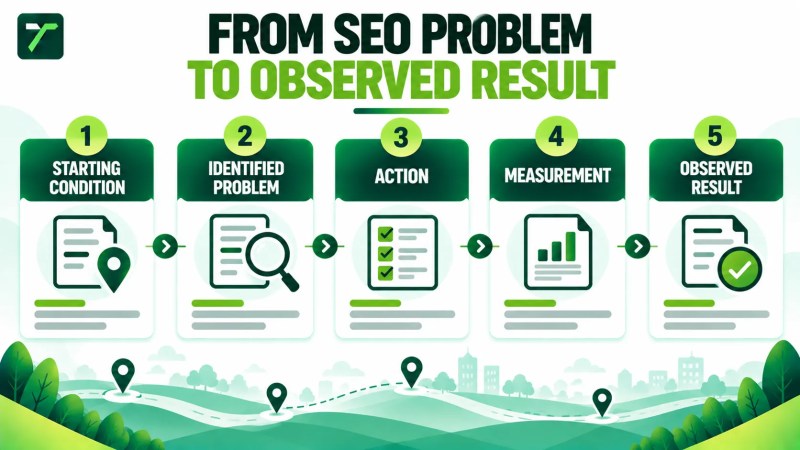
That sequence is more informative than simply reporting that dozens of pages were edited, citations were created, or blog posts were published.
The number of tasks completed matters less than whether those tasks were appropriate for the problem the campaign was trying to solve.
Check the Measurement Period
Every performance claim should be interpreted within a defined period.
A case study might compare the beginning and end of a campaign, one period with a previous period, or performance before and after a major set of changes. Each approach can provide useful information, but the comparison should be clear enough for the reader to understand what the numbers represent.
Ask:
- What dates does the case study cover?
- What period is being compared?
- Was the baseline measured consistently?
- Were major website changes made during the period?
- Could seasonality affect demand?
- Did the business add or remove services or locations?
- Did tracking methods change?
These questions do not invalidate the results. They help establish the context needed to interpret them responsibly.
Be Careful With Before-and-After Comparisons
A before-and-after comparison can be useful, but it should not automatically be interpreted as proof that every observed change resulted from one SEO action.
Search performance can be influenced by multiple factors during the same period. The business may change its website, service offering, advertising, brand activity, operating area, pricing, or conversion process while external search conditions also change.
A stronger case study distinguishes what was observed from what can reasonably be attributed to the campaign.
Evaluate the Metrics and Results
After understanding the baseline, actions, and timeframe, examine what the case study actually measures.
Useful metrics depend on the campaign objective.
For website performance in Google Search, Google Search Console’s Performance report provides metrics including clicks, impressions, click-through rate, and average position. Google also documents performance dimensions such as queries, pages, countries, devices, search appearance, and dates.
For a verified Google Business Profile, Google’s Business Profile performance documentation explains the performance information available for understanding how people discover and interact with a profile.
A local SEO case study might therefore discuss measurements such as:
- organic search clicks
- search impressions
- relevant query visibility
- performance of important landing pages
- local-search visibility
- Business Profile interactions
- tracked enquiries or conversions
- qualified leads where reliable tracking exists
The metric should match the claim being made.
For example, an increase in Search Console impressions means links to the site were seen more often in Google Search according to Google’s impression-counting rules. It does not, by itself, demonstrate that leads increased. Similarly, stronger keyword visibility can be useful evidence of search exposure without proving that the additional visibility generated revenue.
Traffisite’s guide to local SEO KPIs explains how different measurements can be used for different parts of local-search performance. When those measurements need to be communicated to a client or stakeholder, a clear local SEO reporting process can help keep the comparison period, metrics, and business context visible.
Do Not Let Percentage Growth Hide the Baseline
Percentage growth can look impressive when the starting number is small.
For example, increasing a metric from 10 to 20 represents 100% growth, while increasing it from 1,000 to 1,500 represents 50% growth. The smaller percentage in this example represents a much larger absolute increase.
Neither presentation is automatically wrong. A useful case study should provide enough information to understand the underlying scale rather than relying on the percentage alone.
Understand What Average Position Means
Ranking-related numbers also require context.
Google’s Search Console position documentation explains how position and average position are calculated. Average position represents the average topmost position of a result from the property or page across the impressions included in the report, rather than a fixed ranking for every individual search.
Google also explains that an individual search can differ from the reported average because of variables such as search history and location. Its broader documentation on differences in Search results identifies additional contextual factors such as time, language, device, and personalization.
That is why a case study should avoid presenting one ranking number as if it represents the entire search performance of the business.
Look for Limitations and Context
A credible case study does not need to undermine its own results, but it should avoid implying more certainty than the evidence supports.
Useful limitations may include:
- limited historical data
- changes to tracking during the campaign
- seasonal demand
- small starting numbers
- changes to business locations or services
- offline leads that cannot be attributed reliably
- other marketing activity running during the same period
- incomplete access to revenue or CRM data
- differences between tracked rankings and individual searches, which can vary based on factors such as location, time, language, device, context, and personalization
Limitations do not make a case study weak. Clearly explaining them can make the evidence easier to interpret.
Correlation Is Not the Same as Complete Attribution
If search performance improves after SEO work, the timing can support a relationship between the campaign and the observed result, particularly when the changes align with the areas that were worked on.
However, a case study should be careful about claiming that one action caused every improvement unless the available evidence genuinely supports that conclusion.
For service businesses, this is especially important when moving from search metrics to enquiries, booked jobs, or revenue. Google’s Analytics attribution documentation explains attribution as assigning credit to different ads, clicks, and other factors along a user’s path to an important action. Customers can encounter multiple marketing touchpoints before completing an important action, so assigning full credit to one channel or SEO activity may require careful attribution.
How to Compare Local SEO Case Studies
If you are evaluating several SEO providers, avoid choosing between case studies based only on which one reports the largest percentage increase.
Use the same evaluation framework for each example.
- Identify the starting point. Is there enough baseline information to understand the original situation?
- Understand the problem. What was the business trying to improve?
- Review the actions. Does the case study explain what was actually done?
- Check the timeframe. Are the measurement and comparison periods clear?
- Review the metrics. Do the measurements match the objective?
- Check the scale. Are absolute numbers or sufficient baseline context available alongside percentage changes?
- Review attribution. Does the case study distinguish observations from stronger causal claims?
- Look for limitations. Is important context acknowledged?
- Assess relevance. Are the strategy and business situation useful enough to inform your own decision?
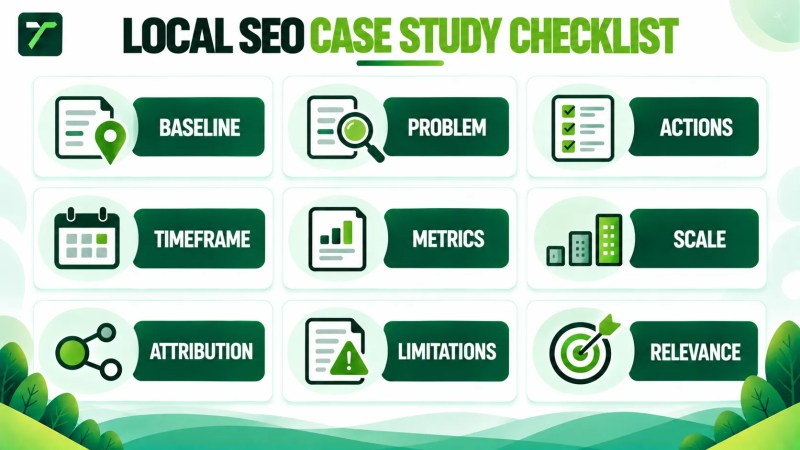
This gives you a more consistent way to compare evidence across businesses with different starting points.
Traffisite’s SEO measurement and reporting guide provides broader context for interpreting SEO data, comparisons, and reporting beyond individual case studies.
Relevance Does Not Mean the Business Must Be Identical to Yours
A case study from the same industry can be useful, but industry matching is not the only form of relevance.
A case study may still provide useful evidence if the underlying challenge resembles yours. For example, the business might have needed better service-page coverage, stronger local visibility, improved website structure, or a clearer measurement process.
Focus on whether the problem, strategy, and evidence help you understand how the provider approaches comparable SEO challenges.
Case Study Red Flags
Some case studies provide too little context to evaluate their claims confidently.
Look more carefully when you see:
- a large percentage increase with no starting number or baseline context
- ranking screenshots without a clear query, location, date, or measurement method
- traffic growth presented as if it automatically equals lead growth
- revenue claims without explaining how revenue was attributed
- no description of the SEO work completed
- no measurement period
- only the strongest metric while other relevant outcomes are omitted
- claims that imply another business should expect the same outcome
- results presented without enough context to understand what changed
These signals do not automatically prove that a result is invalid. They indicate that you need more information before relying on the case study as evidence.
Local SEO Case Study FAQ
What should a local SEO case study include?
A useful local SEO case study should explain the business context, starting conditions, problem, SEO actions, measurement period, metrics, observed results, and relevant limitations. The reader should be able to understand how the work connects with the outcome being discussed.
How do you know whether an SEO case study is credible?
Look for transparent baseline information, specific actions, clearly defined measurements, a stated timeframe, appropriate comparisons, and conclusions that do not go beyond the evidence presented. A case study does not need to reveal confidential business information to provide meaningful context.
Are ranking improvements enough for a local SEO case study?
Ranking improvements can be useful evidence, but they are only one part of local SEO performance. Rankings should be interpreted alongside the campaign objective and, where available, search visibility, clicks, profile interactions, conversions, leads, or other relevant outcomes.
Should a local SEO case study show revenue?
Not necessarily. Revenue can be valuable when reliable attribution exists, but many SEO campaigns do not have complete access to CRM, phone, offline, repeat-customer, or revenue data. A case study should use measurements that can be supported reliably rather than imply revenue attribution that cannot be demonstrated.
How long should a local SEO case study cover?
There is no single timeframe that applies to every local SEO campaign. The appropriate period depends on the starting conditions, scope of work, market, available data, and objective. What matters for evaluation is that the case study clearly identifies the period being measured and the comparison being made.
Can I expect the same results as a business in an SEO case study?
A case study describes a specific business, starting point, market, strategy, and period. It can help you evaluate an SEO provider’s process and evidence, but it should not be treated as a guarantee that another business will reproduce the same outcome.
Should I compare SEO agencies by their biggest case-study result?
A larger reported percentage does not automatically indicate a stronger strategy or better provider. Compare the quality of the evidence, starting conditions, actions, measurement methods, relevance, and limitations rather than using the largest headline number as the deciding factor.
Use Case Studies to Understand the Process Behind the Result
A local SEO case study is most useful when it helps you understand what happened between the starting point and the reported outcome.
Look beyond the headline number. Review the business context, baseline, problem, work completed, timeframe, measurements, and limitations. Then consider whether the conclusions are proportional to the evidence presented.
That approach makes case studies more useful for what they should be: evidence that helps you evaluate a process and its results, rather than a promise that your business will follow the same path.