

Choosing a local SEO agency in the USA involves more than comparing monthly prices or lists of deliverables. Two agencies may both offer local SEO while differing significantly in how they develop strategy, divide responsibilities, communicate with clients, and measure progress.
For a service business, the goal is to understand how an agency would approach your specific website, locations, service areas, competition, and local search presence before deciding whether the relationship is a good fit.
Quick Answer: When comparing local SEO agencies serving the U.S. market, evaluate their strategy, experience with businesses like yours, proposed scope, implementation responsibilities, communication process, reporting, pricing clarity, and ability to explain why particular work is being recommended. Compare the thinking behind the proposal, not just the number of deliverables.
What Should You Look for in a Local SEO Agency?
A useful agency comparison starts with how each provider thinks about your business. A proposal can contain many activities without clearly explaining which problems those activities are intended to address.
When evaluating an agency, consider whether it can clearly explain:
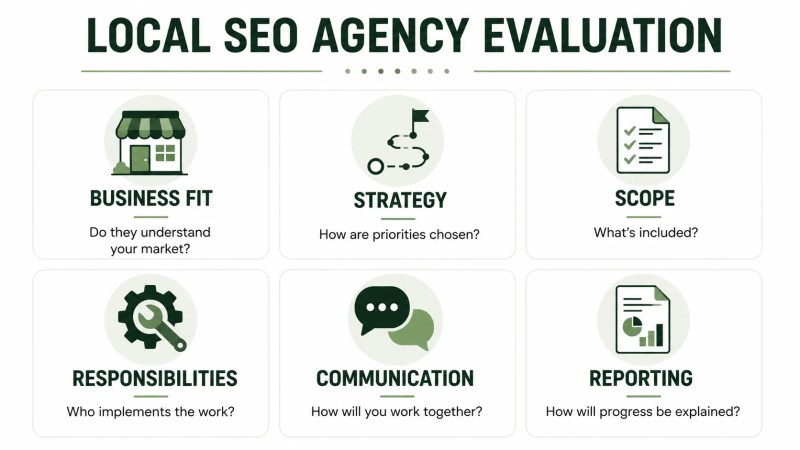
- what it will review before developing the strategy;
- how it identifies and prioritizes SEO opportunities;
- which work is included in the engagement;
- who will implement website and profile changes;
- how your team will communicate with the agency;
- what the agency will measure and report; and
- how the approach will account for your locations or service areas.
If you are still determining what an engagement itself may involve, Traffisite’s guide to local SEO services in the USA provides a service-focused comparison of common areas to evaluate.
Does the Agency Understand Your Type of Business?
An agency does not need to work exclusively with one industry to understand your business, but it should be able to learn how your company generates revenue, where customers are located, which services matter most, and how prospective customers search for those services.
For a service business, ask how the agency would account for factors such as service areas, individual locations, core services, existing location pages, lead-generation paths, and the way the website is currently structured.
Industry familiarity can be useful, but it should not replace research. An agency should still evaluate your actual market rather than automatically applying the same page structure, content plan, or keyword strategy used for another business.
Businesses with geographically defined customers can review Traffisite’s approach to SEO for local service businesses for additional context on this type of search environment.
How Does the Agency Build Its Local SEO Strategy?
Ask what happens before the agency starts producing content or making changes. The answer can reveal whether recommendations are based on an assessment of your business or primarily on a predetermined package.
An initial evaluation can cover different areas depending on the business. Ask whether the agency plans to review relevant areas such as your website and content, technical issues, local search presence, competitors, search demand, and available performance data before setting priorities.
You should be able to understand why the agency recommends a particular sequence of work. If new service pages, location pages, content, technical changes, or authority-building activities are proposed, ask what problem each recommendation is intended to address.
For businesses that want a deeper understanding of the underlying discipline, Traffisite’s local SEO guide explains the broader components of local search optimization.
What Is Included and Who Does the Work?
Clarify the difference between recommendations and implementation. An agency may identify changes that need to be made without necessarily including every implementation task in the agreed scope.
Before hiring, establish who is responsible for areas such as:
- website edits;
- technical fixes;
- content writing and publishing;
- Google Business Profile updates;
- citation work;
- link-related activities;
- conversion tracking; and
- approvals from your internal team.
This is particularly important if several people will be involved. Knowing who owns each task helps you evaluate whether the proposed workflow is practical for your business.
If you are comparing an agency relationship with an individual specialist, the SEO agency vs. freelancer comparison provides another way to think about differences in working structure.
How Will the Agency Communicate With You?
SEO work can involve decisions across content, website structure, technical implementation, local profiles, and reporting. Before signing an agreement, understand how communication will work once the engagement begins.
Ask who your primary contact will be, how questions and approvals are handled, how often priorities are discussed, and how the agency communicates when the original plan needs to change.
Also determine whether you will communicate directly with the people doing the work or primarily through an account manager. Neither structure is automatically better, but knowing the workflow helps set expectations.
How Will the Agency Report Progress?
A report should help you understand what the agency worked on, what it is monitoring, and what it plans to prioritize next. A dashboard filled with metrics is less useful when the agency cannot explain why those metrics matter to the engagement.
Ask what information will be reported, where the data comes from, how frequently reporting is provided, and how the agency connects reported metrics with your objectives.
Ask the agency which measurements it will use for your engagement and why. Available tools such as Google Search Console provide different performance metrics and dimensions, so reporting should make clear which information the agency is monitoring and how it relates to your objectives.
Traffisite’s guide to local SEO reporting provides additional context for evaluating what a reporting process should communicate.
How Clear Is the Pricing and Scope?
Price matters, but comparing agency fees without comparing scope can be misleading. One proposal may include implementation while another primarily includes strategy and recommendations. Content, technical work, local profile management, reporting, and other activities may also be handled differently.
Before comparing prices, identify what each proposal actually includes, what may cost extra, what your team is expected to provide, and whether the engagement is ongoing or project-based.
If you need broader context before evaluating agency proposals, Traffisite’s guide to SEO services cost explains factors to consider when reviewing SEO pricing.
What Warning Signs Should You Watch For?
Be cautious when an agency cannot clearly explain what it plans to do or why particular activities are being recommended.
Other reasons to ask additional questions include:
- claims that an agency can guarantee a #1 ranking on Google;
- strategies explained only through vague terminology;
- large deliverable counts without clear prioritization;
- unclear responsibility for implementation;
- reports without explanation or context;
- pressure to approve work you do not understand; and
- reluctance to explain how proposed work relates to your business.
The objective is not to find an agency that can predict every outcome. It is to find one that can explain its recommendations, responsibilities, process, and measurement approach clearly enough for you to make an informed decision.
Does a Local SEO Agency Need to Be Based in the USA?
If your customers are in the United States, evaluate whether the agency can effectively work with the U.S. markets your business serves. The agency’s physical location is one consideration, but it does not answer questions about strategy, market understanding, communication, or implementation by itself.
Ask how the agency researches your locations, competitors, service areas, and customer terminology. If the team works remotely or across time zones, clarify communication schedules and approval processes before the engagement begins.
Businesses specifically evaluating geographic SEO support can also review Traffisite’s United States SEO services information.
Questions to Ask a Local SEO Agency Before Hiring
A structured conversation can make agency proposals easier to compare. Instead of asking only what is included, ask questions that reveal how the agency makes decisions.

- What will you review before recommending a strategy?
- What do you need to understand about our business before starting?
- How will you determine the first priorities?
- What is included in the proposed scope?
- Which recommendations will your team implement?
- What will our team be responsible for?
- Who will be our main point of contact?
- How will changes in priorities be communicated?
- What will you report and how will you explain the results?
- How will you approach our locations or service areas?
- Are there additional costs that are not included in the proposal?
- What happens if the initial strategy needs to change?
If you are comparing several providers, Traffisite’s broader guide to evaluating local SEO companies can help you organize the comparison.
Frequently Asked Questions
What does a local SEO agency do?
The exact scope varies by agency and engagement. Work may involve website optimization, local content, Google Business Profile management, technical improvements, citations, links, reporting, and other activities identified during the agency’s assessment.
How do I choose a local SEO agency in the USA?
Compare how agencies assess your business, develop priorities, define scope, implement work, communicate, report progress, and handle your locations or service areas. Ask each agency to explain why its proposed activities are relevant to your business.
Should I choose a local SEO agency based on price?
Price is one consideration, but compare the scope and responsibilities behind each price. Determine what is included, what your team must handle, whether implementation is included, and whether additional work may require separate fees.
Should a local SEO agency guarantee rankings?
Google states that no one can guarantee a #1 ranking on Google. Treat ranking guarantees as a warning sign, and ask the agency how it sets expectations, measures progress, communicates uncertainty, and adjusts its strategy when conditions change.
Is an SEO agency better than a freelancer?
Neither model is automatically the right choice for every business. Compare the expertise required, amount of implementation involved, communication structure, available capacity, accountability, and the way you prefer to work.
Can a local SEO agency work with multiple business locations?
An agency can propose a strategy for a multi-location business, but ask how it will evaluate each location, organize website content, manage responsibilities, and determine whether priorities should differ across markets.
Compare the Agency Behind the Deliverables
When evaluating a local SEO agency serving the USA, do not stop at the proposal’s deliverable list. Consider how the agency arrived at its recommendations and how the relationship will work after the agreement is signed.
Compare strategy, business fit, scope, responsibilities, communication, reporting, and pricing clarity. A clearly explained process makes it easier to determine whether an agency’s approach fits your business.