

If you’ve been told your business needs “SEO services” but no one has explained what that actually means, you’re not alone. The term gets used as a catch-all for a wide range of work — some technical, some creative, some ongoing — and providers don’t always define it the same way. For quick definitions of specific terms you’ll encounter along the way, Traffisite’s SEO glossary is a useful reference.
This article breaks down what SEO services typically include, how the individual pieces connect, and what to look for when you’re deciding who to work with.
Quick Answer: SEO services are technical, content, and structural activities intended to help search engines discover and understand a website’s content while improving its usefulness and visibility for relevant searches. Depending on the business and site, this can include technical SEO, site architecture, on-page optimization, content strategy, local SEO, link building, and performance measurement — coordinated rather than treated as isolated tasks.
What SEO Services Actually Cover
Search engine optimization services cover work intended to help search engines discover and understand a website’s content and to make that content useful and accessible to visitors. For a service business, that work commonly spans technical health, site structure, on-page optimization, content, local visibility, links and authority, and measurement.

Not every business needs equal investment in every area. A local contractor’s priorities can look different from a B2B consultancy’s. A good starting point is a full SEO audit, which can identify which of these areas need attention first.
Technical SEO
Technical SEO covers behind-the-scenes factors that affect whether search engines can access, crawl, render, and index a site’s content properly. This can include crawlability and indexability, JavaScript rendering, mobile usability, page experience, structured data, and other technical configurations. If technical issues prevent search engines from accessing, rendering, or indexing important content, resolving those barriers may need to come before other SEO work can have its intended effect. This is usually where technical SEO services come in, addressing issues that affect how a site can be processed by search engines.
Site Structure and Architecture
How a website is organized affects both users and search engines. Google recommends organizing a site logically because doing so can help search engines and users understand how pages relate to the rest of the site. Clear categories, descriptive URLs, and purposeful internal links can all contribute to that organization. This is the focus of SEO website architecture services, and it’s closely tied to internal linking strategy.
On-Page SEO
On-page SEO is optimization work performed directly on individual pages, including titles, headings, meta descriptions, relevant terminology, internal links, and content organization. Google recommends using words people would use to find the content in prominent locations such as titles and main headings. Titles can influence title links in search results, while page content and, in some cases, meta descriptions can be used to generate search snippets. These elements help search engines and users understand what a page covers and can influence how the page is presented in search results. This work is covered in more depth in Traffisite’s on-page SEO services.
Content Strategy
Content strategy determines what gets published, in what order, and why. Rather than publishing pages at random, an effective strategy maps content to the needs and searches of the intended audience and considers how related topics connect. Google recommends creating helpful, reliable, people-first content rather than content produced primarily to manipulate search rankings. Related content can also be organized into clusters around central themes, an approach covered in Traffisite’s guide to topical authority and topic clusters. This planning work is what SEO content strategy services are built around.
Local SEO
For businesses that serve customers in specific areas — home services, contractors, and local professional services — local SEO focuses on improving how accurately and effectively the business is represented for relevant local searches. Google displays local business information across Search and Maps, and says local results are mainly based on relevance, distance, and prominence. Keeping business information complete and accurate is therefore an important part of local search visibility. This is the core of local SEO services.
Authority and Link Building
Links are one of the signals search engines can use to understand pages and their relationships across the web. Google confirms that link-analysis systems, including PageRank, remain part of its core ranking systems, alongside many other signals. Link building and authority services focus on developing relevant, legitimate links and references while supporting the broader SEO strategy.
Measurement and Reporting
SEO services should include a way to measure search performance and business outcomes. Google Search Console can report metrics such as clicks, impressions, click-through rate, average position, queries, and pages, while analytics or conversion-tracking tools can be used to connect organic visits with business actions. Measurement makes it easier to see how search visibility changes over time and where further investigation or adjustment may be useful. Traffisite’s guide to SEO measurement and reporting covers how to approach tracking in relation to business results.
How These Pieces Work Together
These components are most useful when considered together. Technical barriers can prevent important content from being crawled, rendered, or indexed. Logical site organization can help users and search engines understand how pages relate, while useful content gives those pages a reason to exist for the intended audience. Links can contribute signals used by search systems, but Google evaluates pages using many factors rather than a single measure of authority.
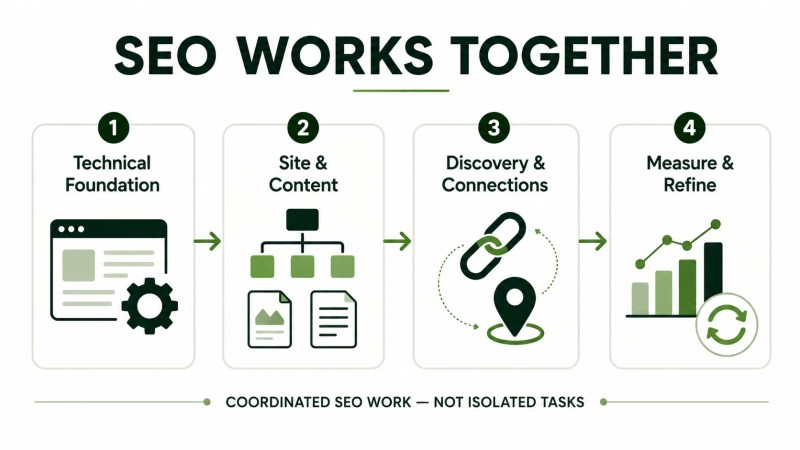
This is why many SEO services are delivered as ongoing, coordinated work rather than as a single one-time task. A monthly SEO service model allows technical issues, content, search performance, and other priorities to be reviewed and adjusted over time. The tradeoffs between ongoing and project-based approaches are covered in this comparison of monthly SEO versus one-time SEO.
Choosing an SEO Service Provider
When evaluating who to work with, it helps to ask specifically which of the areas above they cover and whether the work is coordinated or handled as disconnected tasks. Some providers specialize narrowly — content only, or technical only — while others manage a broader combination of SEO activities.
It’s also worth understanding the practical differences between working with an agency versus a freelancer, since factors such as capacity, communication, specialization, and coordination can vary between providers. This comparison of SEO agencies versus freelancers walks through the tradeoffs.
If you want a broader view of how all of this applies specifically to service businesses, Traffisite’s guide on SEO for service businesses is a useful next step.
Frequently Asked Questions
Do I need all of these SEO services at once?
Not necessarily. An audit can help identify technical, structural, content, and visibility issues so the work can be prioritized according to the site’s condition and business goals.
How long do SEO services take to show results?
There is no single timeline that applies to every site. The condition of the website, the work being performed, the searches being targeted, competition, crawling and indexing, and other factors can all affect when changes become visible. Ongoing measurement is therefore more useful than assuming a fixed result date.
What’s the difference between SEO services and a single SEO project?
A single project, such as an audit or a defined content project, addresses a specific scope of work. Ongoing SEO services can combine technical maintenance, content development, on-page work, local SEO, link-related work, and performance measurement as priorities change over time.
Final Thoughts
“SEO services” isn’t one task — it’s a broad category that can include technical, structural, content, local, link-related, and measurement work. Understanding which areas your site actually needs can help you choose services that address identifiable gaps instead of treating SEO as a single standardized package.