

Pagination helps websites divide long collections of content across multiple pages. You commonly see it on blog archives, category pages, product listings, resource libraries, and other sections where displaying every item on one URL would be impractical.
From an SEO perspective, pagination matters because those additional pages can create paths to content that sits deeper within the website. If those paths are difficult for search engines to follow, important articles, products, resources, or other pages may become harder to discover through normal crawling.
Quick Answer: Pagination SEO is about making paginated series understandable and crawlable. Google recommends giving pages in a paginated sequence their own URLs and linking the pages sequentially with crawlable links. Good pagination supports discovery, while poor implementation can create crawl barriers, weak internal paths, or unnecessary URL variations.
What Is Pagination SEO?
Pagination is the practice of splitting a larger collection across a sequence of pages. A blog archive might show its newest posts on the first page, older posts on page two, and progressively older content on later pages.
Pagination itself is not inherently an SEO problem. The important question is whether the implementation creates clear, crawlable relationships between the pages in the sequence and the individual content those pages contain.
Google’s pagination best practices recommend giving pages in a paginated sequence their own URLs and linking them sequentially so Google can crawl the series.
Pagination therefore sits at the intersection of website architecture, crawling, and internal linking. Traffisite’s guide to website architecture SEO explains the broader role page relationships play in creating a navigable site.
How Pagination Affects Crawling
Google can discover new URLs through links on pages it already knows. On a paginated archive, links between page one, page two, page three, and later pages can provide paths toward content that is not linked prominently elsewhere.
Imagine a service-business blog containing 100 articles but showing only 10 articles on each archive page. If the pagination controls create crawlable links between those archive pages, Google can follow the sequence and encounter articles listed deeper in the archive.
If later pagination pages are not accessible through crawlable links, deeper content loses one potential internal discovery path. This can become more relevant when those items also receive few contextual links from elsewhere on the site.
Google’s link best practices explain that links should generally use an <a> element with an href attribute so Google can reliably crawl them.
Pagination should therefore be considered alongside overall website crawlability. The goal is not to make crawlers visit every paginated URL as often as possible. The goal is to avoid creating unnecessary barriers between search engines and useful content.
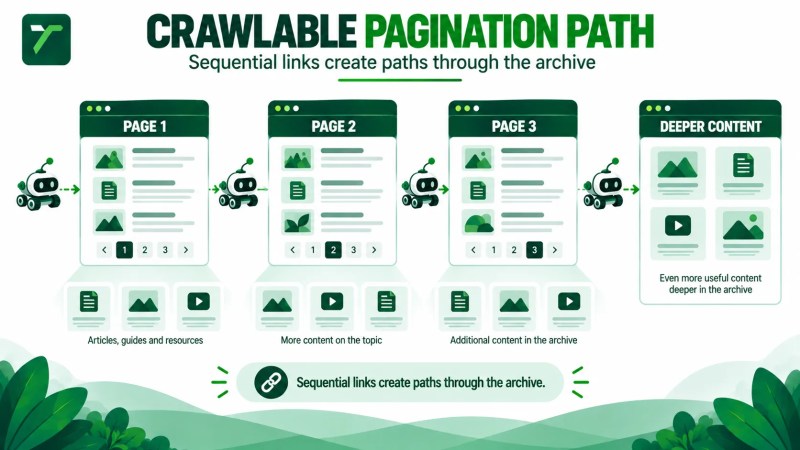
Pagination Can Increase Crawl Depth
Content appearing only on later archive pages may require more link steps to reach from the first page of the series. As an archive grows, older content can move progressively deeper into that sequence.
That does not automatically make the content poor quality or prevent it from being indexed. It does mean that pagination can contribute to the number of internal steps required to reach deeper URLs.
Traffisite’s crawl depth SEO guide explains why unnecessary depth deserves attention when important pages become difficult to reach through the site’s normal internal structure.
Pagination and Indexing
Crawling and indexing are separate processes. Google may discover and crawl a URL without ultimately indexing it, and Google does not guarantee that every discovered URL will be crawled or indexed.
The practical priority is ensuring that the URLs and content Google needs to discover are accessible through appropriate crawl paths and that crawling, canonicalization, and indexing signals do not unintentionally conflict with that goal.
This distinction matters because restricting deeper pagination pages without considering their role in discovery can remove useful crawl paths. The appropriate treatment depends on what the paginated URLs contain and how they fit into the site’s architecture.
For more context on the difference between accessibility and index eligibility, see Traffisite’s guide to indexability SEO.
Pagination and Internal Linking
Pagination is partly an internal-linking system. Each pagination control creates relationships between archive pages, while each archive page links onward to the articles, products, resources, or other items it contains.
Google generally discovers links through URLs in the href attributes of <a> elements. Its crawlers generally do not click buttons or trigger JavaScript functions that require user actions, so pagination should expose crawlable links rather than depend only on interactive controls.
A visually functional “Next” button is therefore not a substitute for a crawlable link when the next page needs to be discoverable through that control.
Traffisite’s internal linking guide covers the broader principles of using links to connect important pages and create understandable paths through a website.
Pagination Should Not Be the Only Path to Important Content
Pagination can help expose deeper items, but important content does not need to depend on a long archive sequence as its only internal route.
Google’s link guidance recommends that every page you care about have a link from at least one other page on your site. High-value service pages, cornerstone resources, important articles, and other priority content can therefore also receive contextual links from relevant pages, hubs, navigation elements, or other appropriate locations.
This can create stronger internal relationships than relying entirely on a page’s position within a chronological archive. Traffisite’s internal linking solution focuses on improving those relationships when valuable pages are difficult to reach or poorly connected.
Pagination SEO Best Practices
Good pagination should work for users while also creating understandable crawl paths for search engines.
- Give pages in the sequence their own URLs. Google recommends using a separate URL for each page in a paginated sequence.
- Link pages sequentially. Include crawlable
<a href>links from each page to the following page so Google can follow the sequence. - Link each page to the items it displays. Articles, products, or resources listed on a paginated page should have normal crawlable links to their individual URLs.
- Keep URL patterns consistent. Avoid unnecessary alternative pagination, filter, or sort URLs that expose substantially overlapping collections.
- Consider deeper content in the wider internal-linking strategy. Important content can receive contextual internal links beyond simply appearing somewhere in a long archive.
- Test the implementation. Pagination that appears to work when clicked should still be checked to confirm that Google can access the intended URLs and links.
These practices fit within a broader website-structure strategy. Traffisite’s SEO website architecture services focus on organizing navigation, hierarchy, URLs, and internal relationships so important content is easier for users and search engines to reach.
Use Consistent Pagination URLs
Google recommends giving each page in a paginated sequence its own URL. For example, later pages can use a page parameter or another stable URL pattern appropriate to the site’s platform and architecture.
The important point is that each intended page in the sequence has an accessible URL and that unnecessary variations are controlled.
For broader URL-planning considerations, Traffisite’s URL structure SEO guide explains how clear URL patterns fit into website architecture.
Keep Navigation Useful for People
Pagination is not only a crawler mechanism. Visitors need to understand that additional content exists and have a practical way to move through it.
Labels such as “Next,” “Previous,” and page numbers can communicate sequence and position, depending on the design and size of the collection. The implementation should reflect how people actually need to browse the content rather than being built solely around crawler behavior.
Common Pagination SEO Mistakes
Pagination problems usually come from implementation choices rather than from pagination itself.
- Making deeper pages unreachable through crawlable links: users may be able to trigger more content visually while Google receives no equivalent crawlable link path.
- Creating excessive URL variations: filters, alternative sort orders, parameters, or multiple pagination patterns can expand the number of URLs associated with a collection.
- Breaking the sequence: missing or incorrect links between pagination pages can interrupt navigation through the archive.
- Relying entirely on pagination for important pages: priority content can move progressively deeper into an archive as new items are added.
- Canonicalizing every pagination page to page one: Google specifically advises against using the first page of a paginated sequence as the canonical URL for the remaining pages.
- Creating low-value pagination URLs accidentally: empty, duplicated, malformed, filtered, or alternative-sort pages can create unnecessary URL variations without helping users browse the collection.

Large or inefficient pagination systems can also overlap with broader crawl-efficiency concerns. Traffisite’s guide to crawl budget SEO explains when unnecessary URL expansion becomes more relevant to crawling.
How to Audit Pagination
A pagination audit should examine both what users can navigate and what a crawler can actually reach. When the audit reveals blocked paths or conflicting indexing signals, technical SEO fixes for crawlability may be needed alongside improvements to the page sequence.
- Identify paginated sections. Find blog archives, categories, product listings, resource libraries, or other collections split across multiple URLs.
- Inspect the page sequence. Confirm that intended pagination pages have accessible URLs.
- Check pagination links. Verify that the sequence uses crawlable links that point to the intended pagination URLs.
- Review item discovery. Confirm that articles, products, or resources displayed on deeper pages are linked with crawlable anchors.
- Look for unnecessary URL variations. Identify duplicate pagination paths, filters, alternative sort orders, parameters, empty pages, malformed URLs, and other unintended versions.
- Review important deeper content. Determine whether priority URLs need stronger contextual internal links elsewhere on the website.
- Check canonical and indexing signals. Confirm that canonical URLs and indexing controls match the intended role of each paginated page.
If pagination is part of a larger structural problem, fixing isolated buttons may not be enough. Traffisite’s website structure solution addresses broader hierarchy and navigation issues, while the crawling and indexing solution is relevant when important URLs are not being discovered or processed as intended.
Pagination SEO FAQ
Is pagination bad for SEO?
No. Pagination is a normal way to organize large collections of content. Problems can arise when the implementation makes deeper content difficult to discover, creates unnecessary URL variations, or uses crawling, canonicalization, or indexing controls in ways that conflict with the intended structure.
Should paginated pages have unique URLs?
Yes. Google’s pagination guidance recommends giving each page in a paginated sequence its own URL and connecting the sequence with crawlable links.
Should paginated pages be indexed?
Google’s guidance focuses on making the paginated content you want Google to discover accessible through crawlable URLs and links, while avoiding indexing unnecessary filter or alternative-sort URLs. Indexing decisions should therefore reflect the purpose and content of the URLs rather than a blanket rule applied to every URL associated with the collection.
Should page two canonicalize to page one?
No, not simply because it belongs to the same paginated sequence. Google’s pagination guidance specifically says not to use the first page of a paginated sequence as the canonical page for the remaining pages. Each pagination page should generally have its own canonical URL unless an appropriate view-all implementation is being used.
Does pagination increase crawl depth?
It can. Content available only on later pagination pages requires additional link steps to reach from the beginning of the sequence. Whether that becomes an important issue depends on the content’s importance and the other internal paths available to it.
Is infinite scroll the same as pagination?
No. Infinite scroll loads additional content as a visitor moves through a long page. For infinite-scroll content that should be discoverable, Google’s lazy-loading guidance recommends supporting paginated loading and giving each content chunk a persistent, unique URL.
Build Pagination Around Discovery, Not Just Page Numbers
Pagination SEO is less about optimizing a “Page 2” label and more about maintaining clear paths through growing collections of content. Search engines need crawlable routes to deeper pages, while users need navigation that makes the collection understandable and usable.
As a site grows, review pagination alongside crawl depth, internal linking, URL structure, crawlability, canonicalization, and indexing. Those systems work together. A clean pagination implementation helps prevent useful content from becoming unnecessarily isolated simply because it has moved deeper into an archive.
For a broader framework for structuring pages and their relationships, Traffisite’s website structure for SEO guide provides the next layer of context.