

Local SEO can feel complicated because visibility is rarely controlled by one setting, one page, or one optimization. A service business may have a complete Google Business Profile but a weak website. Another may have strong service pages but inconsistent business information across the web. Others may simply be competing in an area where proximity makes certain searches difficult to win.
Understanding local SEO ranking factors is therefore less about finding a single ranking trick and more about evaluating the signals that help search engines understand what your business does, where it operates, and how established it is.
For service businesses, that means looking at your Google Business Profile and website as connected parts of the same local search strategy rather than treating Maps and organic rankings as completely separate projects.
Quick Answer: Google explains that local results are mainly based on relevance, distance, and popularity, with its detailed guidance describing the third factor as prominence. Businesses should therefore evaluate how clearly their Google Business Profile describes their services, how location affects the searches they can realistically compete for, and whether reviews, links, and their broader web presence support their prominence. Strong local SEO usually comes from improving these areas together rather than chasing one isolated ranking factor.
How Local SEO Ranking Factors Work Together
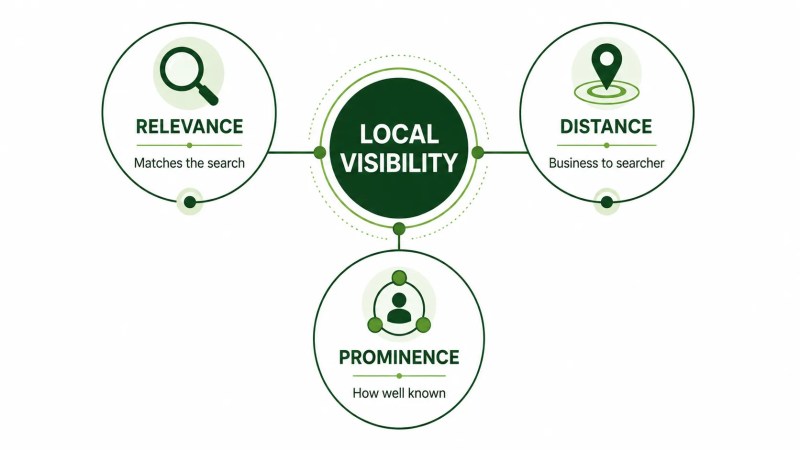
Google explains that local results are mainly based on relevance, distance, and popularity. In its detailed guidance, Google describes the third factor under Prominence, meaning how well known a business is. These concepts provide a useful framework for understanding why one business may appear more prominently than another for a particular local search.
Relevance
Relevance is about how well a Business Profile matches what someone is searching for. Complete and detailed business information can help Google better understand the business and match it with relevant searches.
This is why local SEO should begin with clarity. Your website architecture, service pages, location information, and Google Business Profile should make it easy to understand what the company actually offers. A broader local SEO strategy can then connect those elements instead of optimizing them independently.
Distance
Distance concerns how far a business is from the customer who is searching. If someone does not share their location, Google can use what it knows about their location when determining distance.
This makes geography fundamentally different from many other SEO variables. A business can work on the signals it controls, but it cannot optimize away the physical distance between its location and every potential customer.
Prominence
Prominence reflects how well known a business is. Google says this factor is based in part on information such as how many websites link to a business and how many reviews it has.
These concepts overlap. A highly relevant business may still face limitations because of distance, while a nearby business may struggle if Google cannot confidently determine that it matches what the customer is searching for.
Google Business Profile Signals to Evaluate
For businesses competing in Maps and other local results, one of the first areas to evaluate is the information contained in the Google Business Profile.
Start by checking whether the profile accurately represents the real business:
- Is the primary category the most specific appropriate category for the business?
- Are additional categories genuinely relevant?
- Are the business name, address or service-area details, phone number, website, and hours accurate?
- Are the services represented clearly?
- Is outdated information being corrected when necessary?
Business categories deserve particular attention because they describe what kind of business you operate. The goal is not to select as many categories as possible. It is to choose categories that accurately represent the business.
Profile completeness should also be viewed as an accuracy task rather than a box-checking exercise. Google recommends keeping Business Profile information complete and accurate so customers and Google can better understand the business.
If the profile itself needs work, follow a structured Google Business Profile optimization process before looking for more advanced tactics.
Distance and Location: The Factor You Cannot Fully Control
Distance is one of the most important realities in local search because it changes from searcher to searcher. Two people searching for the same service from different parts of a city may not see identical local results.
That means a ranking report taken from one location does not necessarily represent visibility across an entire service area.
For service businesses, the practical response is not to try to manipulate proximity. Instead, focus on the areas you can improve:
- Make your actual business and service information accurate.
- Create useful pages for services and markets you genuinely serve.
- Keep your website’s location information clear.
- Evaluate rankings from more than one relevant point when measuring local visibility.
This is especially important for companies trying to generate more local leads. Visibility should be evaluated against the markets that can realistically produce customers, not just against a single city-wide ranking snapshot.
Reviews and Prominence
Reviews are another visible part of the local search ecosystem. Google says prominence considers factors such as how many reviews a business has, and that more reviews and positive ratings can help local ranking.
Reviews matter beyond visibility as well. They can help potential customers evaluate whether they trust the company enough to call, request a quote, or book a service.
A sustainable review process should focus on genuine customer feedback rather than shortcuts. Businesses should make it easy for real customers to leave reviews and manage those reviews as part of their broader reputation process.
When evaluating this area, do not look only at the total number of reviews. Consider whether the business has an ongoing process for earning genuine feedback and whether reviews reflect the services customers actually buy.
Your Website Still Matters for Local SEO
Local SEO is not limited to the Google Business Profile. Google can source Business Profile information from publicly available web content, including crawled content from a business’s official website.
The website should therefore clearly communicate basic information about the business: What does it do? Where does it operate? Which services does it provide? Which page best answers a particular customer’s question?
Service-page relevance
Important services generally need clear, useful pages that explain the offering instead of relying on a homepage to address every service-related search.
Those pages should address the actual service, customer needs, relevant details, and appropriate next steps. On-page SEO can help strengthen page relevance by aligning headings, page copy, metadata, internal links, and other page elements with the subject of the page.
Website structure
A business can have good content and still make it unnecessarily difficult for search engines and users to understand how its pages relate to one another.
Services, supporting guides, location content, and related resources should form a logical structure. A well-planned SEO website architecture helps clarify those relationships and reduces the temptation to create disconnected pages for every keyword variation.
Internal linking
Internal links help connect related information across the site. A supporting article can point readers toward a relevant service page, while a service page can direct them to a detailed guide that answers a common question.
The objective is not to insert a predetermined number of links. It is to build useful paths between pages. Traffisite’s internal linking guide explains how those relationships can support a clearer site structure.
Citations and Consistent Business Information
Local citations are mentions or listings of a business’s identifying information across directories, platforms, and other websites. They form part of the broader online information surrounding a business.
The practical priority is accuracy. Incorrect phone numbers, old addresses, duplicate listings, or inconsistent business details can create unnecessary confusion for customers and make a company’s online presence harder to manage.
Businesses do not need to chase every directory they can find. Focus first on important platforms, relevant industry or local listings, and places customers actually use.
For a deeper explanation of how these listings fit into local visibility, see Traffisite’s guide to local SEO citations and business listings.
Authority, Links, and Broader Web Prominence
Prominence extends beyond what appears directly on the Google Business Profile. Google’s current guidance specifically references how many websites link to a business as one of the pieces of information associated with prominence.
For service businesses, this makes relevant external mentions and links worth evaluating as part of the bigger local SEO picture. Useful links may come from industry organizations, suppliers, local organizations, partnerships, publications, or other legitimate websites connected to the business.
The emphasis should be on relevance and legitimacy rather than raw link volume. A sustainable link building and authority strategy should strengthen the business’s wider web presence without relying on low-quality placements created solely for SEO.
What Should You Prioritize First?
There is no universal order that fits every local business. The highest-priority work depends on what is currently limiting visibility.
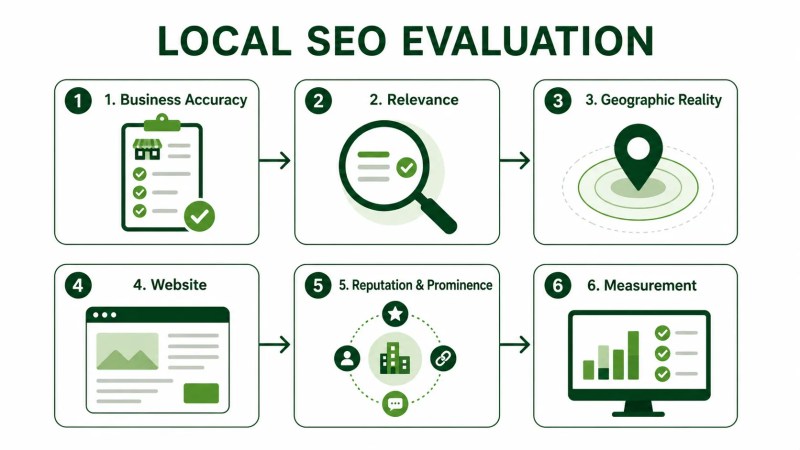
A useful evaluation sequence is:
- Confirm business accuracy. Check the Google Business Profile, important citations, contact information, hours, and website details.
- Check relevance. Make sure the correct services, categories, pages, headings, and content clearly describe what the business offers.
- Review geographic reality. Separate genuine optimization problems from searches where distance may be limiting visibility.
- Evaluate the website. Review service pages, site structure, internal linking, technical accessibility, and local content.
- Review reputation and prominence. Look at genuine customer reviews, relevant mentions, citations, and links.
- Measure visibility over time. Track whether improvements are producing better visibility and meaningful business outcomes rather than reacting to individual ranking checks.
This approach helps prevent a common local SEO problem: investing heavily in one tactic before identifying the actual weakness.
For example, adding more content will not correct inaccurate business information. Building citations will not fix a site whose important service pages are difficult to discover. And rewriting a page cannot change the physical distance between a business and a searcher.
If several of these areas are weak at once, a structured SEO audit can help identify which problems deserve attention first.
Local SEO Ranking Factors FAQ
What are the main local SEO ranking factors?
Google says local results are mainly based on relevance, distance, and popularity, with its detailed guidance describing prominence as how well known a business is. For a practical local SEO review, businesses can also evaluate profile accuracy, reviews, links, website content, citations, and other parts of their wider local presence without treating every item as a separately confirmed Google ranking factor.
Can you improve the distance ranking factor?
You cannot change where a searcher is physically located relative to your legitimate business location. Instead of trying to manipulate distance, businesses should focus on areas they can control, such as accurate business information, relevance, website quality, and prominence.
Do reviews affect local rankings?
Yes. Google says that more reviews and positive ratings can help a business’s local ranking. Reviews should still come from genuine customer experiences rather than being treated as a ranking shortcut.
Does the business website matter for local SEO?
Google says Business Profile information can come from publicly available sources, including crawled content from a company’s official website. A clear and accurate website can therefore reinforce the business information Google may encounter across the web and is an important part of a broader local SEO strategy.
Are local SEO ranking factors different in 2026?
It is better to base a 2026 local SEO strategy on current official guidance and actual performance data than on speculative annual ranking-factor lists. Google’s current guidance continues to explain local results through relevance, distance, and popularity, with prominence used to describe how well known a business is. The specific improvements a business needs will still depend on its profile, website, reputation, competition, and geographic market.
Build a Stronger Local Search Foundation
Local SEO works best when the different parts of a business’s local presence reinforce one another. Your Google Business Profile should accurately represent the business. Your website should clearly explain its services and markets. Business information across the web should be dependable. Reviews and legitimate mentions should strengthen the company’s reputation over time.
Rather than asking which single local SEO ranking factor matters most, identify which part of that system is currently weakest.
Traffisite’s local SEO services focus on building those elements into a coordinated strategy for service businesses that want stronger local visibility and more qualified organic leads.