

Home-service companies often need to compete for searches tied to both a specific service and a specific market. A potential customer may search for a contractor by service, problem, location, cost, or another need that appears during the buying process.
Home services SEO applies SEO principles to the particular needs of businesses that provide services at customers’ homes or properties. Instead of treating SEO as a collection of isolated tactics, a practical strategy connects the services the company provides, the markets it genuinely serves, the information customers need, the business’s local presence, and the authority of the website.
Quick Answer: A practical home services SEO strategy starts with clear service and location coverage, then supports those pages with useful content, local search optimization, strong website structure, internal links, technical foundations, and relevant authority signals. The goal is to create a website and local presence that accurately represent what the business does, where it operates, and what prospective customers need to know before contacting the company.
What Is Home Services SEO?
For this article, home services SEO refers to applying search engine optimization to businesses that provide services at customers’ homes or properties. Depending on the company, that can include contractors and businesses working in areas such as exterior cleaning, HVAC, plumbing, electrical work, landscaping, roofing, pest control, cleaning, and other property-related services.
The challenge is that a home-service company rarely needs visibility for only one broad topic. It may offer several services across multiple markets, while customers search using different combinations of services, problems, locations, and questions.
That makes organization especially important.
A useful strategy should make it clear:
- What services the business actually provides
- Which markets or service areas it genuinely covers
- Which pages address each important customer need
- How related pages connect to one another
- How the business presents itself in local search
- Which supporting topics deserve educational content
- How the website develops relevant authority over time
Traffisite’s SEO for home service companies page provides a broader overview for businesses operating in this category.
The Home Services SEO Framework
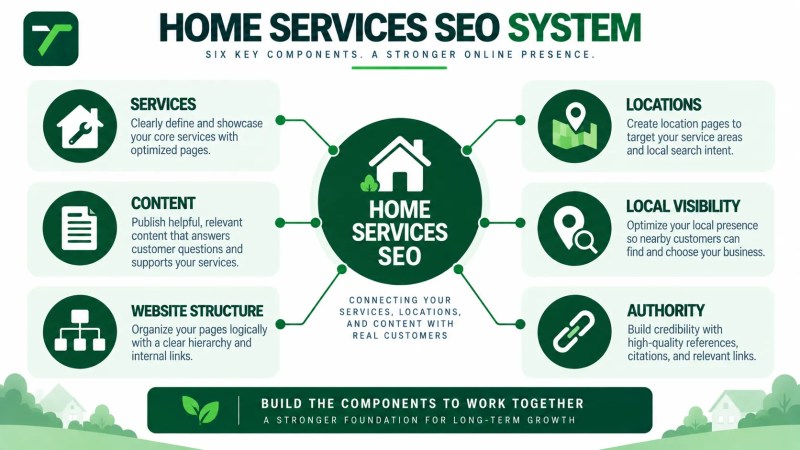
A practical home service SEO framework can be organized around six connected areas:
- Services: Build clear pages around the services customers can actually hire the business to perform.
- Locations: Represent genuine markets and service areas without creating unnecessary or repetitive pages.
- Content: Answer useful questions that arise before, during, and after customers evaluate a service.
- Local visibility: Maintain an accurate local presence that reflects the real business.
- Website structure: Connect service, location, and supporting content through logical navigation and internal links.
- Authority: Develop relevant mentions, links, and other legitimate signals that strengthen the business’s presence beyond its own website.
These areas should work together. Publishing more blog posts will not solve unclear service coverage. Creating more location pages will not fix weak navigation. Building links to a website will not correct pages that fail to explain the underlying services.
The strategy becomes stronger when each component supports the others.
Build Strong Service Pages
Service pages form an important part of a home-service website because they explain what a customer can actually hire the company to do.
Start by identifying distinct services based on real offerings rather than creating a separate page for every keyword variation.
For example, a pressure washing company might genuinely provide several different services. If house washing, roof cleaning, concrete cleaning, and gutter cleaning represent meaningfully different customer needs and real services, separate pages may provide enough room to explain each service clearly.
Each important service page should answer practical questions such as:
- What does the service involve?
- Who is it appropriate for?
- What problems does it address?
- What should the customer expect?
- Where is the service available?
- What is the logical next step for someone interested in the service?
The purpose is not simply to place a target phrase on a page. The page should help a prospective customer understand the service well enough to decide whether it fits their needs.
Traffisite’s on-page SEO guide covers the broader process of aligning individual pages with their purpose, content, headings, and other on-page elements.
Avoid overlapping service pages
Before creating a new service page, compare its purpose with pages that already exist.
If two proposed pages would answer essentially the same customer need with only minor keyword differences, the website may be better served by one stronger page rather than multiple highly similar pages.
This is why service planning should happen before large batches of pages are produced.
Develop a Useful Location Strategy
Home-service businesses also need to represent where they operate accurately.
A company serving several cities may benefit from location-specific pages when those pages have a genuine purpose and can provide useful information for customers in those markets.
The objective is not to create the maximum possible number of city pages. It is to build a location structure that reflects real service coverage and gives visitors meaningful information.
Decide what each location page needs to accomplish
A useful location page should help someone understand whether the business serves that area and which relevant services are available there.
Depending on the business and market, useful information may include:
- The area being served
- Relevant services available in that market
- How the company serves customers there
- Locally relevant service considerations where genuinely applicable
- Clear paths to detailed service information
- A practical way to contact or request service
Avoid adding arbitrary local details simply to make pages appear different. Location content should be relevant to the customer and accurate for the business.
For a broader approach to local visibility, Traffisite’s local SEO guide covers the relationship between websites, business information, local search presence, and ongoing optimization.
Connect services and locations deliberately
Service pages and location pages should not exist as two disconnected groups.
When useful, a location page can point visitors toward relevant service pages, while service pages can help explain where a service is available. The exact linking pattern should reflect the site’s architecture rather than forcing every possible service-and-location combination into separate URLs.
Create Content Around Customer Needs
Service and location pages usually cannot answer every question a prospective customer may have.
Supporting content can address the informational needs surrounding a service, including preparation, maintenance, comparisons, costs, problems, expectations, and decision-making questions where the business can provide useful guidance.
For example, a home-service company’s content opportunities might include questions such as:
- How often is a particular service needed?
- What affects the cost of the service?
- What preparation is required?
- What causes a common property problem?
- When is professional service appropriate?
- How do two relevant service approaches differ?
These are examples of customer needs, not a requirement to publish every possible topic.
A useful content plan begins by identifying questions connected to real services and then deciding whether each topic deserves its own article, belongs within an existing service page, or does not need a page at all.
Traffisite’s SEO content strategy guide explains how to plan content around useful topics rather than publishing disconnected articles simply to increase volume.
Build topic relationships, not a pile of posts
Supporting articles become more useful when they connect naturally to relevant service pages and other closely related resources.
For example, an educational article answering a preparation question can link to the service it supports. A service page can also direct readers to a detailed guide when that guide helps them make a decision.
This creates a more understandable relationship between commercial pages and informational content.
Strengthen Local Search Visibility
Home services SEO can extend beyond the website itself. Businesses that meet Google Business Profile eligibility requirements can also review how their business information appears on Google Search and Maps.
The Business Profile should accurately represent the real business, including its business name, address or service area where applicable, contact information, category, and other relevant profile information.
Google Business Profile has specific eligibility and representation requirements. Implementation should therefore follow Google’s current guidelines rather than assumptions based on competitors.
Traffisite’s Google Business Profile optimization guide covers practical areas to review when improving an eligible business’s profile.
Keep the website and local presence aligned
The website and local business information should consistently represent the same real company and its actual operations.
If the website emphasizes services that are difficult to understand, uses inconsistent business information, or represents markets differently from the company’s actual operations, the overall local search presence can become less coherent.
Start with accurate business information and clear service coverage, then improve the surrounding local presence from that foundation. For home-service businesses that need help connecting website improvements, service-area coverage, and business information, Traffisite’s local search optimization services provide a coordinated implementation option.
For businesses specifically trying to improve local enquiries, Traffisite’s Generate More Local Leads solution addresses the broader relationship between local visibility and lead generation.
Connect Everything Through Website Structure
As service, location, and supporting content grows, website architecture becomes increasingly important.
A visitor should be able to move logically between broader sections and more specific information. Crawlable internal links also give Google paths to discover other pages on the site, while descriptive internal-link context can help people and Google make sense of the connected content.
A conceptual home-service structure might include:
- A homepage introducing the business
- A services section linking to individual service pages
- A locations section for genuine markets where separate pages are useful
- Supporting educational content connected to relevant services
- Company and contact pages that help visitors understand and reach the business
The exact hierarchy should reflect the company’s offerings rather than copying another website’s structure.
Traffisite’s website structure for SEO guide explains how hierarchy, navigation, URLs, and internal links can work together across a larger site.
Use internal links to reinforce relationships
Internal links should help people move to useful next steps.
A service page might link to a relevant supporting guide. A blog article might point to the service it explains. A location page might direct a visitor to services available in that market.
Those connections are more useful when they are contextual rather than added simply to increase the number of links on a page.
Traffisite’s internal linking guide provides a broader framework for creating those relationships deliberately.
Build Relevant Authority
Improving the website itself is only one part of a broader SEO strategy. Home-service businesses can also look for legitimate opportunities to develop relevant authority outside their own sites.
This may involve earning relevant mentions and links through real business relationships, useful resources, local involvement, industry participation, partnerships, or other legitimate opportunities.
The focus should be relevance and legitimacy rather than acquiring links simply because they are available.
A home-service company might review opportunities connected to:
- Professional or trade relationships
- Relevant local organizations
- Suppliers and business partners
- Useful industry resources
- Community involvement
- Original resources worth referencing
Not every opportunity will make sense for every company, and authority building should not rely on fabricated relationships, manipulative link schemes, or low-quality placements.
Traffisite’s link building and authority service addresses this part of SEO as a distinct area rather than treating it as a substitute for strong website foundations.
Measure and Improve the Strategy
Home services SEO should be reviewed as an ongoing system rather than a one-time publishing project.
The most useful measurements depend on the business’s objectives, but the review should connect SEO activity with outcomes that matter to the company.
A practical review can examine:
- Visibility: Are important service and local topics becoming easier to find through search?
- Page performance: Which service, location, and supporting pages are attracting relevant search visits?
- Engagement: Are visitors moving from informational content toward relevant service or contact pages?
- Conversions: Are appropriate pages contributing to enquiries, calls, bookings, quote requests, or other meaningful actions the business tracks?
- Coverage gaps: Are important services, markets, or customer questions still poorly represented?
- Technical health: Can important pages be crawled and indexed as intended?
- Authority gaps: Are there legitimate opportunities to strengthen the site’s external presence?
Do not judge the entire strategy from a single metric. Review how the different components work together and prioritize improvements based on the most important gaps.
Traffisite’s SEO measurement and reporting guide provides a broader framework for connecting SEO activity with meaningful performance indicators.
A practical order of operations
If a home-service website has many potential SEO tasks, prioritize foundational problems before expanding aggressively.
- Confirm the real services and markets.
- Review existing service and location pages.
- Resolve important structural and technical problems.
- Improve core service content.
- Strengthen appropriate location coverage.
- Improve the business’s local search presence.
- Build supporting content around genuine customer needs.
- Improve internal linking between related pages.
- Develop relevant authority.
- Measure results and reassess priorities.
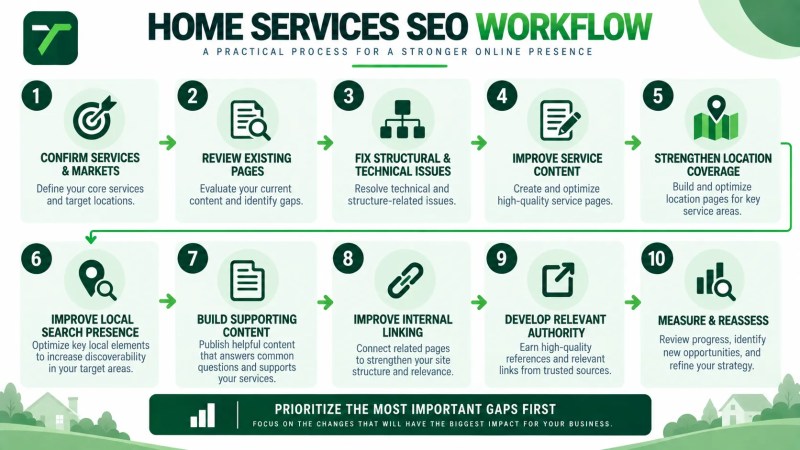
This order is a practical framework rather than a universal sequence. A website with a serious technical problem may need technical work first, while an otherwise healthy site with weak service coverage may need content improvements sooner.
Frequently Asked Questions
What is home services SEO?
For this article, home services SEO refers to applying SEO principles to companies that provide services at customers’ homes or properties. It can involve service and location pages, local search optimization, supporting content, website structure, technical SEO, internal linking, and authority building.
How is home service SEO different from general SEO?
The underlying SEO disciplines overlap, but many home-service businesses also need to represent specific services and genuine service areas clearly. Their strategies may therefore combine broader SEO work with local business information and customer questions related to those services.
Does every city need its own SEO page?
No. A separate location page should have a genuine purpose, accurately represent an area the company serves, and provide useful information for people in that market. Do not create large sets of substantially similar city pages primarily to target location variations. Google identifies certain region- or city-targeted pages that funnel users to another destination, as well as substantially similar pages created for similar search queries, as examples of doorway abuse.
Should every home service have a separate page?
Not necessarily. Separate pages are most useful when the services represent meaningfully different customer needs and can support distinct, useful content. Closely overlapping variations may be better addressed together.
Does a home-service company need blog content?
Blog or educational content can be useful when customers have important questions that service and location pages cannot answer well. The goal is not to publish on a fixed schedule simply for SEO. Content should support real services and useful customer needs.
Is local SEO enough for a home-service business?
Local SEO can be an important part of the strategy, but the website may still need clear service information, useful content, sound structure, internal links, technical foundations, and other relevant SEO work. The appropriate mix depends on the business and its competitive environment.
How should a home-service company start with SEO?
Start by confirming the company’s actual services and markets, then review whether the website represents them clearly. From there, identify the most important gaps across service pages, location coverage, local presence, content, website structure, technical health, internal linking, and authority rather than starting with whichever tactic is easiest to produce.
Build Home Services SEO as a Connected System
Home services SEO works best as a connected strategy. Service pages explain what the company does. Location coverage represents where it operates. Supporting content answers customer questions. Local optimization strengthens the business’s search presence. Website architecture connects those assets, while relevant authority supports the site’s presence beyond its own pages.
Start with the real business rather than a list of keywords. Define the services and markets, map important customer needs to the right pages, build clear connections between those pages, and improve the strategy as performance and business priorities change.